
Williams-Sonoma: A Failed Hardware Store Built an Empire
Williams-Sonoma ranks #59 on NRF's Top 100 Retailers 2026 with $7.55B in U.S. sales. Here is how a Sonoma hardware store became a four-brand home empire.
Part of Retailer Playbooks — history-first profiles of every company on the NRF Top 100 Retailers list.
Williams-Sonoma ranks #59 on the National Retail Federation's Top 100 Retailers 2026 list, compiled with Kantar, with $7.55 billion in 2025 U.S. retail sales. That figure sits on top of a company that has been nearly destroyed twice, once by a partner's death and once by a recession, and saved both times not by discounting but by better catalogs.
A Hardware Store That Didn't Sell Hardware
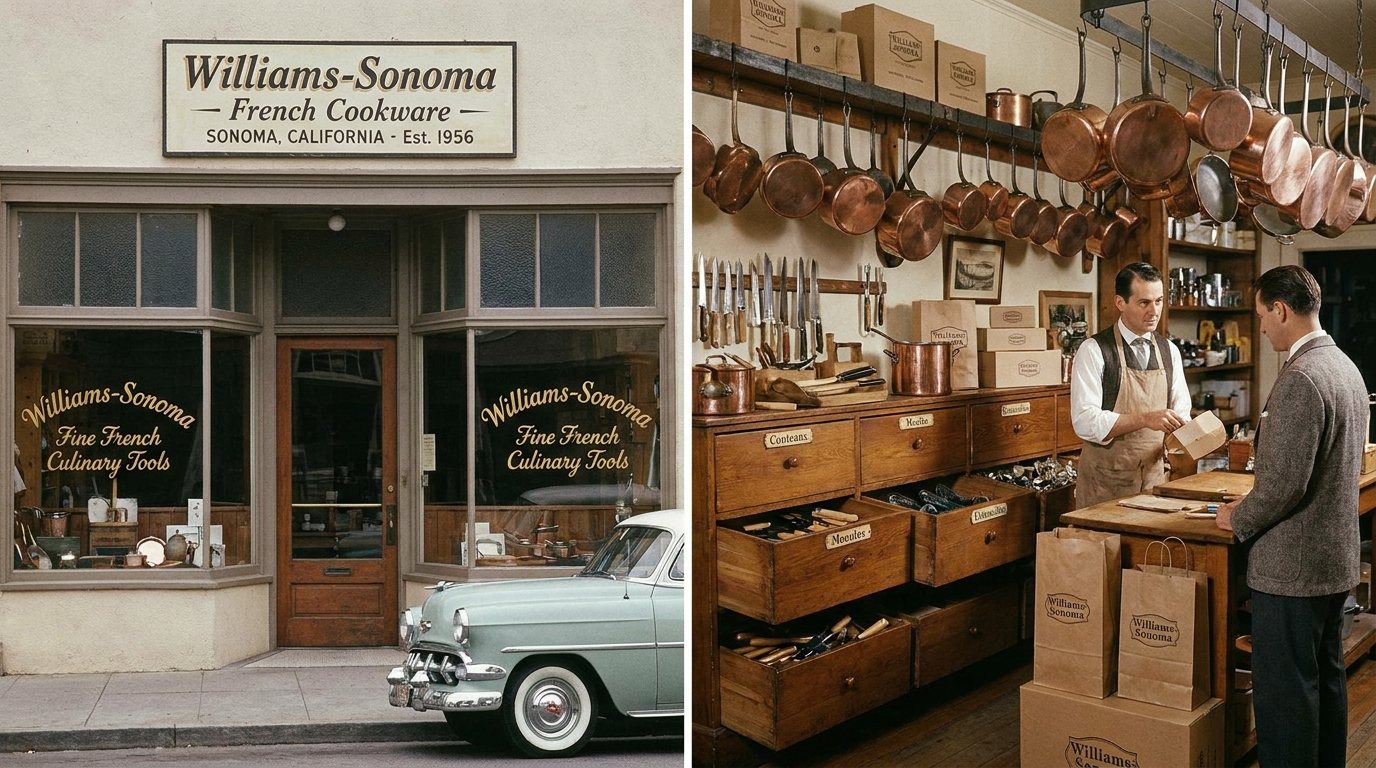
Charles "Chuck" Williams was an Air Force mechanic turned carpenter running a hardware store in Sonoma, California, when a trip to Paris in the early 1950s changed his inventory. He came home fixated on the copper pans, whisks, and omelet pans he'd seen in French professional kitchens, tools American home cooks simply couldn't buy. In 1956 he converted the failing hardware store into a shop selling exactly that, according to FundingUniverse's company history. Serious home cooks noticed fast. Julia Child and James Beard, then building the American food-writing establishment, became early boosters, and Williams relocated the business to San Francisco under the name Williams-Sonoma to chase that following.
By the early 1970s the operation had outgrown one owner-operator. In 1972, Williams partnered with Edward Marcus of the Neiman-Marcus family to formalize the company, splitting duties so Williams could stick to what he loved: picking merchandise.
The Catalog That Invented Direct-to-Consumer Retail
That partnership produced the company's real breakthrough. In 1973, alongside a second store in Beverly Hills, Williams-Sonoma mailed its first catalog, "A Catalog for Cooks," to 5,000 people. Williams later said the catalog could tell stories a store shelf never could, why a pan mattered, how a cook actually used it. It worked. Within a decade, catalog mailings reached 30 million households and catalog sales generated three-quarters of the company's $35 million in annual revenue by 1983, per FundingUniverse.
That is worth sitting with: Williams-Sonoma was a direct-to-consumer, data-driven mail-order business two decades before "DTC" became a category and four decades before anyone said "e-commerce." The muscle the company would later use to move online in 1999 wasn't new. It had been building it since Nixon's first term.
The Company Almost Didn't Survive Its Own Founder's Exit
Edward Marcus died in 1978, and the management that followed him mismanaged the business badly enough that it was sold at a loss: $4.9 million in sales against a $173,000 net loss and $700,000 in debt, according to FundingUniverse. Howard Lester, a former IBM salesman, bought the struggling company for $100,000 in 1978 with partner James McMahan, on the condition that Williams stay on to keep choosing the merchandise.
Lester's ownership era is the hinge of the whole company. By 1983, the chain had grown to 19 stores, catalog circulation had scaled to 30 million pieces, and the company went public that July at $23 a share. In 1986, Lester bought a struggling 27-store housewares chain called Pottery Barn from The Gap for $6 million, a sum that looks almost absurd against what Pottery Barn would become.
The Second Near-Death, and the Turnaround That Actually Worked
The early-1990s recession hit hard: net profit collapsed from $11.2 million in 1990 to under $2 million within two years, even as revenue kept climbing toward $344 million. The fix, engineered by executive Gary Friedman starting in 1993, wasn't a price war. Friedman redesigned "A Catalog for Cooks" from a digest-sized booklet into a full-size format, lifting sales 40 percent. He reorganized Williams-Sonoma stores around monthly merchandising themes, pushing per-store sales up more than 20 percent. And he tore out 80 percent of Pottery Barn's merchandise mix, taking that division from $103 million in sales in 1992 to $165 million in 1993.
By the end of 1993, revenue hit $410 million with earnings north of $11 million, a full recovery in a single year. The lesson that would repeat for decades: when the business struggles, Williams-Sonoma fixes the catalog and the merchandise before it touches price.
| Year | Bet |
|---|---|
| 1956 | Converts a hardware store into a kitchenware shop after a trip to Paris |
| 1973 | Mails "A Catalog for Cooks" to 5,000 households |
| 1978 | Sold for a loss after founding partner's death; Lester buys it for $100,000 |
| 1986 | Acquires Pottery Barn for $6 million |
| 1993 | Friedman turnaround redesigns catalog and merchandise mix |
| 1999 | Launches e-commerce; later adds West Elm (2002) and Rejuvenation (2011) |
| 2021 | Announces plans to close up to a quarter of stores as sales shift online |
Shrinking the Footprint on Purpose
By 2019, Williams-Sonoma, Inc. made the Fortune 500 for the first time in its history, a milestone that arrived not from opening more stores but from closing them. In March 2021, the company announced it would shut up to a quarter of its physical locations while investing in distribution capacity, a bet on e-commerce that had already reached roughly half of company revenue by the mid-2010s, per Wikipedia. Under CEO Laura Alber, who joined in 1995 building the Pottery Barn Kids and PBteen lines and took the top job in 2010, the portfolio now runs four distinct brands (Williams Sonoma, Pottery Barn, West Elm, and Rejuvenation, plus the smaller Mark and Graham) off one shared supply chain and one digital backbone.
The unique insight here, one an About page won't spell out, is that Williams-Sonoma's comfort shrinking its store count wasn't a retreat forced by crisis, unlike most retailers who close stores from weakness. It's a company acting on eighty years of evidence that its actual competitive advantage was never the four walls. It was the catalog, and later the URL. The stores were always the newer, less essential channel bolted onto a direct-response business that started in 1956.
Every one of those catalogs, and every product page that replaced them, depended on someone knowing exactly what was in the box: dimensions, materials, care instructions, the difference between a paring knife and a chef's knife. That unglamorous discipline, getting the product data right before a single word of marketing copy gets written, is the quiet infrastructure underneath every catalog Chuck Williams ever mailed.