
Home Depot's Origin Story: A Firing That Built a Retail Giant
How two fired executives turned a rejected pitch into Home Depot, now ranked No. 5 on the NRF Top 100 Retailers list with $141.12B in 2025 sales.
Part of Retailer Playbooks — history-first profiles of every company on the NRF Top 100 Retailers list.
In 1978, Bernard Marcus and Arthur Blank were unemployed. They'd just been pushed out of Handy Dan Home Improvement Centers in a management shake-up, and the concept they carried out the door with them was too big for most lenders to take seriously. Today that concept is The Home Depot, ranked No. 5 on NRF's Top 100 Retailers 2026 with $141.12 billion in 2025 US retail sales.
A store built for people who didn't know what they were doing
Marcus, Blank, and colleague Ron Brill had a read on the hardware business that ran against the grain of it. Home-improvement retail in the 1970s was a business of small, cluttered stores stocking maybe 10,000 items, staffed by clerks who assumed customers already knew what they needed. Marcus's team noticed something different: do-it-yourselfers were already generating more than 60 percent of building-supply sales, and most of them were guessing. The opportunity wasn't a bigger hardware store. It was a store that could teach.
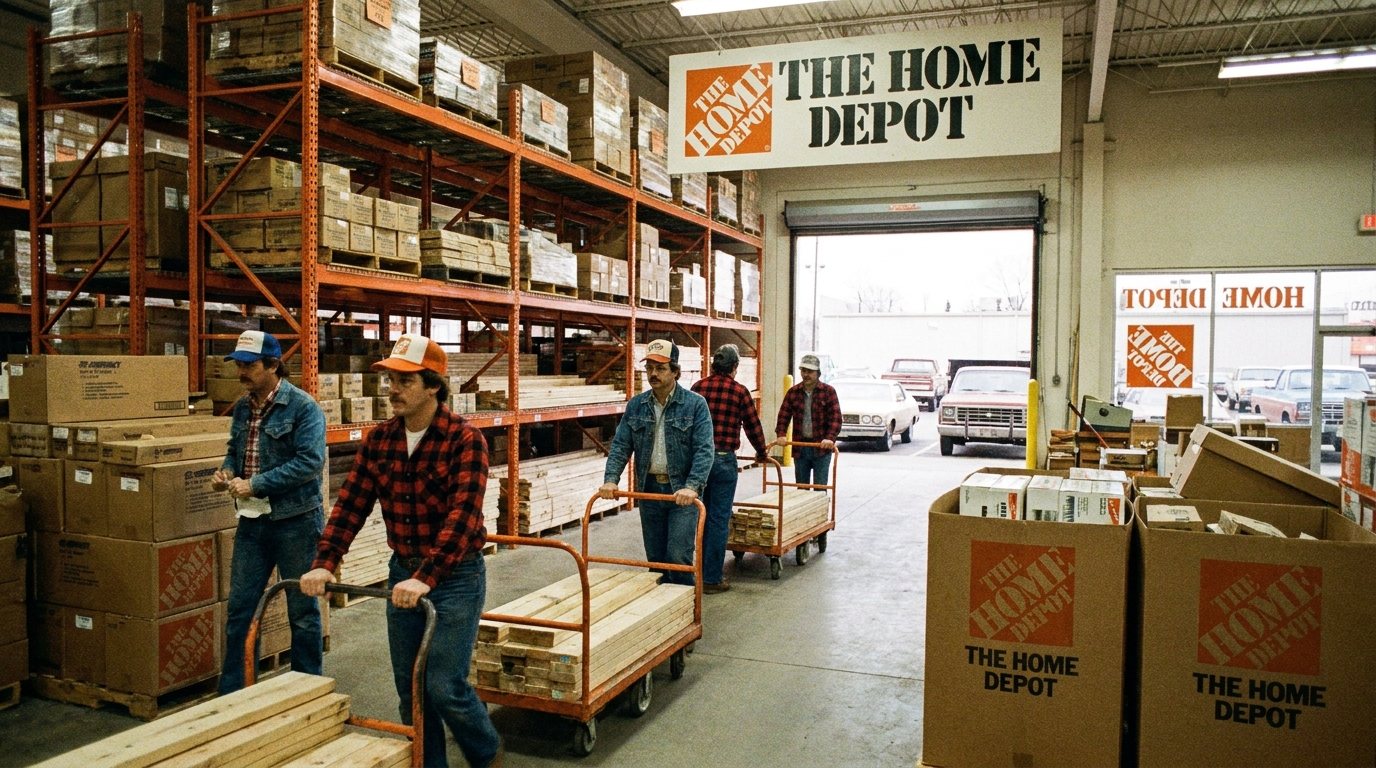
So they built warehouses, not shops: 60,000 square feet, roughly 25,000 SKUs, and a payroll stacked with licensed plumbers and electricians who worked the floor for a wage, not a commission, according to FundingUniverse's company history. That last detail mattered more than it looks. A commissioned sales floor pushes people toward the priciest fix. A salaried one can afford to tell a customer the cheaper part will work fine, which is exactly the kind of trust a first-time DIYer needs before she'll come back for the next project. Investment banker Ken Langone helped the trio raise the capital that banks wouldn't, and on June 22, 1979, the first two stores opened in Doraville and Decatur, Georgia, per Wikipedia's history of the company.
The debt that almost ended it
Home Depot went public on NASDAQ in September 1981 and moved to the New York Stock Exchange in 1984, the same year it operated 19 stores and $256 million in sales, a 118 percent jump from the year before. Growth that fast has a cost. A 1984 acquisition of the nine-store Bowater chain brought along a damaged reputation and mismatched merchandise, forcing Home Depot to let go of nearly all the acquired staff. Store buildout was running upward of $8 million apiece, and by 1985 earnings had fallen 42 percent while long-term debt swelled from $4 million to $200 million in two years, according to FundingUniverse.
The fix wasn't a rescue merger or a new gimmick. It was operational discipline: Marcus's team installed computerized inventory systems, slowed the pace of new openings, and let the balance sheet catch up to the ambition. A 1986 offering of roughly 3 million shares at $17 apiece helped restructure the debt. By 1989, Home Depot had passed Lowe's to become the country's largest home-improvement chain. The lesson retail historians still point to is unglamorous but durable: the near-death moment wasn't caused by a bad idea, it was caused by outrunning the systems needed to run the idea well.
Reinvention, then reinvention again
| Year | Move | Why it mattered |
|---|---|---|
| 1979 | First two stores open in Atlanta | Proved the warehouse-plus-expertise format |
| 1986 | Debt-cutting stock offering | Survived the overexpansion crisis |
| 1991 | EXPO Design Center launches | First bet on upscale, design-led customers |
| 2000s | Robert Nardelli centralizes operations | Efficiency gains, culture strain |
| 2006 | Hughes Supply acquired for $3.2B | Built a wholesale arm for professional contractors |
| 2020 | HD Supply reacquired for $8B | Doubled down on the pro-contractor customer |
| 2024 | SRS Distribution deal announced, $18.25B | Extended reach into roofing, pool, landscape trades |
The 2008 housing collapse hit Home Depot as hard as it hit the industry that supplies it. Sales fell from roughly $91 billion to $71 billion, and the company closed 54 stores. The recovery strategy that followed, under CEO Frank Blake, was a return to fundamentals: refocus on the core retail stores, rebuild associate morale after the Nardelli years, and get serious about who actually drives the register. That last point produced the company's best-known internal statistic: professional contractors make up only about 5 percent of Home Depot's customers but generate close to half its revenue, a ratio the company has been building supply chains and acquisitions around ever since, from Hughes Supply in 2006 to the SRS Distribution deal announced in 2024.
The insight the About page won't give you
The part of this story that's easy to miss is that Home Depot's founding advantage wasn't inventory or square footage. Competitors could and did copy both. What was harder to copy was the incentive structure: a salaried, credentialed sales floor in an industry built on commission selling. That single decision, made under financial pressure by three recently unemployed executives in 1978, is arguably the reason the company survived its own near-collapse a few years later. Trust built at the register during the good years is what gave Home Depot the customer loyalty to absorb the debt crisis of the mid-1980s without losing its base to Lowe's. Most retail turnarounds are described as marketing stories. This one was a staffing model that happened to double as a marketing story.
Where the bet sits today
Home Depot now runs roughly 2,300 to 2,500 stores, employs about 475,000 associates, and stocks more than a million products between its shelves and its e-commerce catalog, per Home Depot's own corporate history. The SRS Distribution acquisition signals where the next chapter is aimed: not at the weekend DIYer who started the company, but at the contractor economy that now pays most of the bills. The founders' original insight, that expertise sells better than a lower price alone, is still the operating premise even as the customer it's aimed at has changed.
Every aisle Home Depot stocks, every SKU a contractor searches for at 6 a.m., depends on product data and supply infrastructure that customers never see and rarely think about. That invisible plumbing is the real story behind most retail giants, Home Depot included.