
How Hy-Vee Turned Employee Ownership Into a Growth Engine
Hy-Vee ranks #35 on NRF Top 100 Retailers with $14.19B in 2025 sales. Its employee ownership model began as an 1938 merger deal, not a perk.
Part of Retailer Playbooks — history-first profiles of every company on the NRF Top 100 Retailers list.
Hy-Vee ranks 35th on the National Retail Federation's Top 100 Retailers 2026 list, compiled annually with Kantar, with $14.19 billion in 2025 U.S. retail sales. It is also, by scale, one of the largest employee-owned companies in the country, a fact baked into a merger agreement from 1938 rather than a modern HR initiative.
Two Storekeepers, One Brick Building
In 1930, Charles Hyde and David Vredenburg opened a general store in Beaconsfield, Iowa, a town small enough that the original brick building would later become a landmark in its own right. Both men already knew the grocery trade. Vredenburg had run stores through General Supply Company, an enterprise tied to the RLDS Church in nearby Lamoni, and Hyde had worked there before striking out on his own with a store in Cameron, Missouri, in 1924. When they combined their separate operations into a partnership called Supply Stores, the Beaconsfield location sold groceries alongside dry goods and clothing, the standard mixed inventory of a Depression-era crossroads store, according to Funding Universe's company history. By 1934 the stores had narrowed to groceries only.
The Deal Hiding Inside the "Employee-Owned" Line
Every profile of Hy-Vee repeats that it's employee-owned, usually as a warm aside. The mechanism behind it is more interesting than the slogan lets on. When Hyde & Vredenburg incorporated in 1938 with 15 stores across Iowa and Missouri, sixteen store managers traded ownership of their individual stores for stock in the new corporation, per Funding Universe. That wasn't a benefit layered onto an existing company. It was the acquisition currency. The only way to get independent storekeepers to give up standalone shops was to make them owners of the combined enterprise rather than employees of it. The arrangement was formalized further in 1960, when the company became owned through an Employees' Trust Fund, according to Wikipedia's history of Hy-Vee, a structure Wikipedia's own entry on employee ownership still cites Hy-Vee for today.
That distinction shapes how Hy-Vee runs stores now. Store directors carry authority closer to a franchise owner's than a district manager's: assortment calls, local vendor relationships, staffing, and even community sponsorships vary store to store in a way most centrally planned chains engineer out of the system on purpose. The founding insight, dating to a Depression-era merger negotiation rather than a management consultant, was that ownership stakes travel further down an org chart than instructions do.
The Name Came From a Suggestion Box
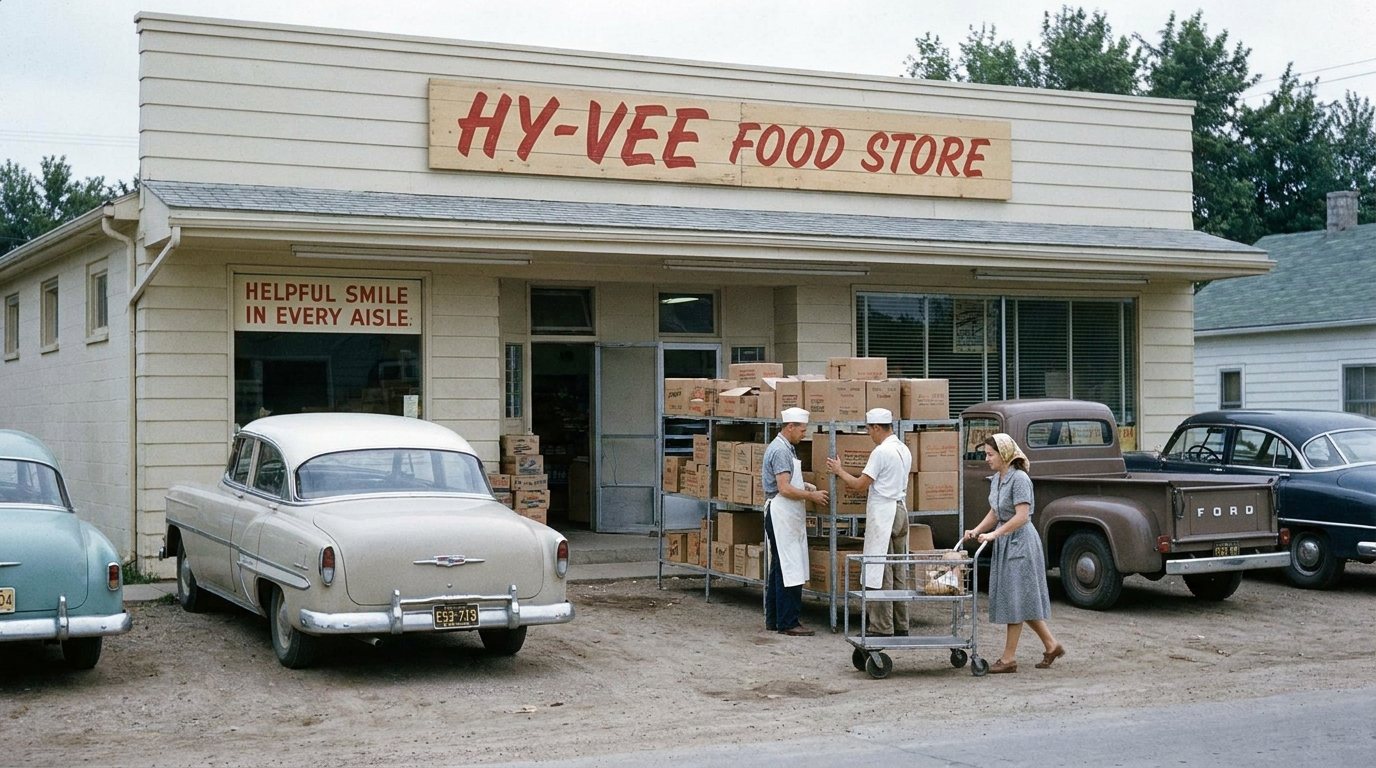
For more than two decades the chain operated as Hyde & Vredenburg, a name that meant nothing to a shopper driving past. In 1952 the company ran an employee contest to find something shorter, and three staff members proposed mashing the founders' surnames into "Hy-Vee." The first store to carry the new name opened in Fairfield, Iowa, in 1953, and the corporate name followed a decade later, becoming Hy-Vee Food Stores, Inc. in 1963, the same year the chain aired its first television commercial and introduced the line that would outlast every other piece of 1960s advertising: "Where there's a helpful smile in every aisle."
Building Faster Than the Map Suggests
Growth after the name change was steady rather than showy. The chain crossed into Minnesota in 1969 through the acquisition of Swanson Stores, reaching 66 locations and $130 million in sales. It surpassed $500 million in annual sales in 1978 and opened its 100th store, in Keokuk, Iowa, the following year, notable enough at the time that Funding Universe singles out its electronic cash registers as a point of pride. Private-label products arrived in 1956, an in-store bakery opened in Iowa City in 1957, and by 1999 the chain had grown to 208 stores and $3.5 billion in sales, a high-water mark that made it, per Wikipedia, the second-largest employee-owned company in the United States.
The expansion kept a distinctly regional shape for decades. Nebraska came in 1977, Illinois in 1979, Kansas in 1988. Only in the 2020s did Hy-Vee push into Indiana, Kentucky, Tennessee, and Alabama, a move the company signaled in December 2021 alongside plans for its first distribution center outside Iowa, in Nashville.
Not Every Bet Landed on Schedule
Hy-Vee's history isn't a straight line up. Shopping carts, now unremarkable, had to be introduced with free candy bars in 1940 because customers didn't trust them at first. The chain sold off its Heartland Pantry convenience stores in 1999, and its electricfood.com gourmet subsidiary never became the growth channel the dot-com era promised for it. More recently, the 24-hour store model that once signaled scale and confidence ended in 2020, with most locations pulling back to close overnight, and a Louisville, Kentucky store announced for a 2023 opening still hadn't been built as of mid-2025. A company built on a century of small-town groceries is still learning how to move at big-market speed.
The Infrastructure Behind the Smile
Hy-Vee's slogan promises a smile in every aisle. Delivering on it across 285-plus stores in a dozen states depends on less charming machinery: distribution centers, private-label supply chains, and the unglamorous discipline of knowing what's actually on every shelf, in every store, at every hour. That's the infrastructure this series keeps circling back to, the part no customer sees and every retailer has to get right.