
Indiana Oxygen: 111 Years of Betting Against the Roll-Up
Founded in 1915 and still Brant family-run, Indiana Oxygen self-funds its growth and builds its own gas plants while rivals consolidate under PE.
Part of Distributor Playbooks — strategy teardowns of every company on the MDM Top Distributors lists.
Modern Distribution Management named Indiana Oxygen to its 2026 Top Distributors list in the Gases & Welding Supplies vertical, a category the trade press usually covers in terms of who bought whom. Air Liquide bought Airgas. Linde merged with Praxair. Taiyo Nippon Sanso now owns Matheson. Indiana Oxygen bought a piece of Matheson. It has been independent, family-owned, and headquartered in Indianapolis since 1915, and that fact matters more to its strategy than its age does.
The last name standing
Two brothers, Walter and John Brant, started the company in 1915 selling oxygen and acetylene to Indiana's machine shops and foundries. More than a century of industrial gas consolidation later, Indiana Oxygen calls itself the oldest gas and welding supply distributor in the country, and it is hard to find a serious rival to that claim. Every other name that competed with it in 1915 has since been folded into Air Liquide, Linde, or a private-equity-backed regional platform. Indiana Oxygen is still run by a Brant: CEO Jay Brant is Walter's great-grandson.
That is the unique insight of this profile. It is not that Indiana Oxygen is old. Family businesses that survive four generations in a capital-intensive, safety-regulated, multinational-dominated industry are rare enough to be worth studying for how, not just noting for how long.
Succession as a repeated practice, not a lucky break
The proverb about family firms is "shirtsleeves to shirtsleeves in three generations," and industrial gas distribution has offered plenty of proof: family operations that grew regionally, then sold to a strategic buyer or a PE roll-up when the founder's grandchildren wanted liquidity or lost interest. Indiana Oxygen made it to a fourth generation, and leadership there has talked about it in public as a deliberate discipline rather than an inheritance. CEO Jay Brant has spoken specifically about succession planning as an ongoing function of the business, not a one-time event triggered by a retirement. Treating the handoff itself as a competency, something to be practiced and revisited rather than assumed, is a big part of why the company is still answering to a Brant and not a private equity fund.
Building the plants instead of just running the trucks
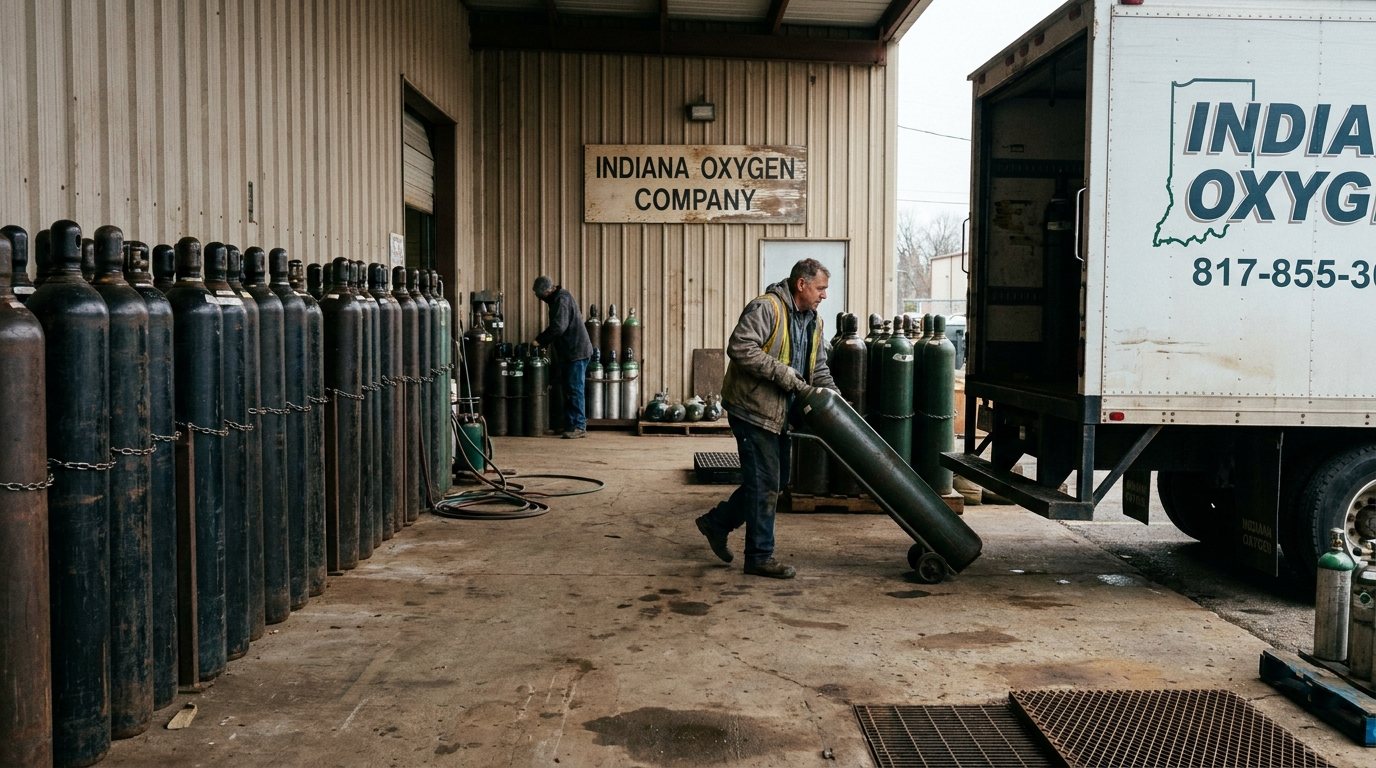
Distribution is the reselling business by default: buy gas in bulk from a producer, break it into cylinders or bulk deliveries, and move it to the customer. Indiana Oxygen does more than that. Per its own sustainability disclosures, the company owns and operates two cylinder gas filling plants, an acetylene manufacturing plant, and a specialty gas laboratory. It has put $23 million into capital assets over the past five years, and says every dollar of it was self-funded. EBITDA as a share of sales has been rising over that period, and long-term debt has been falling, not growing, while the company builds. That is the opposite financing profile of most consolidation stories in this vertical, where growth is typically leveraged and outside capital sets the pace.
Owning the manufacturing step also changes the customer relationship. A distributor that only resells bulk gas is at the mercy of its supplier's allocation and pricing. A distributor that fills its own cylinders and produces its own acetylene controls more of its own supply chain, which matters more in gas than in almost any other distributed category, because the product itself is hazardous, perishable in the sense that certification and purity windows matter, and expensive to transport.
The acquisition ran in the unusual direction
In July 2012, Matheson transferred ownership of its Elkhart, Indiana gas and welding supply business to Indiana Oxygen. Matheson is a national industrial gas producer that itself now sits inside a Japanese conglomerate's global portfolio. The usual channel narrative has the local independent selling out to the national player as it scales past what a family can finance. Indiana Oxygen's Elkhart deal ran the other way: a piece of a multinational's non-core geography landed with the independent, not the other way around. It is a small transaction in absolute terms, but it is a useful data point against the assumption that consolidation only flows toward the biggest balance sheet.
Density over reach
Indiana Oxygen operates 13 branches across Indiana and Ohio, from Fort Wayne and Elkhart in the north down to Vincennes and Seymour in the south, plus outposts in Cincinnati and Dayton. That is a regional footprint, not a national one, and the company has not chased the kind of coast-to-coast branch count that defines its biggest competitors. What it has instead is a company-owned delivery fleet running its own logistics rather than leaning on third-party carriers, which matters in a product category where a late cylinder delivery can stop a welding shop's production line for a day.
| Year | Milestone |
|---|---|
| 1915 | Walter and John Brant found the company in Indianapolis |
| 2012 | Acquires Matheson's Elkhart, Indiana gas and welding business |
| 2020-2025 | $23M in self-funded capital investment; expands specialty gas production |
| 2026 | Named to MDM's Top Distributors list, Gases & Welding Supplies |
| 2026 (targeted) | ISO 9001-17025 certification completion |
The tension worth naming
Self-funded growth is a genuine strategic choice, and it cuts both ways. It means Indiana Oxygen answers to no outside investor's timeline and can hold onto a family culture that shows up in five-star employee reviews and long-tenured branch managers. It also means the company's pace of expansion is capped by what its own balance sheet can carry, in a category where PE-backed rivals can outbid on the next tuck-in acquisition using someone else's money. Indiana Oxygen has clearly decided that control is worth more than speed. Whether that holds as the multinationals keep consolidating the supplier side of the business is the open question for its fifth generation.
Every distributor in this series wins or loses on the boring stuff nobody outside the industry sees: which branch has the truck, whose plant fills the cylinder, and whose books can survive a decade without a merger. Indiana Oxygen has answered that question the same way since 1915.