
J.C. Penney: The Cash-Only Store That Outgrew Its Rule
J.C. Penney is #77 on NRF's Top 100 Retailers 2026 with $5.96B in U.S. sales, and its no-credit founding rule built and later strained the company.
Part of Retailer Playbooks — history-first profiles of every company on the NRF Top 100 Retailers list.
J.C. Penney ranks #77 on the National Retail Federation's Top 100 Retailers 2026 list, compiled with Kantar, with $5.96 billion in 2025 U.S. retail sales. That figure represents a company that has been bought, bankrupted, and rebuilt more times than most retailers survive once, and whose founding rule turned out to be both its edge and, eventually, its weakness.
A Store Built on Refusing Credit
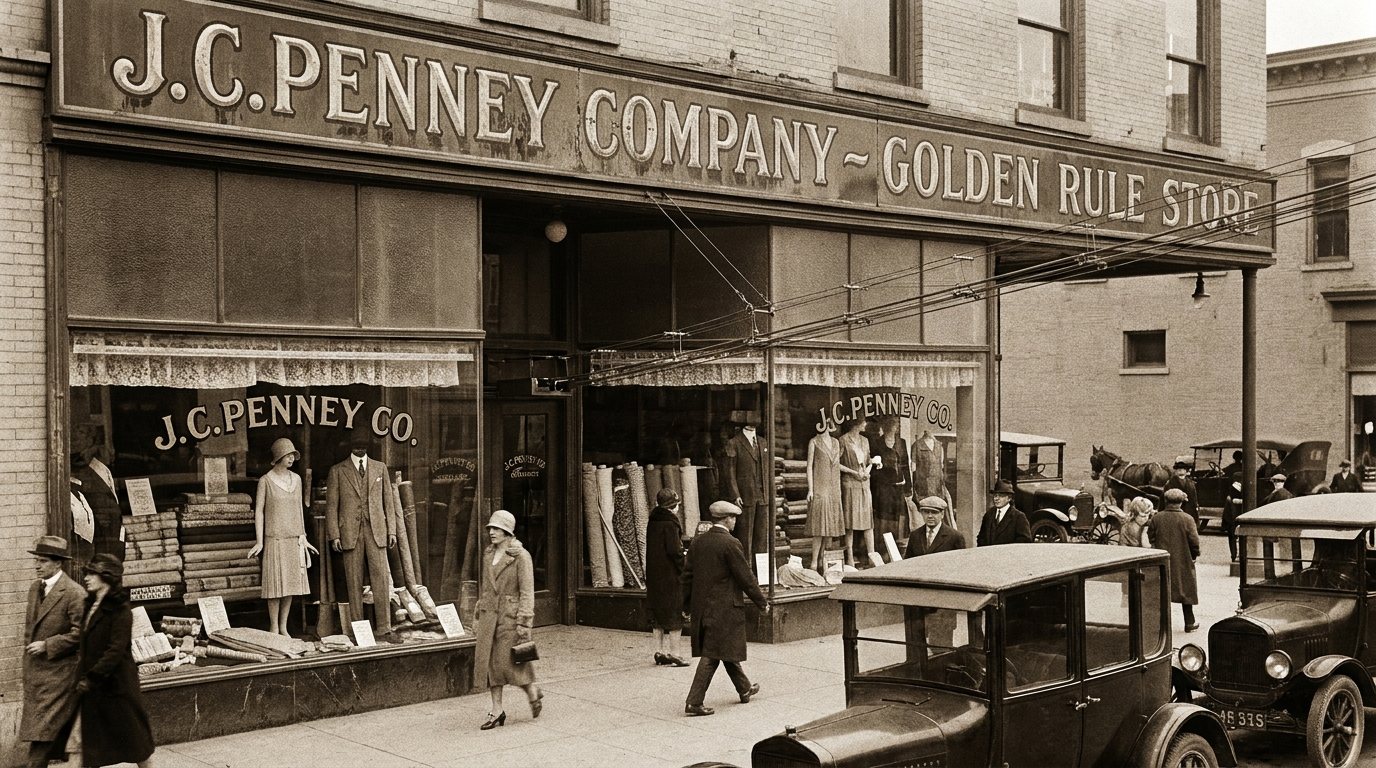
In 1902, a mining town in southwestern Wyoming called Kemmerer already had a graveyard of failed dry goods stores. A local banker warned 26-year-old James Cash Penney that three prior "cash only" shops had gone under, because miners were paid partly in company scrip and expected credit at the company store. Penney opened his store anyway, refusing both scrip and credit, and named it after the "Golden Rule" philosophy he'd absorbed working for Guy Johnson and T.M. Callahan's Golden Rule Mercantile chain in Evanston, Wyoming, according to Wikipedia's history of the company. The store did $28,898 in sales its first year, per FundingUniverse's company history.
The cash-only stance was not a gimmick. It was a bet that treating customers as buyers rather than debtors, and pricing goods low because the store carried no bad-debt risk, would beat the scrip economy at its own game. It worked in Kemmerer, and it kept working.
The Growth Engine Nobody Copies Anymore
What actually built J.C. Penney into a national chain was not merchandising. It was ownership structure. After Callahan and Johnson dissolved their own partnership in 1907, Penney adopted a rule of his own: a store manager could buy a one-third partnership in a new location, provided he trained a replacement to run his old one. Managers who made money for Penney also made money for themselves, and they had a personal stake in training their own successors, which meant the model could replicate itself without J.C. Penney raising outside capital for every new door.
It is, in effect, a franchise system built decades before franchising existed as a retail category. By 1912 there were 34 stores; by 1917, 175; by 1924, the company opened its 500th store. A central buying office in Salt Lake City, opened in 1909, let the growing chain negotiate as one buyer even as it expanded storefront by storefront through manager-partners rather than corporate rollout crews.
That structure is the detail most retail histories skip past on the way to the department-store years, and it is arguably the more interesting story: J.C. Penney scaled the way modern franchise brands scale, using local operators' own capital and incentive, a full generation before McDonald's or Holiday Inn made the model famous.
Surviving What It Was Built to Survive
The Depression should have gutted a chain built on retail margins, but J.C. Penney's founding discipline paid off twice. The company cut inventory hard, pushed for lower purchase prices, and passed savings to customers, and profits rose through the 1930s even as competitors folded. By 1936 the chain counted 1,496 stores and $250 million in sales, according to FundingUniverse.
The next transformation came in the 1960s, when J.C. Penney followed its customers out of downtowns and into shopping malls, adding appliances, sporting goods, auto centers, and beauty salons to what had been a dry-goods and apparel operation. Peak scale arrived in 1973: 2,053 stores. James Cash Penney died in 1971 at 95, having lived to see the company he founded with a single storefront cross $5 billion in annual revenue.
The Rule Gets Rewritten, Then Broken
By 1959, the company that would not extend credit had become a major credit card issuer. That reversal is easy to miss, but it is the clearest sign of how far J.C. Penney had moved from its founding premise: the same institution that once bet its survival on refusing debt now bet its growth on extending it, because a mall-anchor department store in the 1960s competed on financing terms as much as on price.
The 1980s brought a deliberate narrowing, cutting appliances, hardware, and the money-losing Treasury discount chain, and a headquarters move to Plano, Texas in 1987. The 1990s brought acquisitions in drugstores (Eckerd) and international ventures in Brazil, Chile, and Mexico, most of which were later sold off. When Sears shuttered its catalog operation in 1993, J.C. Penney's own catalog briefly became the largest in the country, a legacy channel it would eventually wind down as e-commerce took over.
The Ron Johnson Experiment
No chapter gets studied by retail strategists more than 2011 to 2013, when former Apple retail chief Ron Johnson took over as CEO and tried to remake J.C. Penney's identity overnight. He killed the coupons and clearance events that regular shoppers relied on, replacing them with "everyday low prices," and began converting stores into a mall of curated boutiques. Sales fell 22 percent within the year, according to Wikipedia's account, and Johnson was fired in April 2013, with predecessor Mike Ullman brought back to stabilize the ship.
The lesson retail teams still cite: a pricing and merchandising strategy that worked for a company selling $600 phones to aspirational buyers did not transfer to a department store whose core customer had spent decades trained to wait for the sale.
Bankruptcy, Rescue, and a New Shape
The 2010s were a slow bleed. Stock fell below $1 in December 2018. COVID closed every store in March 2020, and on May 15, 2020, J.C. Penney filed for Chapter 11, delisting from the NYSE after 91 years of continuous trading. Simon Property Group and Brookfield Property Partners bought the company out of bankruptcy for roughly $800 million later that year, keeping the store base running as a private operating company rather than liquidating it, per Wikipedia.
J.C. Penney returned its headquarters to Plano in 2023. In 2025, its parent merged with SPARC Group, the Simon and Authentic Brands Group retail venture, to form Catalyst Brands, a house that now also holds Brooks Brothers, Lucky Brand, Nautica, Aéropostale, and Eddie Bauer under one roof, according to Wikipedia's entry on Catalyst Brands. More than a century after a single cash-only storefront in Kemmerer, J.C. Penney is now one brand inside a multi-brand mall-apparel holding company, still selling the middle-class basics its founder built the business around.
Few chains have had their founding principle both save them and later work against them so cleanly. That tension, between the discipline that built a retailer and the compromises that keep it alive decades on, runs through the whole of American retail history.