
JD Sports: How a Bury Shoe Shop Bought Its Way Across America
JD Sports ranks #70 on NRF's Top 100 Retailers 2026 with $6.37B in US sales, built almost entirely by acquiring Finish Line, Shoe Palace, DTLR, and Hibbett.
Part of Retailer Playbooks — history-first profiles of every company on the NRF Top 100 Retailers list.
JD Sports lands at #70 on the NRF Top 100 Retailers 2026 list, with $6.37 billion in 2025 US retail sales, according to the National Retail Federation and Kantar. Most American shoppers who have bought a pair of sneakers from Finish Line, Shoe Palace, DTLR, or Hibbett have shopped at a JD Sports company without ever seeing the name JD Sports. That gap between scale and recognition is the story.
A shop in Bury, not a plan for an empire
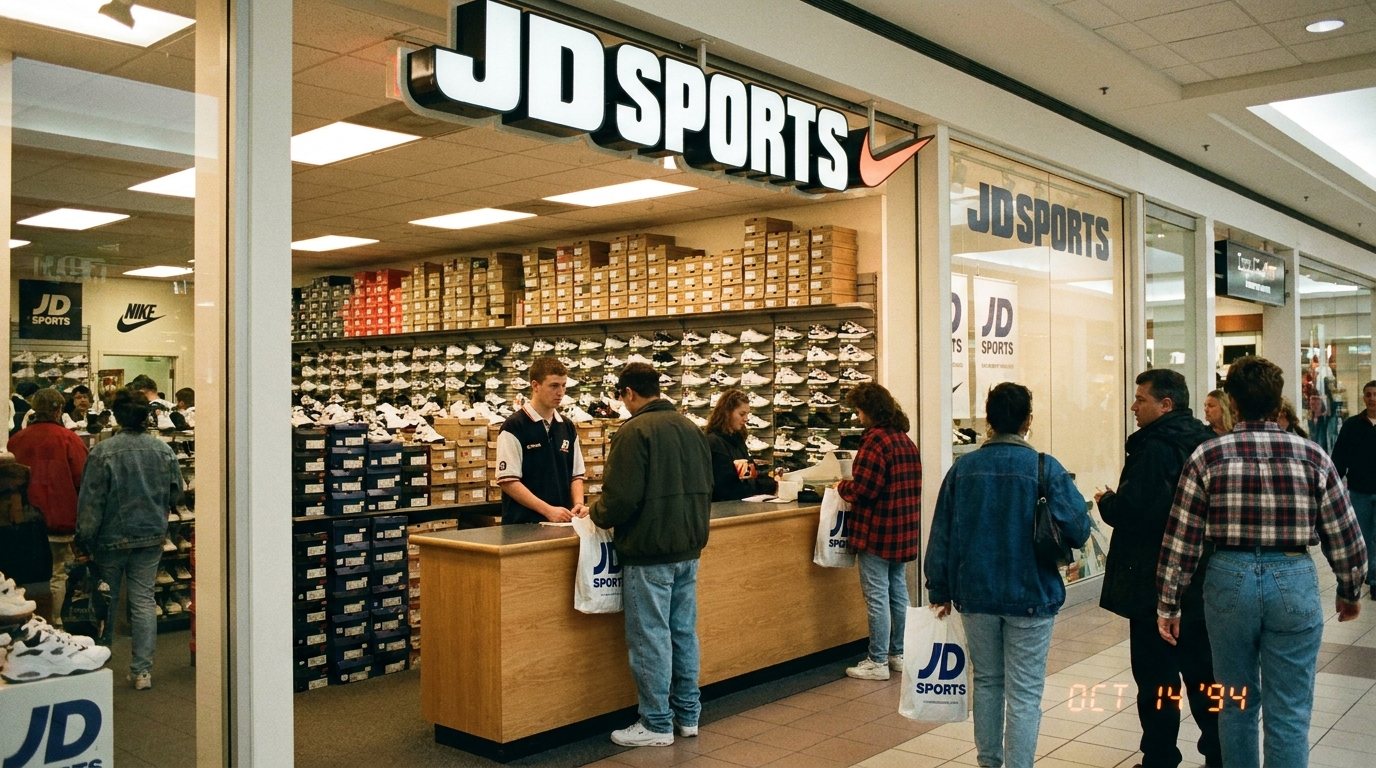
JD Sports began in 1981 as a single shop in Bury, Greater Manchester, opened by John Wardle and David Makin. The initials are literally their first names, John and David, stitched together into a fascia that would eventually stretch across four continents, according to Wikipedia's account of the company. The timing mattered. Early-1980s Britain had a booming appetite for branded sportswear driven by football terrace culture, where wearing the right European trainer and the right track top was its own kind of fluency. A small operator selling that specific wardrobe in a northern English town was tapping something real, and by 1983 the business had already pushed into Manchester's Arndale Centre.
What Wardle and Makin built next wasn't a chain so much as a consolidation machine. JD acquired First Sport, adding 209 stores, in 2001, then Allsports and its 70 stores in 2005. That same year, Pentland Group bought the founders' stake for £44.6 million, taking a 45 percent holding that has since grown into majority control near 55 percent, per Wikipedia. Pentland is itself a curious piece of British retail infrastructure, the family holding company behind Speedo and a longtime Reebok stakeholder, and its arrival gave JD both patient capital and a template: buy proven retail footprints instead of building new ones from scratch.
Crossing the Atlantic without changing the sign
JD Sports did not enter the United States by opening JD-branded stores and hoping Americans would learn the name. It entered by buying the companies Americans already trusted.
The first and largest move came in 2018, when JD completed its $558 million acquisition of Finish Line, a mall-based sneaker and apparel chain founded in Indianapolis in 1976 by Alan Cohen and David Klapper. At the time of the deal, Finish Line ran roughly 288 stores across 40 states plus Puerto Rico, and it operated shoe departments inside more than 450 Macy's locations, a footprint documented on Finish Line's Wikipedia page. That single transaction handed JD instant mall coverage and a decades-old relationship with Macy's that would have taken years to negotiate from zero.
JD kept buying. Shoe Palace, a West Coast sneaker and streetwear retailer with deep roots in hip-hop and skate culture, joined the portfolio for $325 million in December 2020, per Wikipedia. DTLR, a Baltimore-founded urban-core retailer, followed in 2021 for $360 million. Then in 2024, JD closed a $1.08 billion deal for Hibbett, a chain founded in 1945 that had built its entire identity around small and mid-sized Southern and Midwestern towns, typically anchoring strip centers next to a Walmart rather than competing for mall space, according to Hibbett's Wikipedia entry. By 2024 Hibbett covered 1,169 stores in 36 states, with its heaviest presence in Georgia, Texas, and Alabama.
| Year | Acquisition | Price | What it added |
|---|---|---|---|
| 2018 | Finish Line | $558M | National mall presence, Macy's shop-in-shops |
| 2020 | Shoe Palace | $325M | West Coast streetwear and sneaker culture credibility |
| 2021 | DTLR | $360M | Urban-core East Coast retail |
| 2024 | Hibbett | $1.08B | Small-town and rural Southern reach |
The insight the banners hide
Here is the part that doesn't show up on a corporate About page: JD Sports built its US business by deliberately not merging its acquisitions into one identity. Finish Line still looks like Finish Line. Hibbett still looks like Hibbett, still sits next to the same Walmarts it always has. DTLR still reads as a Baltimore urban retailer. Each banner keeps the local trust and cultural specificity it earned on its own, while JD, sitting above all four as parent, gets geographic and demographic coverage that a single expanding fascia could never assemble as quickly. A mall shopper in Ohio, a streetwear buyer in Los Angeles, and a family in small-town Alabama are all customers of the same London Stock Exchange-listed company, and none of them would necessarily know it. Most retail rollups eventually rebrand what they buy to capture marketing efficiency. JD's American strategy bets the opposite: that the banners are worth more intact than unified.
Where that strategy has landed
Globally, JD Sports Fashion plc now operates thousands of stores across more than 30 countries, is a constituent of the FTSE 100, and reported group revenue above £12 billion in its most recent fiscal year, with Régis Schultz as chief executive, per Wikipedia. In the US specifically, that revenue shows up as $6.37 billion in 2025 retail sales, good for #70 on NRF's list, split across four store fascias that most customers experience as unconnected. It is a rollup built the hard way, one long-established regional retailer at a time, rather than the fast way of exporting a UK logo and waiting for it to catch on.
Every banner JD owns runs on the same unglamorous plumbing underneath the different signage: a catalog of shoes and apparel that has to be accurate, in stock, and findable, whether the shopper is standing in a mall in Indiana or scrolling a phone in rural Georgia.