
Cutting returns in jewelry & watches with better product data
Jewelry and watch returns trace back to missing specs, not bad taste. Here's the exact data a ring or watch PDP needs, with a diamond ring example.
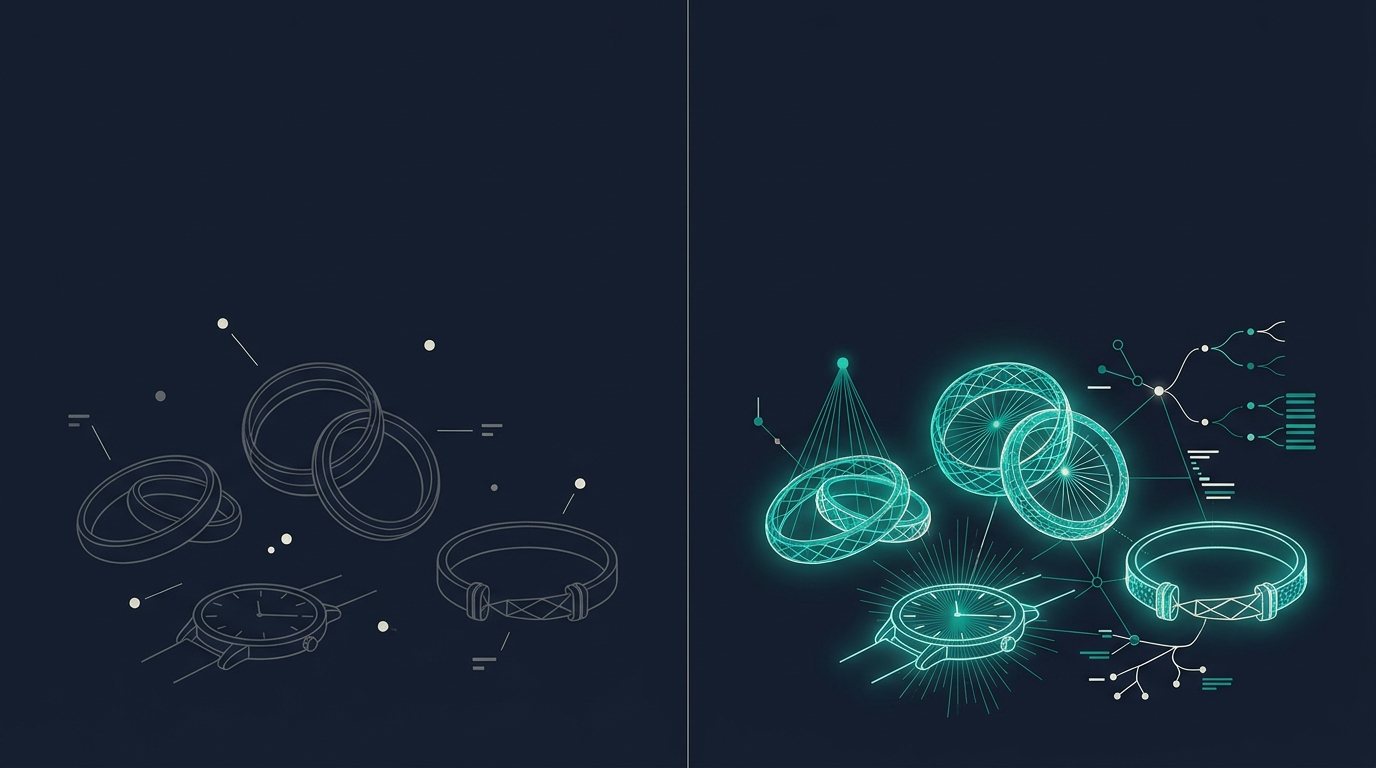
Jewelry and watches carry some of ecommerce's highest price points and thinnest product pages. A shopper deciding on a four-figure ring or a five-figure watch is making a purchase they can't try on, based on a page that usually tells them less than a jeweler behind a counter would in thirty seconds. Here's what that page needs to answer, and what it costs when it doesn't, using a diamond engagement ring as the example.
The return isn't about the jewelry. It's about the page.
Jewelry doesn't have the sizing chaos of apparel, but it isn't immune to returns. Benchmarks vary by source: one widely cited breakdown puts jewelry and accessories returns at 12-15%, below the ecommerce average of roughly 19-20%, while others place the category closer to the general average because of ring sizing and gemstone color mismatch. Either way, the drivers are consistent: sizing, stone appearance not matching the listing, and gifting purchases made without enough confidence to be final.
Jewelry and watches are as high-consideration as retail gets: expensive, hard to regift once returned, and bought against expectations set by a few photos and a short spec block. Online penetration for jewelry has actually been ticking down, not up: the online share of jewelry retail sales fell to 29.2% in 2023 from 31.4% in 2022 as shoppers went back to physical counters, and category conversion rates slid alongside it. That's as much a data-confidence problem as a preference shift. When a page can't answer the questions a jeweler would, shoppers go find someone who can.
The questions a jewelry or watch shopper actually needs answered
Before checkout, a shopper evaluating a piece of fine jewelry or a watch runs through a specific list, whether the page helps them or not:
- What exactly is the metal (10k, 14k, 18k, platinum), and is that verified or just a supplier claim
- What's the actual stone: natural, lab-grown, or simulant, and how is that disclosed
- Is there an independent grading report (GIA, IGI, AGS), viewable before I buy
- What are the real 4Cs: carat, cut, color, clarity, not just "brilliant-cut diamond"
- What's the ring size range, and can it be resized after purchase, and by whom
- For a watch: case size, movement type, water-resistance rating
- Is this new, vintage, or refurbished, and what's covered under warranty
- What's the return and resize window, and does resizing void the return
A generic listing answers two or three of these. The rest live in a certificate PDF, a supplier spec sheet, or nowhere at all.
A diamond engagement ring, before and after
Here's a common pattern: a solitaire engagement ring, round brilliant center stone, sold across a size run. Below is what a typical supplier feed hands a retailer, next to what a shopper (or an AI shopping agent) needs to buy with confidence.
| Attribute | Raw feed | Enriched |
|---|---|---|
| Metal | "14k gold" | 14k white gold (verified alloy, stamped), also available in 14k yellow, 18k white, platinum |
| Center stone | "1 carat diamond" | 1.02 ct, natural, round brilliant, G color, VS1 clarity, excellent cut |
| Grading | Not listed | GIA report #, viewable PDF linked, plotted diagram included |
| Stone origin | Missing | Natural (not lab-grown); lab-grown version listed separately at its own price point |
| Setting | "Solitaire" | 4-prong solitaire, cathedral shank, comfort-fit interior |
| Ring size | "5-9" | Sizes 4-10 in half sizes; free resizing within 60 days, one time |
| Warranty | Generic "lifetime" claim | Covers prong tightening and rhodium replating; excludes stone loss from impact damage |
| Return policy | "30-day returns" | 30-day return unworn with tags; resized rings final sale |
The "raw feed" column is what most jewelry catalogs import by default: a metal guess, a carat number, a setting name. The grading report, stone-origin disclosure, and resize policy are what actually decide whether a nervous first-time buyer clicks "buy" or closes the tab to ask a jeweler in person, and they're the fields most likely to be missing.
Ask an AI shopping assistant to "recommend a one-carat GIA-certified engagement ring under $6,000 with a comfort-fit band," and it's matching against those exact structured fields: carat, certification, price, band feature. A listing that only says "1 carat diamond ring" has nothing for the assistant to match against, and gets filtered out before a shopper ever sees it, regardless of how good the ring actually is.
Where this shows up on the watch side
Watches carry the same gap. A shopper comparing dive watches wants water resistance stated in meters or ATM, not "water resistant," plus a movement type and a case diameter in millimeters, since none of those are adjustable after purchase the way a strap is. Case size and water-resistance rating are treated as standard, expected specs by watch buyers, but they're routinely vague or missing on pages that only carried over a marketing description.
The fix in both categories is structural, not cosmetic. Not a better photo or a longer description, but the specific, verifiable fields that let a shopper stop guessing and an AI agent stop filtering the product out.
The checklist
For any fine jewelry or watch SKU, these fields should exist and be populated before it goes live:
- Verified metal type and purity, not a copied supplier claim
- Stone type disclosed as natural, lab-grown, or simulant, with no ambiguity
- Independent grading report linked, where one exists
- Full 4Cs (or equivalent gemstone specs) in structured form, not just a marketing phrase
- Ring size range and resizing policy, stated plainly
- Watch case size, movement type, and water-resistance rating in standard units
- Condition grade for vintage or refurbished pieces, plus clear warranty terms
- Return window and any conditions that make a return final (resizing, engraving, custom work)
Most catalogs are missing several of these on any high-value SKU, and the gaps cluster on the exact fields a shopper needs before committing four figures to something they can't try on.
Where Anglera fits
Your PIM stores the metal type, the carat weight, the certification number. It doesn't catch when a grading report link is missing, flag an ambiguous stone-origin field, or notice that half your ring sizes lack a resize policy while the other half don't. Anglera scores every jewelry and watch listing against the fields that drive return-free purchases, gap-fills them from source specs and certificates, and keeps them current as new pieces arrive, so the page a nervous shopper reads and the feed an AI agent parses tell the same story.