
How Kohl's Built America's Off-Mall Department Store Empire
Kohl's went from a Milwaukee grocer to #34 on NRF's Top 100 Retailers with $14.78B in sales, by betting on off-mall strip centers while rivals bet on malls.
Part of Retailer Playbooks — history-first profiles of every company on the NRF Top 100 Retailers list.
Kohl's sits at #34 on the NRF Top 100 Retailers 2026 list, with $14.78 billion in 2025 U.S. retail sales, compiled by the National Retail Federation with Kantar. That number belongs to a chain that spent fourteen years owned by a British tobacco company, got sold off as a misfit, and then built one of the most durable real estate bets in American retail. The full arc runs from a Milwaukee corner grocery to a coast-to-coast chain that briefly overtook JCPenney as the country's largest department store operator.
A grocer's son builds a supermarket empire
Max Kohl, a Polish immigrant, opened a corner grocery store in Milwaukee in 1927. It grew into Kohl's Food Stores, a regional supermarket chain that by the 1940s was a fixture of Milwaukee neighborhoods, with the company's first full supermarket format arriving in 1946, according to Wikipedia's history of Kohl's. Groceries, not clothing, were the family business for its first three and a half decades. The department store that carries the Kohl's name today was, at its start, a side bet by a grocery chain looking for a second act.
That bet arrived in September 1962, when Kohl opened his first department store in Brookfield, Wisconsin. The idea was to plant something between the high-end department stores and the discounters, a positioning gap that had not yet been named as a category, per FundingUniverse's company history. It worked well enough that by 1972 the chain had grown to five department store locations, according to Encyclopedia.com's account.
The tobacco company years
In 1972, British American Tobacco's U.S. arm, BATUS Inc., bought a controlling stake in Kohl's, taking full ownership by 1978. It was an odd fit from the start. BATUS also owned Saks Fifth Avenue, and a value-oriented Midwestern chain selling national brands at a discount sat uneasily next to a luxury flagship in the same portfolio. The grocery operations, the original business, were sold off to A&P in 1983, and the food stores that once carried the family name closed for good in 2003.
By the mid-1980s BATUS had grown Kohl's to 34 stores but treated it as an outlier asset rather than a growth priority. In 1986, the company's own management bought the 40-store chain back from BATUS in a buyout, and spent the next three years doing something BATUS never had: refining what "the Kohl's concept" actually meant. Under chairman and CEO William Kellogg, who had led the chain since 1979, that meant moderately priced national-brand apparel for middle-income families, more than 80 percent name-brand merchandise, narrow but deep assortments, and a deliberately lean cost structure with centralized buying, per FundingUniverse.
The bet that mattered more than the merchandise
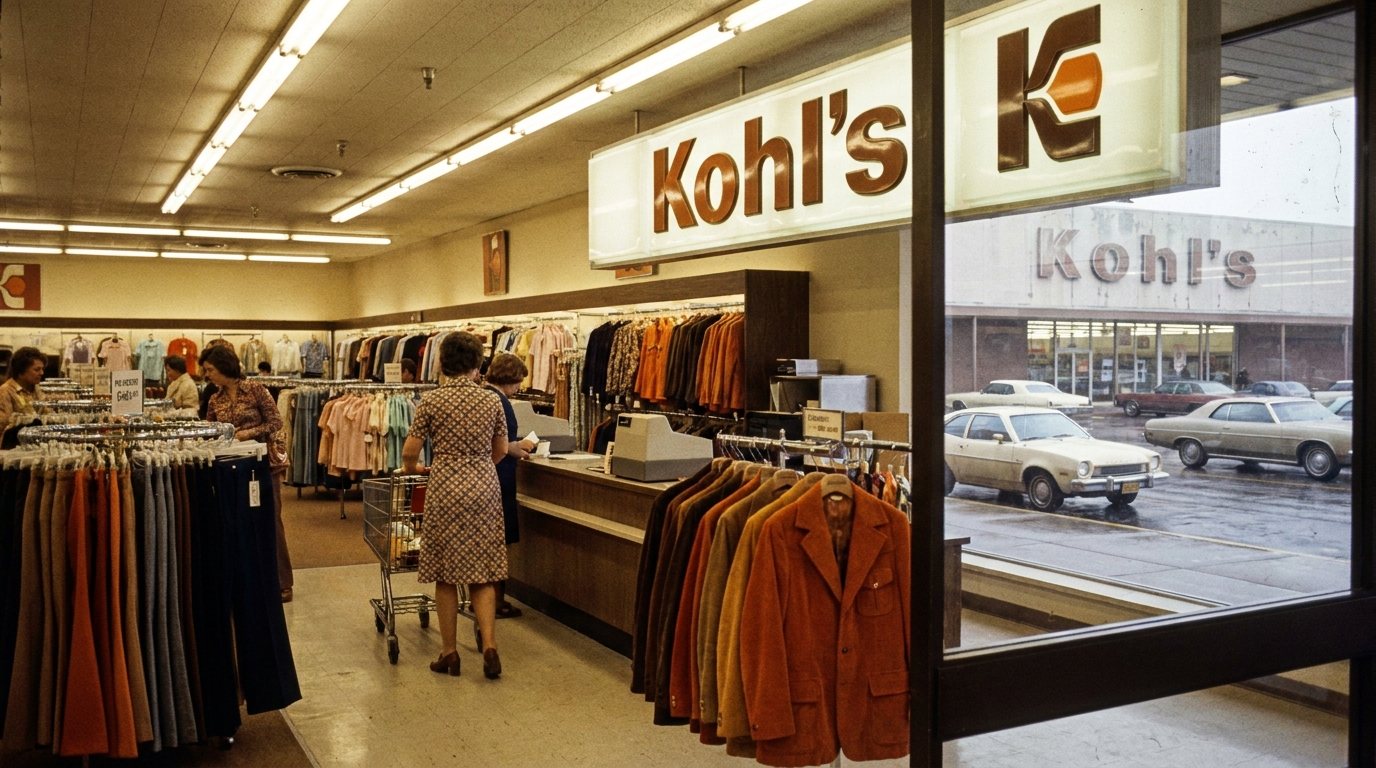
The merchandising formula was smart. The real edge was underneath it: real estate. Kohl's built its stores off-mall, in standalone locations and strip centers rather than as anchor tenants inside enclosed shopping malls. Nearly every department store chain of that era, Sears, JCPenney, Montgomery Ward, was tethering its growth to mall developers instead. Here is the thing worth naming plainly, because it does not show up on Kohl's own About page: that off-mall real estate call, made in the 1970s and 1980s for reasons that were probably just about cheaper land and parking, is what let Kohl's dodge the mall-anchor collapse that gutted so many of its department-store peers three decades later. Chains that leased space inside malls were stuck when mall foot traffic cratered. Kohl's owned or leased its own boxes, controlled its own parking lots, and never had its fate tied to some mall operator's occupancy rate.
That structural choice paid off for decades. Kohl's went public on the NYSE in 1992 under ticker KSS, starting from 76 Midwest stores, and used the IPO capital to build distribution infrastructure, adding three automated distribution centers between 1994 and 1997 and a fourth in Missouri by 1999, the same year it acquired 33 former Caldor stores after that chain's liquidation, per Wikipedia and FundingUniverse. Expansion followed the map outward: the New York area in 2000, Dallas-Fort Worth and California in 2003, the Pacific Northwest in 2006, and a Southeast push that added 43 stores between 2005 and 2008. By May 2012, Kohl's had grown large enough to surpass JCPenney as the largest department store chain in the United States by store count.
Reinvention as a habit
Kohl's kept experimenting with the format rather than resting on it. It sold its private-label credit card portfolio to J.P. Morgan Chase for $1.5 billion in 2006, then moved that relationship to Capital One in 2011. In 2016 it launched Kohl's Pay, an early integrated mobile checkout combining card, loyalty rewards, and coupons in a single tap. In 2017 it began accepting Amazon returns in select stores, a partnership that expanded nationwide by 2019 and turned Kohl's locations into a physical front door for a digital-only retailer. Two companies that might otherwise compete for the same shopper instead struck a deal that drove foot traffic into Kohl's stores.
Not every bet landed. The Off/Aisle discount concept, tested starting in 2015, was shuttered by 2019. Multiple acquisition approaches in 2022, from Hudson's Bay, Sycamore Partners, and a Simon Property Group and Brookfield partnership, all fell through. Home goods sales slid for twelve consecutive quarters through early 2024 even as the company expanded that assortment by 40 percent. The response was another store-within-a-store bet: Sephora shops inside Kohl's locations starting in 2021, followed by a Babies R Us collaboration across roughly 200 stores in 2024. Michael Bender became permanent CEO in November 2025 after a stretch as interim leader, inheriting a chain of roughly 1,174 stores in every state but Hawaii, still generating close to half of its revenue from private brands like Sonoma Goods for Life, itself a business worth more than $1 billion on its own.
The through-line from the Brookfield parking lot in 1962 to the Sephora counters of today is the same one: Kohl's has always treated the store format itself, where it sits, what fills the aisles, who else gets a corner of the floor, as the thing worth redesigning.
Retail's history is written in ledgers, loading docks, and the unglamorous data that ties a catalog page to a shelf. This series is part of that record.