
How Kroger Almost Missed Inventing the Supermarket
Kroger ranks #4 on NRF's Top 100 Retailers with $154.74B in 2025 U.S. sales, and its history includes rejecting the supermarket concept it later had to relearn.
Part of Retailer Playbooks — history-first profiles of every company on the NRF Top 100 Retailers list.
Kroger is the fourth-largest retailer in the United States, with $154.74 billion in 2025 U.S. retail sales according to the National Retail Federation's Top 100 Retailers 2026 list, compiled with Kantar. That scale traces back to a 24-year-old grocer with $372 and a grudge against mediocre food. What most retail histories skip is the year Kroger had the supermarket inside its own walls, said no, and had to spend the next five years catching up to an idea it invented and threw away.
A Grocer Who Couldn't Stop Testing the Product
Bernard "Barney" Kroger opened his first store at 66 Pearl Street in Cincinnati on June 24, 1883, with his life savings of $372, according to Wikipedia's history of the company. He'd left school at 13 after his father's business collapsed in the Panic of 1873, and by 20 he was already running a grocery store for someone else. His rule, repeated to clerks for decades, was blunt: "Be particular. Never sell anything you would not want yourself."
That obsession showed up as vertical integration before the term existed. In 1901, Kroger became the first grocery chain to bake its own bread, according to FundingUniverse's company history. In 1904 he added meat departments by acquiring Nagel Meat Markets, a move that so threatened independent butchers that some sabotaged Kroger's cash registers and intimidated its female cashiers. Kroger held the line. By 1929, aggressive acquisition of regional chains had pushed the company past 5,500 stores, mostly across the Midwest and South.
The Idea He Said No To
Here is the detail most company profiles leave out. Around 1930, a Kroger executive named Michael Cullen pitched leadership on a radical format: a large, self-service, high-volume store selling groceries at rock-bottom margins, run out of an abandoned warehouse. Kroger's executives turned him down. Cullen quit, borrowed capital, and opened King Kullen in Queens, New York, in 1930, a store now widely credited as America's first true supermarket.
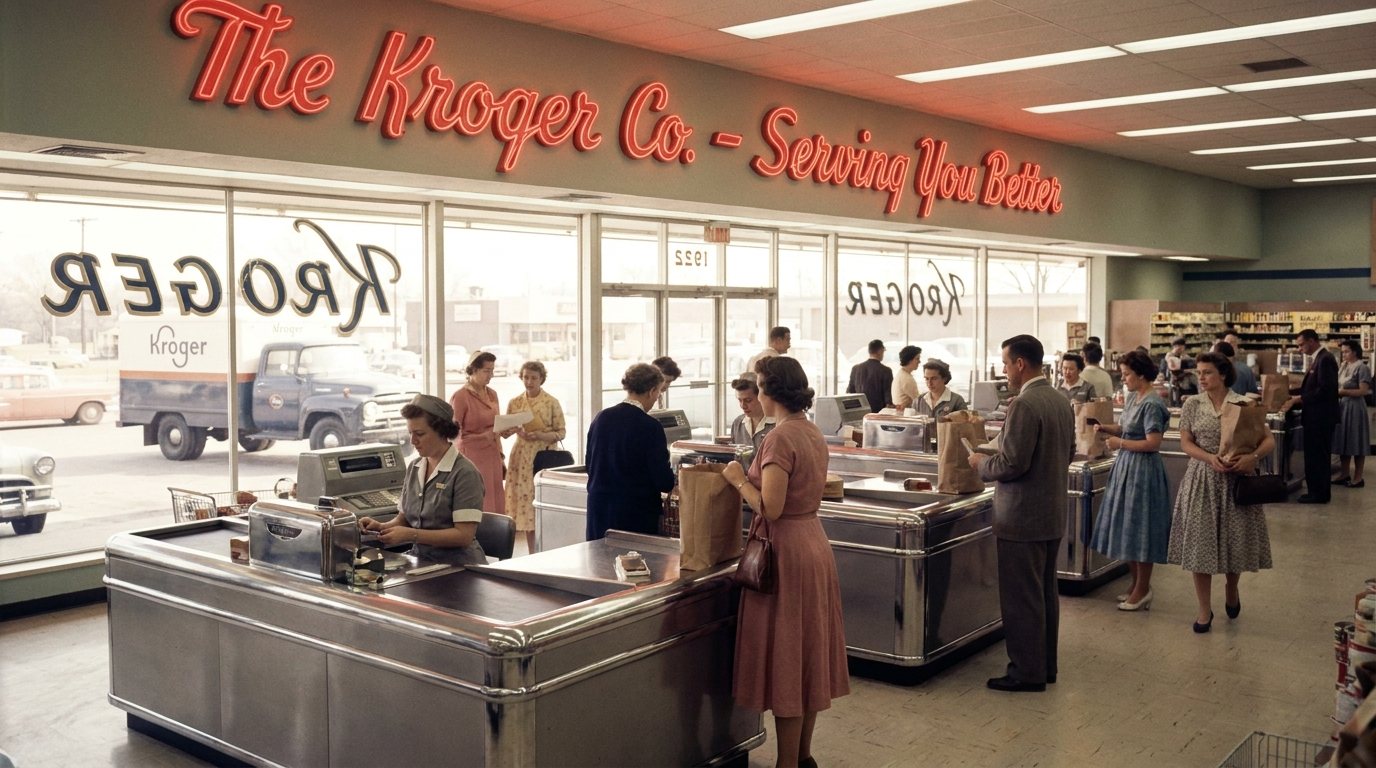
Kroger didn't sit still after the rejection. By 1935 the company was running 50 supermarkets of its own, retrofitting the format it had passed on five years earlier. The lesson isn't that Kroger missed the supermarket. It's that the company that said no to the idea inside its own building was fast enough to absorb it from a competitor within half a decade, a recovery speed that mattered more to Kroger's next century than the original miss did.
Barney Kroger himself wasn't around to see it. He sold his personal shares in 1928 for more than $28 million, a year before the stock market crash, and stepped away from daily control.
Surviving the Depression by Inventing Consumer Research
The 1930s brought both the Depression and a wave of political hostility toward chain stores, which lawmakers cast as a threat to Main Street. Company president Albert Morrill decentralized Kroger into 23 regional branches and, in 1930, founded the Kroger Food Foundation, assembling 750 homemakers to test products in their own kitchens. It was among the first scientific consumer-research operations any grocer had run, built specifically to counter accusations that chain stores sold inferior food.
The Merger Spine
Kroger's next 90 years were built on a short list of deliberate, large bets rather than constant small acquisitions:
| Year | Move | Why it mattered |
|---|---|---|
| 1983 | Merged with Dillon Companies (King Soopers, City Market, Fry's) | Made Kroger a coast-to-coast operator for the first time |
| 1988 | Rejected KKR/Dart Group takeover bids, recapitalized with $3.6B in new debt | Kept the company independent while rival Safeway went private under KKR that same era |
| 1999 | Acquired Fred Meyer ($8B, plus Ralphs and Smith's) | Briefly made Kroger America's largest supermarket operator by revenue |
| 2014 | Acquired Harris Teeter ($2.5B) | Re-entered the Carolinas after a 25-year absence |
| 2024 | Albertsons merger blocked by federal court | Ended the largest proposed grocery combination in U.S. history |
| 2026 | Announced acquisition of Giant Eagle ($1.65B) | Opened a new growth chapter in the Pittsburgh market |
The 1988 decision deserves more attention than it usually gets. When Dart Group and Kohlberg Kravis Roberts circled with buyout offers as high as $5 billion, Kroger's board chose to load the balance sheet with debt and pay shareholders directly rather than sell. Safeway, facing a nearly identical threat that same decade, went the other way and was taken private by KKR, then spent years cutting stores and staff to service the debt. Kroger's version of that same leveraged bet was structured to keep the company public and operating, and the $5.3 billion in debt it carried into the 1990s got worked down through a genuinely unglamorous discipline: $120 million spent between 1992 and 1994 on checkout systems and inventory technology, producing roughly $23 million a year in savings.
What the Fred Meyer Deal Actually Bought
The 1999 Fred Meyer acquisition is usually filed under "Kroger got big." What it actually did was hand Kroger a working multi-department format, superstores running 145,000 square feet with groceries, apparel, and a jewelry counter, that Fred Meyer had spent decades perfecting in the Pacific Northwest. Kroger didn't build the format. It bought a finished one and rolled it out nationally, the same pattern as the supermarket itself seven decades earlier: absorb a proven idea fast rather than always originate it first.
The Ledger Kroger Runs On Now
Kroger's more recent identity runs on data as much as shelves. In 2015 it took full ownership of 84.51°, its consumer-analytics unit, buying out Tesco's remaining stake in what had been a joint venture called Dunnhumby USA. In 2018 it partnered with UK-based Ocado to build automated fulfillment centers, the first opening in Monroe, Ohio in 2021. Its private-label operation, branded Our Brands, now accounts for roughly 30 percent of units sold, produced across 33 manufacturing plants, a direct descendant of the same 1901 bakery decision.
Sources: Wikipedia, FundingUniverse, Kroger's own history page, NRF Top 100 Retailers 2026.
Every grocer's fortune eventually comes down to the same unglamorous stack: what's on the shelf, what's known about the shopper, and how fast the catalog behind both can move. Kroger's century-plus record is a study in how often that stack gets rebuilt, one merger and one format at a time.