
Linde: The Distributor That Bought Back Its Confiscated Half
Linde (Americas) lands on MDM's 2026 Top Distributors list for Gases & Welding Supplies. Its real competitive edge traces back to a century-old corporate split.
Part of Distributor Playbooks — strategy teardowns of every company on the MDM Top Distributors lists.
Linde (Americas) sits on MDM's 2026 Top Distributors list for Gases & Welding Supplies, one of seventeen companies MDM lists alphabetically rather than ranked, since almost none of them will disclose a number. That silence fits a business built on scale nobody needs to advertise. It also masks the stranger fact about Linde: the company competing for that welding shop's cylinder order was, for most of the twentieth century, legally split in two.
A company that merged back with its own confiscated half
Carl von Linde founded the business in Germany in 1879 on refrigeration technology for breweries, then built out air-liquefaction plants that became the foundation of industrial gas production. He opened an American plant in Buffalo in 1907. When the United States entered World War I, it seized Linde's American assets as enemy property and folded them into Union Carbide, where they operated for decades as Linde Air Products before eventually becoming Union Carbide Industrial Gases and, in 1995, an independent company called Praxair, per Wikipedia's history of Praxair.
Meanwhile the German parent kept operating on its own track, buying BOC for roughly 11.7 billion euros in 2006 and Lincare for $4.6 billion in 2012 to build out healthcare gases. In 2017 the two long-separated halves agreed to an all-share merger valued near $75 billion, completing in October 2018 as Linde plc, domiciled in Ireland with headquarters in the UK. By 2024 the combined company reported $33 billion in revenue and roughly 65,000 employees, per Wikipedia's entry on Linde plc. The distributor now selling welding gas out of a strip mall in Ohio descends directly from a company Washington broke apart as a wartime security measure. That is not a detail you'll find on the About page, and it explains something the org chart doesn't: why Linde's American welding and packaged-gas business still runs semi-autonomously inside a global parent, with its own retail identity, its own store network, and its own supply chain logic layered on top of the corporate one.
The tension nobody in the aisle mentions
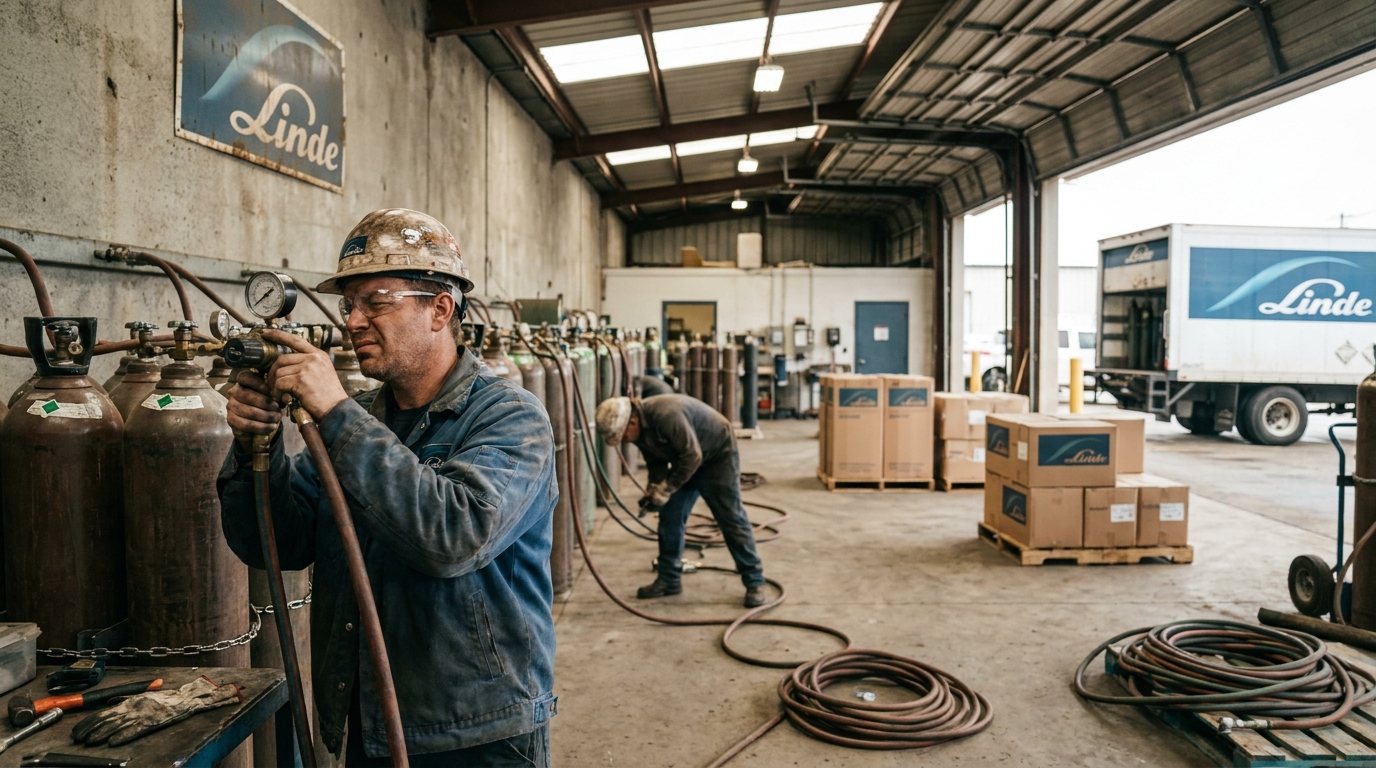
Here is the part worth naming plainly. Linde is simultaneously one of the world's two or three largest producers of industrial gas and the operator of a direct-to-shop retail chain. Its Gas & Equipment Centers, reachable through LindeDirect's store network, sell oxygen, argon, acetylene, MIG and TIG machines, wire, and safety gear across all 50 states, stocked alongside Linde's own PROSTAR private-label line next to Miller, Lincoln, and ESAB equipment. But independent regional welding-gas distributors, several of them sitting right next to Linde on MDM's own list, buy bulk gas at wholesale from producers like Linde because building an air-separation plant is not something a regional distributor can do. Linde is their supplier and their competitor at the same counter. Most channel businesses pick a lane. Linde's advantage is that it never had to, because it owns the molecule from the plant to the cylinder to the storefront.
Winning by building the customer's plant, not just delivering to it
Linde's sharpest recent move extends that logic past cylinders entirely. Its "small on-site" program has Linde build, own, and operate gas plants directly at a customer's facility under long-term contracts, financing the capital equipment itself in exchange for a locked-in multi-year supply agreement. In 2024 the company signed 59 new agreements covering 64 such plants, its fifth consecutive record year, driven largely by electronics and EV battery manufacturing and by glass and metals producers chasing emissions cuts, according to coverage of the results. CEO Sanjiv Lamba described the plants, built on Linde's proprietary ECOVAR technology, as leveraging the company's existing footprint to "enhance network density." That phrase is the whole strategy in three words: every plant built inside a customer's fence line makes the next contract in that region cheaper to win, because the pipeline, the technicians, and the supply chain are already local.
A leadership signal worth reading
Linde's most recent board move underlines where the center of gravity sits. Sean Durbin, appointed Chief Operating Officer effective October 2025, spent the prior two years as Executive Vice President running Linde North America specifically, according to reporting on the transition. Sanjiv Lamba adds the chairman title in January 2026 as Steve Angel, a 25-year Linde and Praxair veteran, retires from the board. Promoting the head of the Americas region into the top operating job is not a routine reshuffle; it is a company telling its own market that the region built from that confiscated 1917 asset base is still where the operating discipline gets set.
The real trade-off
The honest tension is capital allocation. Linde is currently committing $8 billion to $10 billion toward clean-energy projects, including a roughly $2 billion low-carbon hydrogen and carbon-capture plant in Beaumont, Texas. Those are multi-decade, single-site bets chasing tax credits and industrial decarbonization contracts. The welding shop on Route 9 buying a cylinder of argon is a completely different customer, on a completely different sales motion, inside the same P&L. Betting big on hydrogen megaprojects while still running a 50-state retail counter business is a legitimate strategic stretch, and it is the same stretch every industrial gas major is making right now. Linde's history suggests it has survived stranger splits than that.
Distribution rewards look boring from the outside: a catalog kept current, a branch stocked correctly, a truck that shows up on time. Linde's century of getting there the hard way is a reminder that even the biggest players in a channel are still, underneath, running on exactly that kind of unglamorous infrastructure.