
Lowe's: The Hardware Store That Invented Big-Box Retail First
Lowe's ranks #9 on NRF's 2026 Top 100 with $83.96B in sales. Its real history: it built the big-box home-improvement model before Home Depot existed.
Part of Retailer Playbooks — history-first profiles of every company on the NRF Top 100 Retailers list.
Lowe's comes in at #9 on the NRF Top 100 Retailers 2026, the National Retail Federation's annual ranking compiled with Kantar, with $83.96 billion in 2025 U.S. retail sales. The popular version of home-improvement history credits Home Depot with inventing the category. The record says otherwise: Lowe's built the economic engine of price-disrupting building-materials retail three decades earlier, then spent the 1990s racing to catch up to the store format its own idea had made possible.
A General Store on Main Street
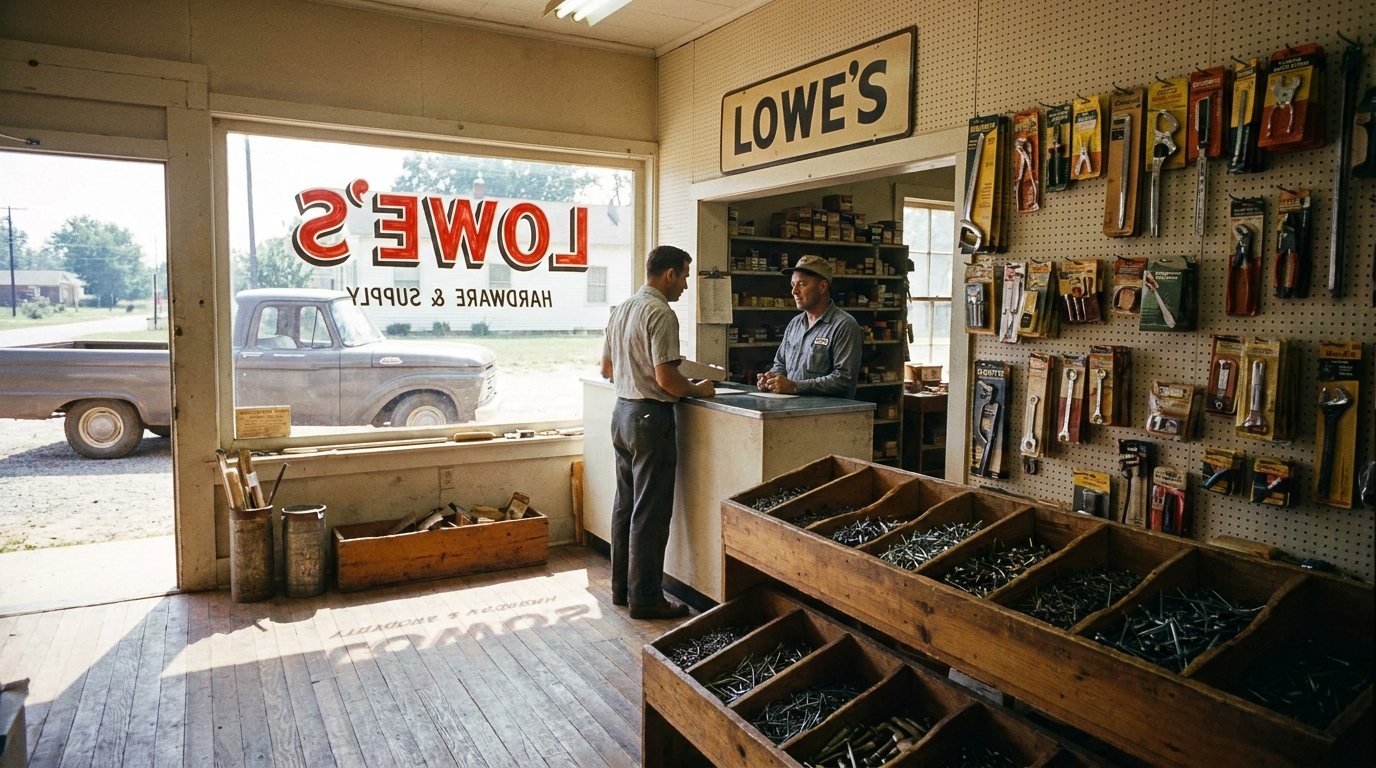
L.S. Lowe opened a general store in North Wilkesboro, North Carolina, in 1921, selling hardware, dry goods, and groceries to a small Appalachian foothills town, according to Lowe's own corporate history. It was a modest operation with no obvious path to national scale. When Lowe died in 1940, ownership passed to his daughter, Ruth Buchan, who sold the business to her brother James for $4,200, according to Wikipedia's account of the company's founding. James then brought in Ruth's husband, Carl Buchan, as a partner in 1943.
Buchan is the pivotal figure most casual retail histories skip past. He saw the same thing every returning GI and every small-town builder in the Southeast saw in 1946: a wave of postwar home construction was coming, financed by the GI Bill and pent-up demand after fifteen years of Depression and war had frozen the housing market. Rather than keep the store as a general-goods operation, Buchan acquired a controlling stake and refocused it entirely on hardware and building materials, betting the whole business on that one forecast, per FundingUniverse's company history.
The Idea Nobody Credits Lowe's For
The bet alone wasn't the innovation. The innovation was how Buchan intended to fund and price it. He began buying directly from manufacturers in bulk, cutting wholesalers out of the chain entirely, according to FundingUniverse. That single decision is the same disintermediation logic that would later get attributed to the category-killer big-box format Home Depot popularized starting in 1978. Lowe's was running that playbook, in miniature, in small-town North Carolina more than three decades before "big-box" was a term anyone used.
The scale followed. A second store opened in Sparta, North Carolina, in 1949. The company incorporated formally as Lowe's North Wilkesboro Hardware, Inc. in 1952, and by 1955 it had grown to six stores. Buchan died in 1960, and his executive team took the company public the following year as Lowe's Companies, Inc., listing shares at $12.25. By 1962 it had 21 stores and $32 million in revenue. By the late 1960s that had grown past 50 stores and $100 million in sales, and by 1979, the year Lowe's listed on the New York Stock Exchange, revenue had climbed to $900 million across more than 200 stores, helped by an in-house financing program that got local builders FHA-approved construction loans.
The Whiplash Decade
Lowe's built its first half-century almost entirely around the contractor: the builder buying lumber and fixtures by the truckload. That model has a flaw. Contractor demand is brutally cyclical, tied to interest rates and housing starts, and the early 1980s housing downturn hit Lowe's hard enough that Chairman Robert Strickland and President Leonard Herring pushed through a strategy called RSVP, for retail sales, volume, profit, redesigning stores around the do-it-yourself consumer instead of the tradesman, according to FundingUniverse. It worked fast: Lowe's crossed $1 billion in annual sales in 1982, and by 1983 consumer sales had overtaken contractor sales for the first time in company history.
Then the ground moved again. Home Depot, founded only in 1978, built stores nearly five times the size of a typical Lowe's location and turned "warehouse" into the default shape of home-improvement retail. By 1989 Home Depot had passed Lowe's as the industry's largest chain. Lowe's spent the next several years converting its entire real estate footprint, store by store, from roughly 20,000-square-foot neighborhood locations into 75,000-square-foot-plus warehouse formats, a $71.3 million restructuring that began in 1991. By 1996 more than 400 stores had made the conversion and revenue had nearly tripled to $8.6 billion.
Finding Ground Home Depot Didn't Hold
Matching the warehouse format wasn't enough on its own; Lowe's needed reasons for shoppers to choose it specifically. It kept serving contractors even after the consumer pivot, leaned into major appliances, added home electronics and home office equipment in 1994, and built out interior design services that Home Depot largely skipped, per FundingUniverse. Geographic expansion under CEO Robert Tillman through the late 1990s and early 2000s pushed the company out of its Southern base into the Midwest, Northeast, and West, accelerated by the 1999 acquisition of Eagle Hardware & Garden and a first Canadian store in Hamilton, Ontario.
| Year | Milestone |
|---|---|
| 1921 | L.S. Lowe opens general store in North Wilkesboro, NC |
| 1946 | Carl Buchan refocuses the store on building materials, buys direct from manufacturers |
| 1961 | Company goes public as Lowe's Companies, Inc. |
| 1982-83 | RSVP strategy shifts focus to consumers; $1B sales year |
| 1991-96 | Store fleet converted to warehouse format to match Home Depot |
| 1999 | Eagle Hardware & Garden acquisition, first Canadian store |
| 2021 | Company centennial |
Lowe's crossed into Fortune's 100 list in 2002 with $22 billion in revenue, launched Lowes.com back in 1995, brought on Marvin Ellison as president and CEO in 2018, and marked its hundredth year in business in 2021. Today it operates roughly 1,750 stores and employs about 270,000 people, permanently seated as the number-two hardware and building-materials chain behind Home Depot, a position it has held since 1989.
The century-long thread running under all of it is the same one Carl Buchan pulled in 1946: figure out where the materials come from, cut out whoever doesn't need to be in the middle, and get the price and the product to the person building something. Every era since has just been a new answer to that same question.