
Lululemon: How a Snowboard Guy Invented Yoga Pants
Lululemon is #71 on NRF's Top 100 with $6.33B in 2025 U.S. sales. Its founder built the brand on Ayn Rand, lost it to one bad comment, then fought his way back.
Part of Retailer Playbooks — history-first profiles of every company on the NRF Top 100 Retailers list.
Lululemon lands at #71 on NRF's Top 100 Retailers 2026 list, with $6.33 billion in 2025 U.S. retail sales. The company that turned yoga pants into a $10 billion global business was founded by a snowboard-apparel entrepreneur who had never taught a yoga class, built the culture around an Ayn Rand novel, got pushed out after one disastrous comment about women's bodies, and then spent the next decade trying to force his way back in. That last part isn't finished yet.
A Snowboard Guy Discovers Yoga
Chip Wilson spent nearly two decades building Westbeach Snowboard Ltd, a surf-skate-snowboard apparel company he started in 1979. He sold it in 1997, then took a yoga class. What he noticed wasn't the meditation. It was the fabric. Cotton clung, sagged, and went sheer with sweat, and the studios of late-1990s Vancouver were full of women wearing gear built for men doing something else entirely.
Wilson launched Lululemon Athletica on January 12, 1998, treating yoga apparel as a technical-fabric problem rather than a fashion one, the same way he'd treated snowboard jackets. He designed a proprietary stretch fabric meant to move like skin, not fight it. The company name itself was a marketing bet: Wilson reportedly liked that Japanese speakers struggle with the letter L, figuring a name built around it would read as playfully "exotic" if the brand ever expanded into Japan. It was a strange founding logic for an apparel company, and it worked anyway.
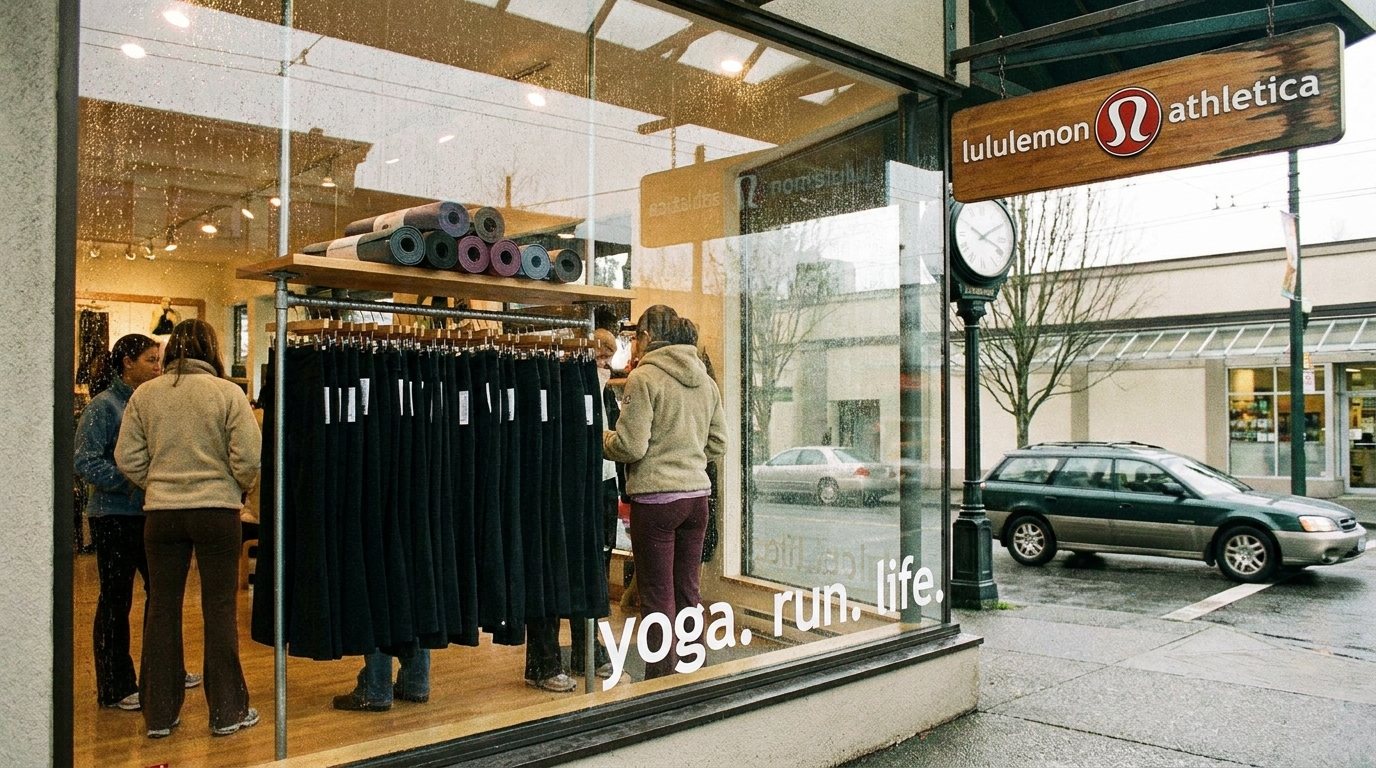
The first store opened in Vancouver in November 2000, and it wasn't built as a store. It was a working design studio by day and a rented-out yoga space by night, so the label's earliest customers were also its product testers. That loop, make the gear, hand it to the people using it hardest, listen, adjust, became the seed of what later grew into Lululemon's ambassador network of local instructors and athletes, still core to how the brand markets today without traditional celebrity endorsement.
Objectivism on a Shopping Bag
The brand's other founding influence was less obvious and more controversial. Wilson was a devoted reader of Ayn Rand, and Lululemon's early culture absorbed her philosophy of individual will and self-reliance so thoroughly that shopping bags carried the line "Who is John Galt?", a direct lift from Atlas Shrugged. It was an unusual pairing: a brand selling communal yoga-studio warmth while printing libertarian philosophy on its packaging. Few customers noticed. Fewer competitors copied it. It gave Lululemon a store experience that felt like it stood for something, even when shoppers couldn't say what.
Wilson stayed CEO until 2005, when he sold a 48% stake to Advent International. Two years later, on the strength of a cult following that had spread from Vancouver studios to Nasdaq investors, Lululemon went public in July 2007, raising $327.6 million. Christine Day, previously co-president at Starbucks, took over as CEO in 2008 and pushed the company from a regional yoga label into a national athletic-wear chain.
The Comment That Nearly Broke the Brand
2013 delivered the low point twice. First came a product failure: black yoga pants that turned unintentionally sheer under stretch, a defect serious enough that Lululemon pulled roughly 17% of all women's pants sold that year and lost both its chief product officer and, soon after, CEO Christine Day.
Then came Wilson himself. In an interview explaining the pilling problem, he said some women's bodies simply don't work in the pants, remarks Time characterized as fat-shaming. The backlash was fast and it was personal, aimed at the founder rather than the company. By December 2013, Wilson had resigned as chairman. He left the board entirely in February 2015, saying he'd "achieved the goals I set when I came back," a line that read very differently in hindsight given what came next.
The Long Rebuild
Laurent Potdevin, formerly of TOMS, took over as CEO in 2013 and steadied the ship, before resigning in 2018 over misconduct tied to an employee relationship. Calvin McDonald, who arrived from Sephora that year, ran the company for the following seven years and turned it into the growth story that gets it onto this list: revenue climbed to $10.6 billion by fiscal 2024, the company pushed into footwear in 2022, built out menswear as a real second business line rather than an afterthought, and became the official outfitter for Canada's Olympic and Paralympic teams through the 2028 Los Angeles Games.
Not every swing landed. Lululemon bought the home-fitness startup Mirror for $500 million in 2020, betting a chunk of pandemic-era stock appreciation on connected home workouts. By 2022 it had written off $442.7 million of that bet, a rare public admission from a company that had spent a decade being right.
The Founder Comes Back Anyway
Here's the unique thread underneath the resume: Wilson never actually left. He kept a large personal stake, kept criticizing publicly (a 2016 open letter accused the company of "losing its way" to Nike and Under Armour), and in December 2025, with the stock underperforming and challengers like Alo Yoga and Vuori eating into the premium-yoga-wear category Lululemon invented, he launched a proxy fight against his own board. McDonald announced his departure that same month. By May 2026, Lululemon settled by appointing two new directors, former ESPN CMO Laura Gentile and former On co-CEO Marc Maurer, ending the fight without fully resolving what it exposed: a founder who got exiled for one bad sentence in 2013 still had enough conviction, and enough shares, to force his way back to the table twelve years later. Most retail founders who leave under a cloud stay gone. Wilson's arc, snowboard entrepreneur to yoga-pants inventor to exiled chairman to activist shareholder, is closer to a second act than an ending.
Lululemon is still, at bottom, a fabric company that figured out community before its competitors figured out fabric. The rest, the philosophy on the bags, the ambassador instructors, the founder who won't stay away, is the part that made a stretch-pant patent into a $6 billion-a-year U.S. business.
Every retailer on this list eventually reduces to the unglamorous machinery behind the storefront: what gets made, where it's tracked, and who's still fighting over the answer decades later.