
Macy's: A Star Tattoo, a Rollup Century, and Its Reverse
Macy's ranks #25 on NRF's Top 100 Retailers 2026 at $21.68B in U.S. sales. Its real history is a century-long rollup now running in reverse.
Part of Retailer Playbooks — history-first profiles of every company on the NRF Top 100 Retailers list.
Macy's ranks #25 on the NRF Top 100 Retailers 2026, the National Retail Federation's annual sales ranking compiled with Kantar, with $21.68 billion in 2025 U.S. retail sales. The company that logo suggests permanence: a red star, unchanged for more than a century. The man who put it there almost never got the chance.
A Whaler's Tattoo and Four Failed Stores
Rowland Hussey Macy was born on Nantucket in 1822, into a Quaker family that made its living from the sea. At fifteen he shipped out on the whaler Emily Morgan, and somewhere on that voyage a sailor inked a red star onto his hand or forearm, accounts differ on which. Between 1843 and 1855 Macy opened four dry goods stores, in Massachusetts and in Gold Rush California with his brother Charles. All four failed. In 1858 he tried a fifth time, on Sixth Avenue at 14th Street in Manhattan, deliberately north of the established retail district where rents were cheaper and foot traffic was building. Opening day receipts came to $11.08. He kept the star as his mark, and it is the same star on the shopping bags today, a permanent souvenir of a career that had already run through four bankruptcies before it produced a single success (Wikipedia).
The Brothers Who Bought the Basement
Macy's own tenure at the top was short. He died in 1877, and the store passed through a series of owners before Lazarus Straus, a Bavarian immigrant selling crockery, struck a deal after the Civil War to run a china and glassware concession in Macy's basement. His sons Isidor and Nathan ran that department, and in 1888 they became full partners in the store itself. By 1896 the Straus brothers owned R.H. Macy & Co. outright. Isidor Straus turned out to be the more consequential builder: alongside Macy's he and Nathan bought a controlling stake in Wechsler & Straus in 1893 and renamed it Abraham & Straus, seeding a second department store empire before either brother had a clear sense they were founding an industry pattern. Isidor also served a term in Congress and died on the Titanic in 1912, refusing a seat in a lifeboat while his wife Ida refused to leave without him. It is a genuinely tragic footnote to a retail biography, and it is also, unusually for this era of American business, the origin story of two separate department store chains that would later end up owned by the same company (Wikipedia: Isidor Straus).
A Parade to Sell Coats
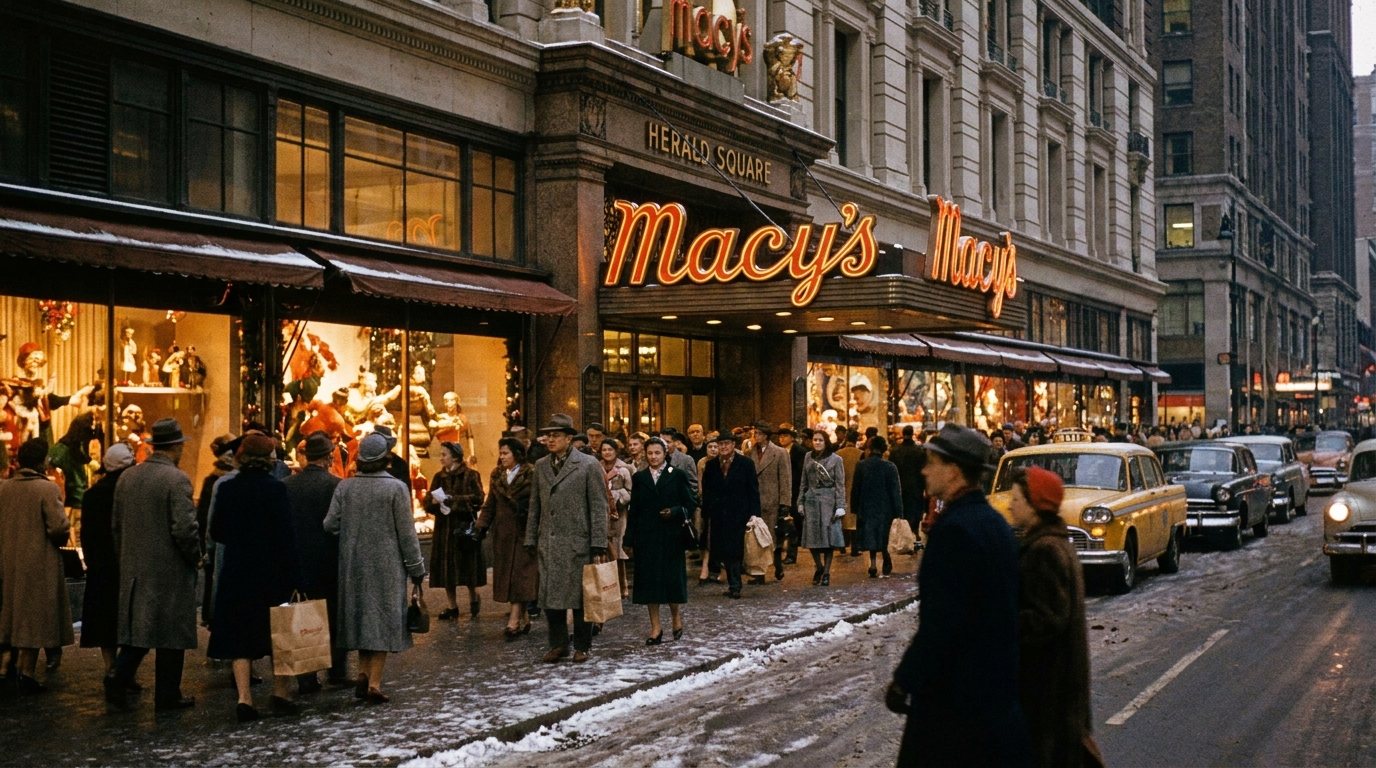
By 1902 the flagship had moved to Herald Square, eventually swallowing most of a city block, and by 1924 Macy's needed a way to keep shoppers in the store through the holiday season. Store employees, many of them recent European immigrants, marched to Herald Square that November dressed in costumes borrowed from festival traditions back home. A quarter million people showed up on the first try. Live zoo animals gave way to Tony Sarg's puppet-designed balloons in 1927, helium lifted them off the ground in 1928, and the whole affair went dark from 1942 to 1944 so the rubber and gas could go to the war effort. It came back in 1945, got a permanent boost from the 1947 film Miracle on 34th Street, and now draws crowds that make the 1933 count of one million look modest. Few retail marketing stunts have run continuously for a century; almost none of them were invented to move winter coats (Wikipedia: Macy's Thanksgiving Day Parade).
The Rollup Century
Here is the part the store's own history page tends to undersell. Macy's did not grow into a national chain by opening new Macy's stores in new cities. It grew by buying other people's department stores and, eventually, erasing their names. Bamberger's in Newark, Davison-Paxon in Atlanta, and O'Connor Moffat in San Francisco joined the fold between 1929 and 1945. Federated Department Stores, founded that same year of 1929 as a holding company for regional chains including Abraham & Straus, Filene's, and Lazarus, eventually acquired Macy's itself in 1994, after Macy's own 1992 bankruptcy following a failed leveraged buyout. Then, in 2005, Federated bought the May Department Stores Company for $11 billion and spent the next two years converting roughly 330 stores, Marshall Field's in Chicago, Filene's in Boston, Famous-Barr in St. Louis, Foley's in Houston, into stores simply called Macy's. Federated renamed itself Macy's, Inc. in 2007. The signage changed practically overnight in city after city; the shopping habits of entire regions got reassigned to a single national brand in a matter of months (Wikipedia: Macy's, Wikipedia: Macy's, Inc.).
| Year | Move |
|---|---|
| 1858 | R.H. Macy opens on Sixth Avenue after four prior failures |
| 1896 | Straus brothers take full ownership |
| 1902 | Flagship relocates to Herald Square |
| 1929 | Federated Department Stores founded; Bamberger's and Davison-Paxon acquired |
| 1994 | Federated acquires Macy's out of bankruptcy |
| 2005-07 | May Company acquired; ~330 stores rebranded Macy's; company renamed Macy's, Inc. |
| 2024 | Plan announced to close 150 stores by 2026 |
When the Rollup Ran in Reverse
That is the unique observation worth naming plainly: Macy's is not really a story of one store's organic growth, it is a century-long consolidation machine that kept absorbing regional retail identities into a single nameplate, and it is now running that same machine in reverse. In February 2024 the company announced it would close roughly 150 locations, about 30 percent of its footprint, by 2026, after Arkhouse Management and Brigade Capital had spent months trying to take the whole company private for as much as $6.6 billion, an offer the board rejected as too low. The rollup that once turned Marshall Field's and Filene's into Macy's is now, under CEO Tony Spring's "Bold New Chapter" plan, shrinking the same footprint it once assembled, trading square footage for a smaller set of stores meant to carry the whole banner's weight the way the Herald Square flagship once did alone (Wikipedia: Macy's, Inc.).
The star tattoo survived a teenager's whaling voyage and four bankruptcies to become one of the most recognized marks in American retail. The chain under it has spent a hundred years proving that the real product was never a single store, it was the ability to absorb one.
This is part of an ongoing series on the companies that built American retail, told through the unglamorous infrastructure, catalogs, supply chains, stores, and data, that actually makes a name-brand nameplate mean something.