
How Mallory Safety and Supply Built a Roll-Up Without PE
Mallory Safety and Supply ranks among MDM's top safety distributors after 20 acquisitions since 2005, all funded without private equity or a stock listing.
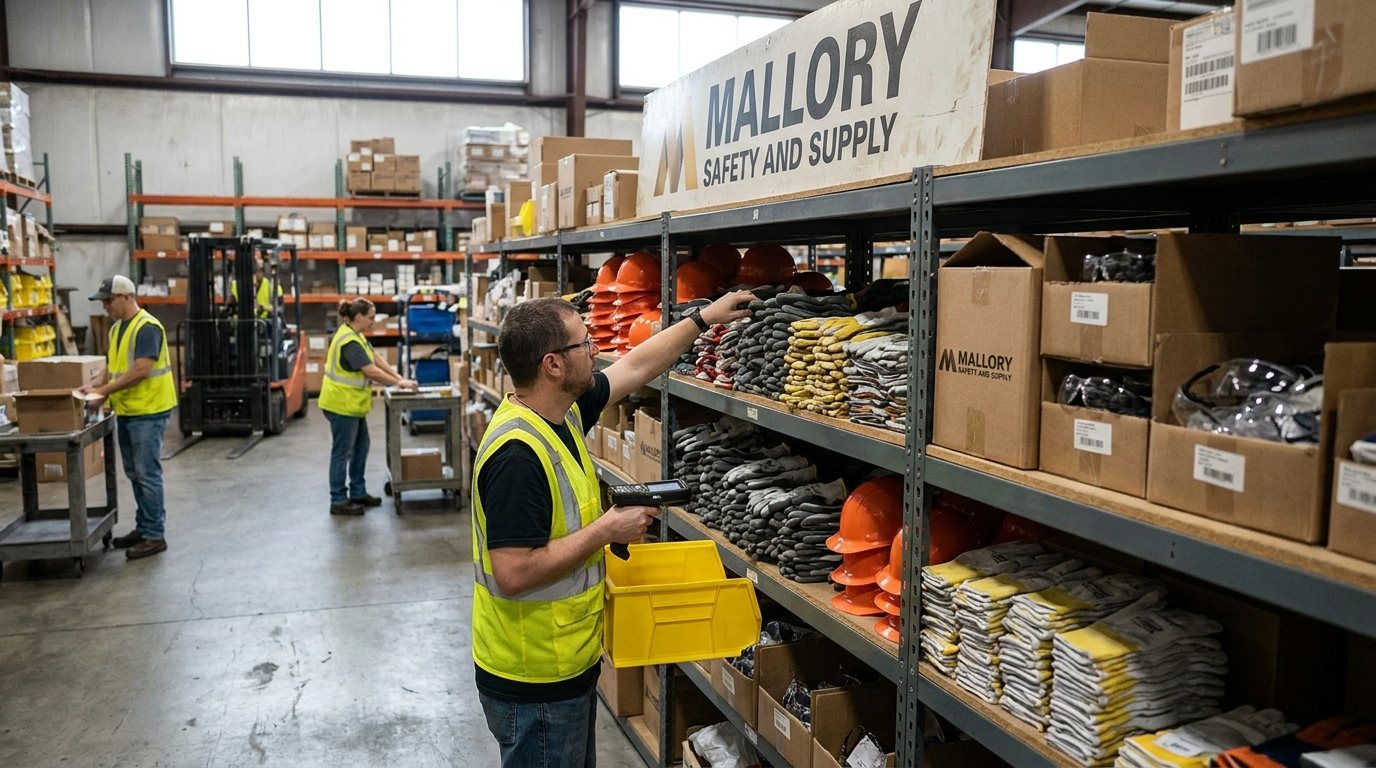
Part of Distributor Playbooks — strategy teardowns of every company on the MDM Top Distributors lists.
Mallory Safety and Supply lands at number 13 on the Safety list in Modern Distribution Management's 2026 Top Distributors report, the trade publication's annual accounting of North America's biggest distribution companies. That ranking sits a few rungs below giants like Grainger and Fastenal, which is the wrong way to read it. Mallory got there from a standing start as a Pacific Northwest logging-supply house, through roughly twenty acquisitions, without ever taking on a private equity partner or selling shares to the public. In a category increasingly rolled up by outside capital, that ownership structure is the story.
From logging blocks to OSHA
The company's own history page traces it back to the 1800s, when FB Mallory Co. sold gear out of Portland, Oregon's old Pine Street Market, and later manufactured logging blocks stamped with a diamond-M mark according to Mallory's company history. The pivot that matters came in the 1970s, when OSHA's arrival and a change of ownership to the Loy family turned a hardware supplier into a safety-focused distributor. That's the founding bet: regulation was going to create a permanent, recurring demand for compliance gear, and a regional supplier with vendor relationships was better positioned to fill it than a new entrant.
Tim Loy joined the company in 1999 and took it over from his father, Avery Loy, in the 2000s. Under his run, Mallory picked a growth model that looked nothing like its era's playbook. Instead of raising outside capital to chase national scale the way rivals did, Mallory bought other family-owned independents, one region at a time, and folded them into a shared operating system the company calls The Mallory Way.
The buy list
The acquisition record, published on Mallory's own site, is unusually candid for a private company, and it reads like a map of the safety-distribution channel's consolidation over two decades:
| Year | Acquisition |
|---|---|
| 2005 | California Safety and Cleanroom Supply |
| 2010–2014 | Safety & Supply Co., PALM Abrasive, ENSA North America, Interstate Safety & Supply |
| 2018 | Norwest Safety, Essential Safety Products, Safety West, Industrial Safety Supply |
| 2020–2022 | Wise Safety & Environmental, Safety Supply, Mesa Equipment & Supply |
| 2023–2024 | Safety Station, Rocky Mountain Industrial Supply, Cool Solutions |
The most recent additions show the pattern clearly. In November 2023 Mallory bought Safety Station in Colorado Springs along with its sister embroidery company, Ink182. Two months later it added Rocky Mountain Industrial Supply, which brought three Wyoming branches (Cheyenne, Casper, Rock Springs) plus a North Dakota sales office serving energy and mining customers, according to Distribution Strategy Group's coverage of the deal. Each deal added not just revenue but a capability: RMI came with an instrumentation and fall-protection service center and a hose-fabrication shop, the kind of local expertise that's expensive to build from scratch and cheap to acquire alongside a customer book.
By 2025, that string of deals had built a company Industrial Distribution's Big 50 report pegs at $250 million in 2024 sales, 36 locations, and 650 employees, with a top executive quote noting sales growth of 25 percent between 2021 and 2024 and a plan to keep expanding geographically, per Industrial Distribution's 2025 Big 50 rankings.
The insight: acting like a roll-up, staying like a family business
Here's the tension worth naming. Every other company that has consolidated the safety and industrial distribution channel at scale has done it with someone else's money: Grainger and Fastenal fund M&A off public balance sheets, Vallen and White Cap sit inside larger corporate parents, and a long list of regional platforms have been assembled by private equity sponsors looking for a multiple-expansion exit. Mallory has run the identical playbook, buying other regional independents on a steady annual cadence, without either of those capital sources. It stayed a Loy family company through the entire acquisition run.
That's a real trade-off, not a purely admirable one. Self-funded roll-ups grow only as fast as retained earnings and bank lines allow, which is a plausible reason Mallory's Big 50 sales growth (25 percent over three years) looks steady rather than explosive next to PE-backed peers making eight acquisitions a year. The offsetting advantage shows up in patience: Mallory can hold a marginal branch in a Wyoming energy town through a commodity downturn instead of answering to a fund's exit clock. It also explains why Mallory leans on cooperative infrastructure instead of scale alone, holding a board seat with the buying group supplyFORCE and membership in Affiliated Distributors, the mechanisms independents use to get vendor terms and technology investment they couldn't negotiate alone.
The other place that shows up is Diamond M, Mallory's private-label PPE line, which the company traces back to the diamond-and-M mark stamped on those 19th-century logging blocks. Direct-sourcing container loads of gloves and glasses under its own brand is a small-margin lever most single-region distributors can't justify, but a national footprint built from twenty acquisitions can.
None of this is guaranteed to keep working. A safety distributor competing against Grainger's $17.9 billion in scale needs either capital markets access or a very disciplined M&A engine, and Mallory has bet everything on the second option remaining viable.
This series looks at the operators who make the unglamorous plumbing of distribution, catalogs, branches, and inventory, actually work.