
Market Basket: The Grocery Chain Shoppers Fought to Save
Market Basket ranks #81 on NRF's Top 100 with $5.54B in sales. Its history: a 1917 lamb butcher shop, a family feud, and the 2014 employee uprising.
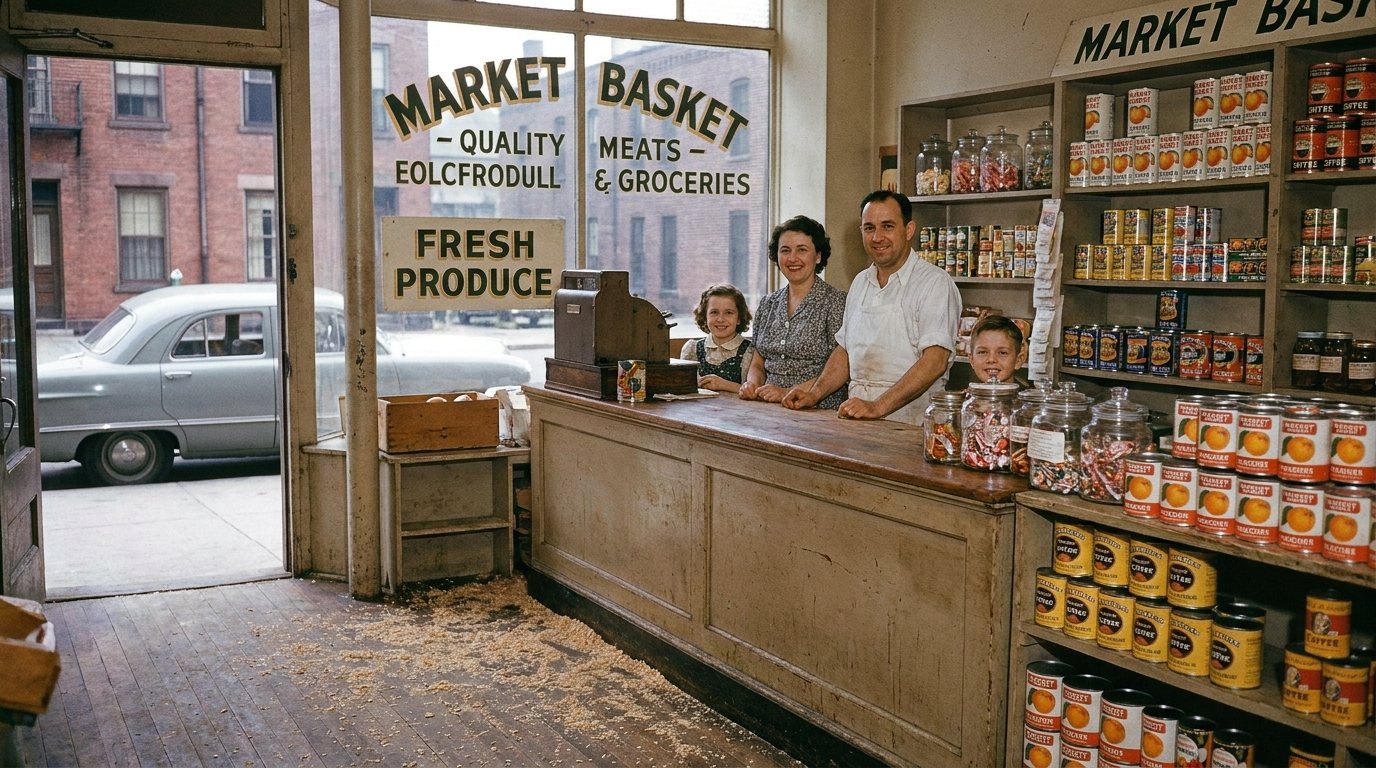
Part of Retailer Playbooks — history-first profiles of every company on the NRF Top 100 Retailers list.
Market Basket comes in at #81 on the NRF Top 100 Retailers 2026, the National Retail Federation's ranking of U.S. retailers by 2025 sales, with $5.54 billion. That number undersells the story. This is a family-owned New England grocery chain that survived a 24-year legal war between two branches of the same family, then in the summer of 2014 watched its own employees and customers shut it down rather than let a boardroom coup stand.
A Butcher Shop in the Acre
The chain traces to 1906, when Athanasios "Arthur" Demoulas landed at Ellis Island after fleeing the Greco-Turkish War and settled in Lowell, Massachusetts. He married Efrosene Soulis in 1914, and in 1917 the couple opened DeMoulas Market in Lowell's Acre neighborhood, a grocery store built around a slaughterhouse for fresh lamb, a specialty that served the city's Greek and immigrant mill-worker population, according to Wikipedia's history of the Demoulas family.
The Depression nearly ended it. The family extended credit to customers who could not pay, a decision that cost them in the short run and bought them a loyal customer base that outlasted the crisis, per Wikipedia's account of Market Basket. Their youngest son, Telemachus, known as Mike, left school to work the store full time and helped keep it out of foreclosure.
Two Brothers, One Chain
In 1954, Athanasios and Efrosene sold the market to two of their sons, Mike and George, for fifteen thousand dollars. The brothers rebuilt it into a modern supermarket operation. Within fifteen years they had grown from a single store to fifteen, and annual sales climbed from roughly two thousand dollars to nine hundred thousand by the mid-1950s. George died in 1971, and Mike carried the chain forward alone, expanding it to 57 stores under the Demoulas and Market Basket banners by the late 1990s.
That growth is also where the trouble started.
The Feud
In 1990, George's widow and children sued Mike, alleging he had bought out their shares in the company for a fraction of their worth without their full knowledge. A jury agreed. It awarded George's branch of the family roughly $206 million and restored their 50.5 percent ownership stake, splitting control of the chain almost evenly between two sides of the same family who by then barely spoke. Further lawsuits over the following decade added accusations of wiretapping and mismanaged pension funds, though courts found little wrongdoing beyond the original share dispute.
By 2002, Mike's son Arthur T. Demoulas had assembled a board majority. He became CEO in 2008 and ran the company on a simple, expensive premise: pay workers well, price groceries low, carry no long-term debt, and let profit-sharing do the work that a stock price does at public grocers. Sales grew from roughly $3 billion to $4 billion under his tenure, and the workforce grew from about 14,000 to 25,000.
The Summer the Shelves Went Empty
On June 23, 2014, the board, still controlled by the George Demoulas branch of the family, fired Arthur T. along with two of his top lieutenants. What followed had no real precedent in American retail. There was no union involved. Warehouse workers simply stopped making deliveries. Store managers and department heads signed open letters demanding Arthur T.'s reinstatement. Customers, who owed the company nothing, stopped shopping at Market Basket entirely and told reporters they were doing it out of loyalty to a CEO they had never met.
By mid-July, rallies outside the Tewksbury warehouse and the Chelsea flagship store drew crowds in the thousands. Shelves sat empty for weeks in stores that normally moved fresh produce daily. The company that prided itself on low prices and full aisles was, for the first time, visibly failing at both, and its own workforce was the reason.
On August 22, Arthur T. offered $1.5 billion to buy out the opposing family faction's 50.5 percent stake, financing reportedly arranged with backing from The Blackstone Group. The deal closed that December, and Arthur T. returned as CEO of a company he now controlled outright.
The Insight Underneath the Story
The 2014 uprising is usually told as a morality tale about a boss workers loved. The more useful reading, for anyone who runs a retail business, is structural. Market Basket could pay above-market wages and hold prices below competitors because the ownership fight had, almost by accident, kept the company private, debt-averse, and free of the shareholder pressure that pushes public grocers toward self-checkout lanes and thinner staffing. That structure was the product of decades of family litigation nobody would have called a strength while it was happening. It became one anyway, and it is the reason the workforce had something worth walking out to protect.
Today Market Basket runs roughly 90 stores across Massachusetts, New Hampshire, Maine, and Rhode Island, still without self-checkout, without a loyalty card, and still privately held by the Demoulas family, per the company's own site. Leadership questions within the family have resurfaced in the years since, a reminder that the arrangement which built the chain's loyalty has never fully stopped being contested.
Behind every full shelf and every low price tag sits a supply chain, a distribution warehouse, and a set of decisions about who gets paid what and who gets to make that call. Market Basket's story is what happens when the people running those decisions and the people stocking the shelves decide they are on the same side.