
How Matheson Gave Up Its Own Name After 99 Years
Matheson lands on MDM's 2026 welding-gas list, but the deeper story is a 1927 US gas pioneer folding its name into a Japanese parent this year.
Part of Distributor Playbooks — strategy teardowns of every company on the MDM Top Distributors lists.
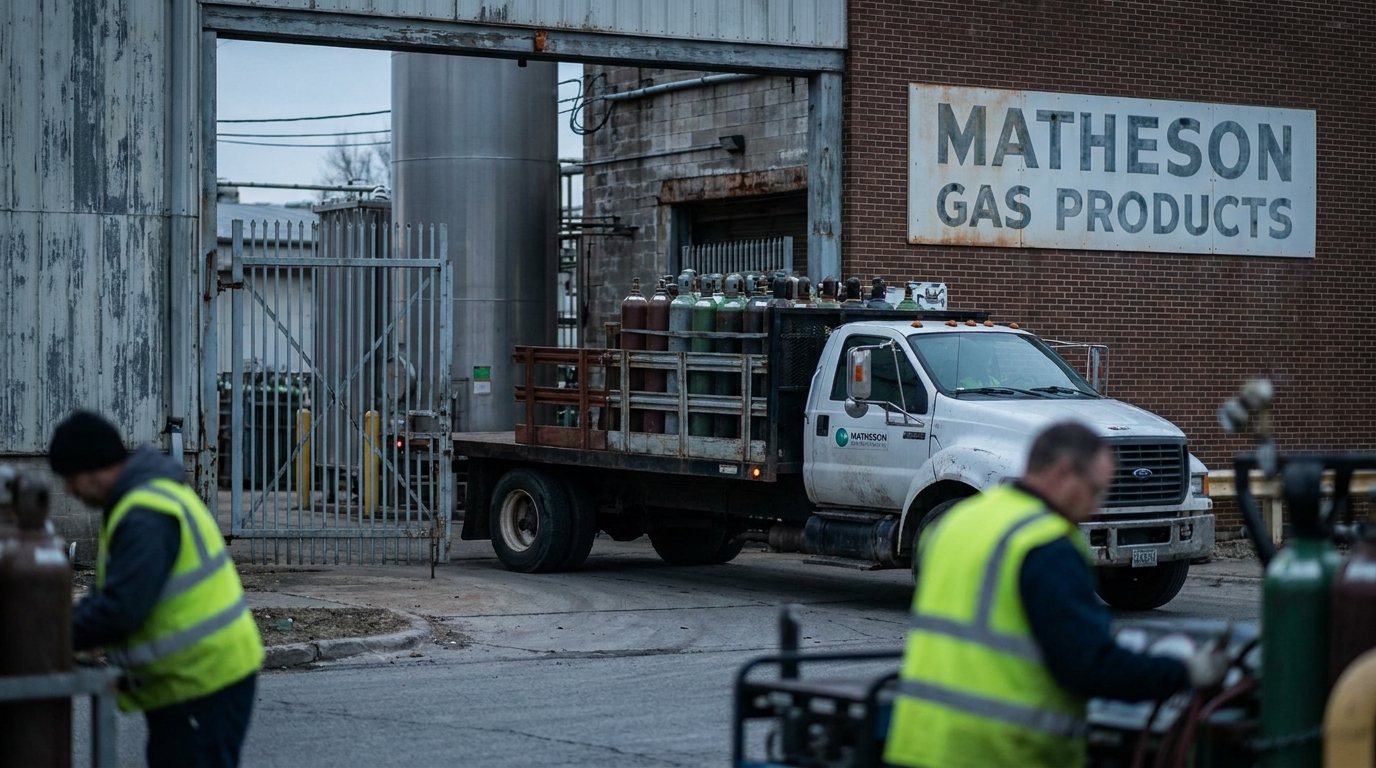
Matheson shows up on Modern Distribution Management's 2026 Top Distributors list under Gases & Welding Supplies, one of the oldest names in American industrial gas still moving cylinders to welding shops and fab floors. What the ranking does not show is that the company on the list this year is not quite the company that built the reputation. Sometime in the past year, the century-old Matheson brand quietly gave way to a new one on its own website: Nippon Sanso Matheson. That handoff, more than any single branch count, is the story worth understanding.
A century as an independent name
Adam Matheson founded Matheson Gas Products in 1927 in North Bergen, New Jersey, building what became known as the first reliable commercial source of high-purity scientific gases, according to the company's own history on its current site. Two years later the company introduced the lecture bottle, the small cylinder still used in chemistry labs at practically every university in the country. In 1981 Matheson became the first commercial producer of silane, a specialty gas critical to semiconductor manufacturing, and won a Semmy Award for it. For half a century the company built its identity on specialty and scientific gas chemistry, not on being a welding-counter distributor. That came later, and Wikipedia's account of the company lays out how.
The acquisition that never really ended
In 1989, Tokyo-based Nippon Sanso Corporation, itself founded in 1910, bought Matheson outright. Three years later Nippon Sanso acquired Tri-Gas of Irving, Texas, and in 1999 folded the two US operations together into Matheson Tri-Gas. The combined company rebranded simply as MATHESON in 2010, and in 2020 it was formally reorganized under Nippon Sanso Holdings Corporation, an affiliate of Mitsubishi Chemical Holdings. Every one of those moves kept the Matheson name on the door in the US even as ownership, capital, and strategy sat entirely in Tokyo. That is the pattern worth naming: Matheson has not been an independently controlled American distributor for 37 years. What changed recently is that the name finally caught up to the ownership.
| Year | Event |
|---|---|
| 1927 | Adam Matheson founds Matheson Gas Products in North Bergen, NJ |
| 1989 | Nippon Sanso Corporation acquires Matheson |
| 1999 | Merger with Tri-Gas forms Matheson Tri-Gas |
| 2010 | Rebrands as MATHESON |
| 2020 | Reorganized under Nippon Sanso Holdings |
| 2026 | Rebrands as Nippon Sanso Matheson |
Building backward into its own supply
Most companies on a distributor list buy their core product from someone upstream and compete on service, price, and delivery. Matheson does that too, but it also runs roughly forty air separation units that make the industrial gas it sells, and its newsroom notes it broke ground on a new one in Las Vegas in August 2025 to add capacity. It picked up Semi-Gas Systems in 1990 to deepen its position in electronics-grade gas, bought a HyCO syngas business in 2019, and has since signed long-term hydrogen supply contracts feeding renewable-diesel production. A welding shop ordering a cylinder of argon-CO2 blend from a Matheson branch is, in effect, buying from the same corporate system that is building hydrogen plants and semiconductor materials capacity elsewhere in the portfolio. That vertical reach, producer and distributor under one roof, is a different competitive posture than a pure-play gas reseller working thinner margins on someone else's molecules.
Buying the branch network, not just the molecule
The distribution footprint itself was assembled through steady acquisition rather than organic branch-by-branch buildout: Linweld, Polar Cryogenics, Five Star Gas and Gear, Western International Gas & Cylinders, and Continental Carbonic Products all came into the fold between 2004 and 2016, each adding retail density in a different region or specialty (dry ice, cryogenics, cylinder exchange). The result today is more than 300 locations and roughly 4,500 employees across the US, a footprint built the way a lot of gas and welding distribution gets built: buy the regional player, keep the trucks running, fold the back office in later.
The tension in dropping the name
The strategic bet embedded in the 2026 rebrand is not subtle. A century-old brand that welders, machine shops, and lab managers recognize at the counter carries real trust equity, the kind competitors spend years trying to replicate. Trading that for a single global brand aligned to a Japanese parent buys consistency across 300 subsidiaries and roughly 20,000 employees worldwide, and it signals to customers in electronics and hydrogen that they are dealing with the fourth-largest industrial gas producer on earth, not a regional cylinder supplier. It also means the next welder who calls a local branch for a tank of shielding gas is now placing that call to a company whose name has never been on an American storefront before. Whether that trade nets out well depends on how much of Matheson's welding-gas business ran on the old name's local trust versus the parent's balance sheet and supply reliability. Distributors watching this one should note that the answer will show up first in retention, not in the rebrand press.
Distribution rewards the companies willing to own the unglamorous middle of the supply chain, whether that means running your own gas plants or just keeping the branch network's data straight.