
Meijer: The Family Grocer That Invented the American Hypermarket
Meijer invented the American hypermarket in 1962, stayed private for 90 years, and built a $22.82 billion grocery-and-general-merchandise chain.
Part of Retailer Playbooks — history-first profiles of every company on the NRF Top 100 Retailers list.
Meijer sits at #21 on NRF's Top 100 Retailers 2026 list, with $22.82 billion in 2025 U.S. retail sales. It is still owned entirely by the family that founded it, which is unusual enough at that scale. What is more unusual is that the format every big-box grocer in America now runs on, one roof holding groceries and general merchandise, was built first in Grand Rapids, Michigan, by a barber who needed somewhere to put a store.
A Barbershop With a Grocery Problem
Hendrik Meijer emigrated from the Netherlands in 1907 and settled into cutting hair in Greenville, Michigan. By 1934, in the depth of the Depression, he was looking to expand his shop and couldn't find anyone willing to rent him adjacent space. So he opened a grocery store instead, stocked with $338.76 in goods bought on credit, according to FundingUniverse's company history. His 14-year-old son Frederik worked the store from the start.
That detail matters because Fred is the one who turned a barber's side hustle into a format the whole industry would eventually copy.
The Basket That Changed the Store
In 1935, Fred designed something new for the shop floor: hand-held baskets and a sign inviting customers to gather their own groceries instead of handing a list to a clerk behind the counter. Self-service sounds obvious in hindsight. In 1935 it was a genuine break from how American grocery stores operated, and it let Meijer move more customers through the store faster than competitors who still staffed a full counter service model.
The store grew on that idea. Cedar Springs got a location in 1942, Ionia in 1946, and the company opened its first Grand Rapids store in 1949, per Wikipedia's account of the company. By the late 1950s Meijer ran more than ten stores across Michigan.
Betting Against Stamps
In 1961, with trading stamps (the loyalty currency of the era, redeemable for merchandise) nearly universal among grocers, Meijer dropped them. The company chose to compete on price instead of on a rewards gimmick every rival was already running. It was a contrarian call at the time, and it previewed a pricing philosophy Meijer would return to more than once, including a second break from double coupons in 1990.
Thrifty Acres: Building the Format First
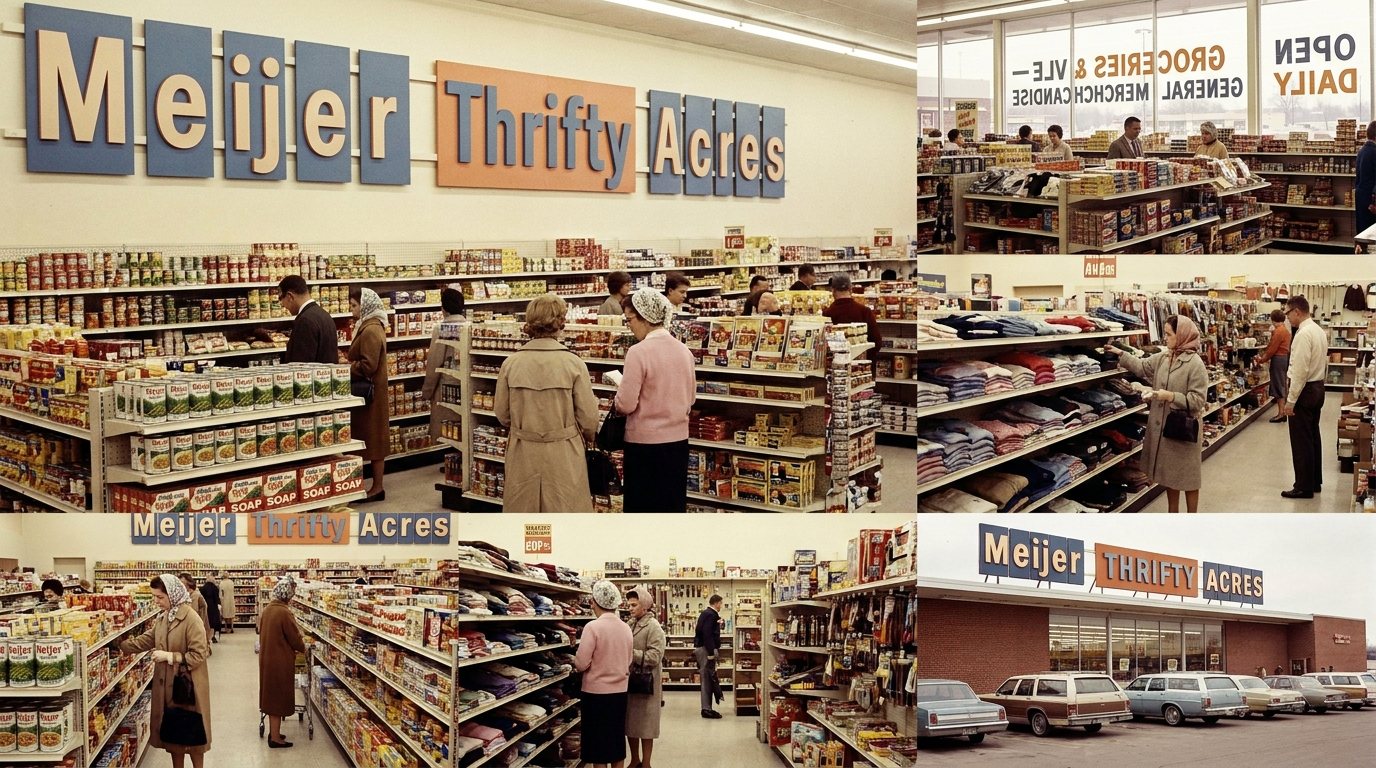
The pivotal bet came in 1962. Meijer opened Thrifty Acres at 28th Street and Kalamazoo Avenue in Grand Rapids: a 180,000-square-foot store that combined a full grocery department with general merchandise under one roof. It is widely credited as the first hypermarket in the United States.
Hendrik Meijer died in 1964 at age 57, two years after that store opened. Fred, then in his mid-40s, kept building. Thrifty Acres locations were renamed Meijer in 1986, and the company pushed further into modernizing the shopping experience: 24-hour store operations by 1988, early electronic checking technology by 1989.
This is the fact worth sitting with. Walmart didn't open its first Supercenter, its own version of groceries-plus-general-merchandise under one roof, until 1988. Meijer had been running that format for 26 years by then. The company that is now synonymous worldwide with the combined supercenter model was not the one that invented it.
Why the Inventor Stayed Regional
That gap between inventing the format and dominating it is the piece of this story that doesn't show up on Meijer's own history page. Meijer had a two-decade head start on the hypermarket and never used it to go national, go public, or franchise aggressively. Fred Meijer passed operational control to his sons Doug and Hank in 1990 but stayed chairman until his death in 2011, and the company kept expanding methodically rather than explosively: Indiana in 1994, Illinois in 1995, Kentucky in 1996, reaching $6 billion in revenue with 117 supercenters across five states by 1997, per FundingUniverse. Compare that pace to Walmart's national buildout over the same years and the contrast is stark. Meijer chose depth in the Midwest over breadth across the country, and it chose to stay private while doing it.
That's the unique insight here: the company that solved the hypermarket problem first is also the case study in choosing not to scale it the way the format's eventual winner did, and both companies were reacting to the same discovery, one just optioned it for national conquest and the other didn't.
The company kept its patient-expansion posture well past Fred's death. Wisconsin got its first stores in 2015, Michigan's Upper Peninsula in 2017, Ohio in 2019, with Pennsylvania entry planned as of 2025, according to Wikipedia. Today Meijer operates roughly 259 supercenters plus smaller-format stores, employs about 70,000 people, and remains 100 percent owned by the Meijer family, now into a fourth generation of leadership. Fred Meijer's grandson Peter Meijer would go on to represent Michigan's 3rd congressional district, a footnote to a family whose fortune was built one grocery aisle at a time, as detailed on Wikipedia's page for Frederik Meijer.
Ninety-one years after a barber ran out of room to expand his shop, the company still runs on the same instinct that built it: solve the format problem first, and let the growth follow at its own pace rather than someone else's.
Every era of American retail runs on the unglamorous machinery behind the storefront, whether that's a basket of self-served groceries in 1935 or a supply chain feeding 259 supercenters today. This profile is part of an ongoing series on the companies that built that machinery.