
How Motion & Flow Control Products Wins by Betting on One Brand
MFCP ranks #6 in MDM's 2026 Hose list. Its edge: becoming Parker Hannifin's largest US distributor by depth on one brand, not breadth across many.
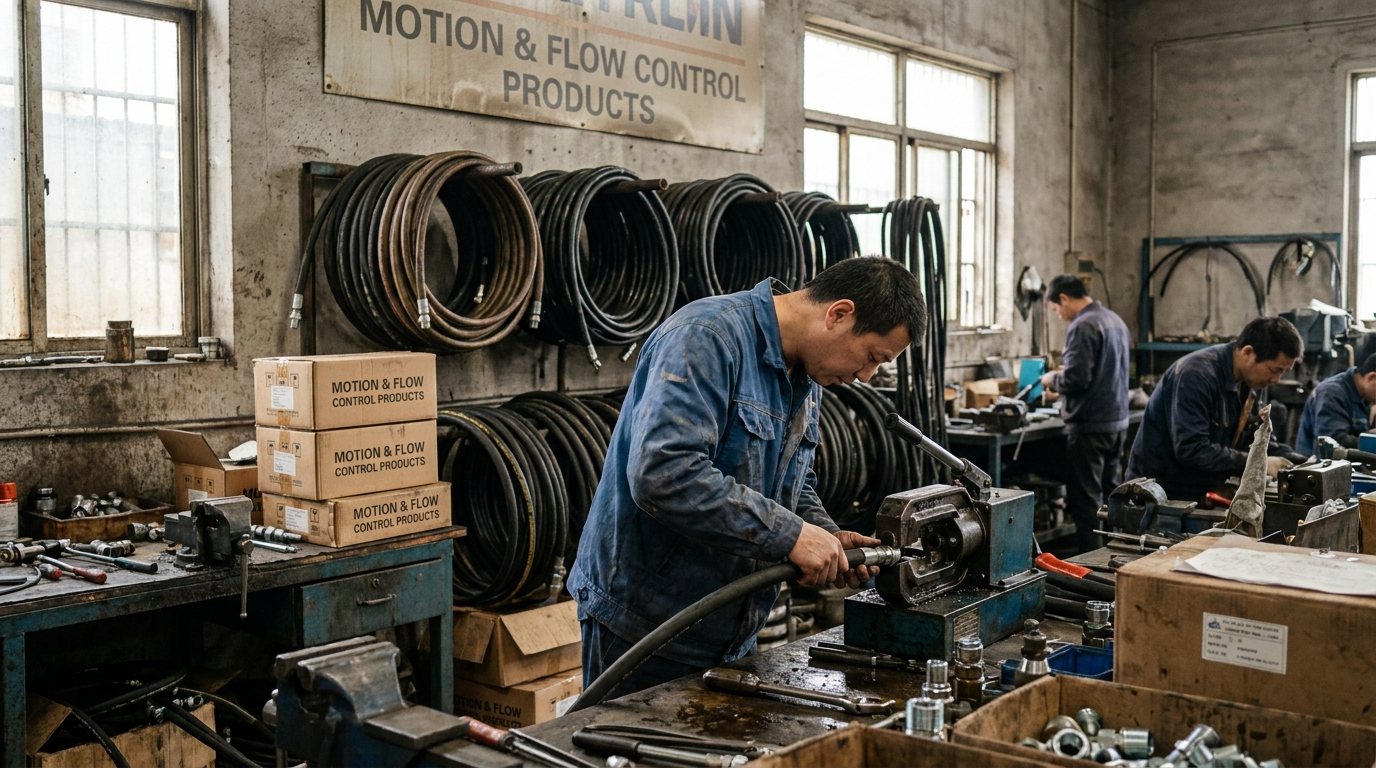
Part of Distributor Playbooks — strategy teardowns of every company on the MDM Top Distributors lists.
Motion & Flow Control Products shows up once on Modern Distribution Management's 2026 Top Distributors list: #6 in Hose, on an estimated $272 million in FY2025 revenue. It also charted at #49 in Industrial Supply on MDM's 2025 list; it no longer appears on that list in 2026. Most distributors that size chase scale by adding brands. MFCP did the opposite, and it is worth understanding why that worked.
The bet: one manufacturer, not ten
Walk into most independent fluid power distributors and you will find a case full of competing hydraulic fitting brands, a sales team trained to cross-sell whichever one is in stock, and a pitch built around choice. MFCP built its branch network almost entirely around a single manufacturer relationship: Parker Hannifin. Its stores operate as certified ParkerStore Hose Centers, and by its own count and that of peers in the channel, MFCP has become Parker Hannifin's largest independent distributor in the United States.
That is the non-obvious part of this story. Distribution scale usually comes from breadth: more brands, more categories, more reasons for a customer to call one number. MFCP scaled by narrowing to the opposite strategy: go deep enough on one manufacturer's product line and service standard that the brand's engineering, training, and OEM relationships become the distributor's own moat. A customer who wants genuine Parker parts, Parker-certified hose assembly, and Parker's field engineering support has fewer places to go, and MFCP made itself the obvious one across more than 50 branches in 11 western states, from Washington and Montana down through Arizona and Nevada.
Built by merger, not by founding
MFCP's own founding story is really two founding stories. Trace the corporate lineage back far enough and you land on McCoy Sales Corporation, a fluid-power distributor with roots dating to 1960 in Colorado. The company as it exists today, though, was created in 2011 when McCoy Sales merged with Fluid Connector Products, Inc., combining two regional Parker distributors into one western operator large enough to matter nationally. Colville Group had already been backing the business since 2006, and that continuity is unusual: this is a distributor that has been under the same sponsor's involvement, in one form or another, for close to two decades, through a merger, a change of majority owner, and a growth recapitalization, without the business ever being flipped to a strategic buyer or taken public.
| Year | Event |
|---|---|
| 1960 | McCoy Sales Corporation founded in Colorado |
| 2006 | Colville Group begins backing McCoy Sales |
| 2011 | McCoy Sales merges with Fluid Connector Products, Inc. to form MFCP |
| 2019 | PNC Erieview Capital, Colville Group, and Stonehenge Partners acquire MFCP |
| 2020 | MFCP acquires Controlled Motion Solutions (COMOSO), adding 11 Southwest branches |
| 2024 | MFCP divests 3 Northern Plains ParkerStores to MCE; Stonehenge and Colville complete a new growth investment |
| 2025 | MDM ranks MFCP #49 in Industrial Supply, #6 in Hose |
| 2026 | MDM ranks MFCP #6 in Hose; no longer on the Industrial Supply list |
The 2020 acquisition that mattered more than its size
The COMOSO deal is a small transaction by dollar value but a good window into how MFCP thinks about growth. Controlled Motion Solutions wasn't a generic branch-count add. It was, in Parker's own channel, the largest "tri-technology" distributor in the Southwest, meaning it had technical depth across hydraulics, pneumatics, and sealing rather than just inventory. MFCP CEO Ross Surratt framed the acquisition around capability, not footprint: COMOSO brought "superior technical capabilities," and COMOSO's own CEO framed the deal the same way, as extending technical expertise rather than just adding stores. Nine California locations plus one each in Arizona and Nevada came with it. The lesson generalizes: MFCP's M&A screen looks for engineering and repair capability first, geography second.
Pruning as strategy, not retreat
The more interesting move came in October 2024, when MFCP sold three ParkerStore locations, in Williston, North Dakota, Sioux Falls, South Dakota, and Sidney, Montana, to Motion & Control Enterprises (MCE). On paper this looks like contraction. In context it reads as discipline. Those three branches sat in the Bakken oil corridor, a geography adjacent to but distinct from MFCP's core western footprint, and MCE wanted exactly that corridor to strengthen its own Parker Truck Hydraulics presence. MFCP had added 18 new brick-and-mortar locations in the three years before that divestiture. A distributor growing that fast usually keeps everything it touches; MFCP traded three branches for a cleaner map instead. Roll-up-era distributors are rarely willing to shed anything voluntarily, because branch count is the metric everyone tracks. MFCP treated fit as more important than the number.
What the fresh capital signals
Two months after that divestiture, Stonehenge Partners and Colville Group closed a new growth investment in MFCP, described explicitly as capital to accelerate expansion rather than a change of control. Coming right after a deliberate trim, the sequencing suggests a company that knows exactly which parts of its map it wants to be biggest in, and is now funded to go get them. For a distributor whose core strategic choice is depth on one manufacturer over breadth across many, that kind of precision, prune here, invest there, is the more defensible version of growth than simply adding square footage everywhere it can.
Distribution rankings measure revenue and rank, but the businesses behind them are won branch by branch, catalog by catalog, and relationship by relationship. This series exists to study how.