
How Murphy USA Turned Walmart Parking Lots Into a Fuel Empire
Murphy USA ranks #96 on NRF's 2026 Top 100 Retailers with $4.34B in sales. Here's how a lumberman's oil bet became a stripped-down fuel-retail machine.
Part of Retailer Playbooks — history-first profiles of every company on the NRF Top 100 Retailers list.
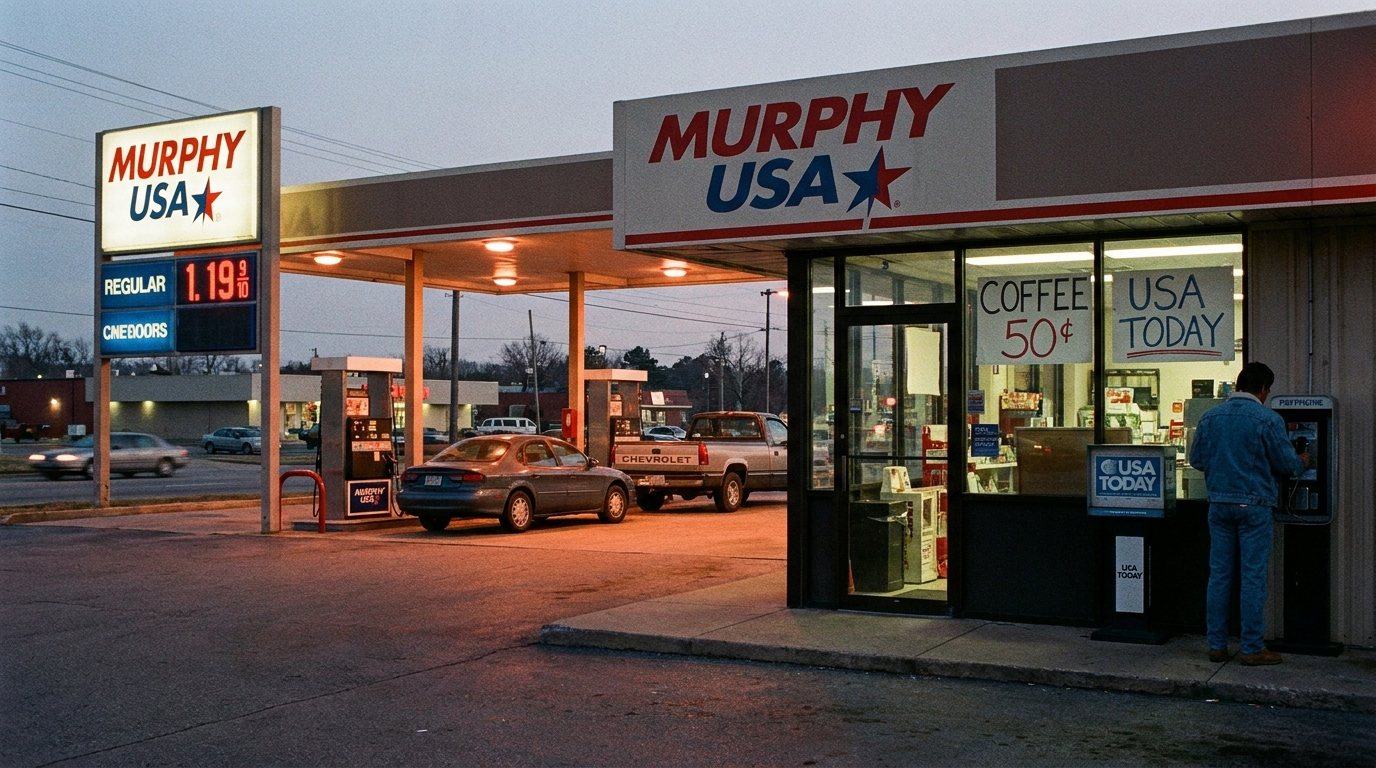
Murphy USA lands at #96 on NRF's Top 100 Retailers 2026, the National Retail Federation's annual ranking compiled with Kantar, with $4.34 billion in 2025 U.S. retail sales. It is one of the strangest success stories in that list: a fuel retailer built by an oil exploration company, refined into a business that sells gas cheaper than almost anyone else in America, on some of the smallest real-estate footprints in retail.
An oil fortune built on a lumberman's hunch
The company's roots trace to Charles H. Murphy, Sr., who ran a lumber business in El Dorado, Arkansas in the early 1900s and controlled thousands of acres along the Arkansas-Louisiana border. He drilled his first well in 1907, but the real break came decades later. In 1936 and 1937, Murphy and his associates found major oil fields in southern Texas and Arkansas, and in 1944 they hit their biggest deposit yet near Delhi, Louisiana, according to FundingUniverse's history of Murphy Oil Corporation. That discovery gave the family enterprise the scale to consolidate as C.H. Murphy & Company.
When the elder Murphy fell ill, his son Charles H. Murphy, Jr. took over and made the call that mattered most for everything that followed: an oil business this size needed a corporate structure, not a family partnership. He reincorporated it as Murphy Corporation in 1950, and the company listed on the New York Stock Exchange in 1956, two years after his father's death. Through the late 1950s and 1960s, Murphy Jr. built an integrated oil company, adding refineries in Superior, Wisconsin (1958) and Meraux, Louisiana (1961). In 1960 the company bought Spur Oil Co. and its network of branded service stations. By 1969, the Spur system spanned 942 company-run stations plus 1,332 more operated by others internationally, per FundingUniverse.
The Walmart bet nobody else wanted to make
Spur gave Murphy decades of retail-fuel experience, but the pivotal move came in the mid-1990s, when the company started putting small gas stations directly into Walmart Supercenter parking lots. It was a low-cost, high-volume bet: instead of building a full convenience store on an expensive standalone lot, Murphy would drop a compact kiosk at the edge of a parking lot already full of shoppers Walmart had spent its own marketing dollars to attract. By 1999 the partnership had grown to 145 stations, according to FundingUniverse, and Murphy kept expanding it inside a wholly owned subsidiary founded in 1996 and named Murphy USA.
The model worked because it inverted the usual convenience-store math. A typical gas station-plus-store spends heavily on the building and the merchandise mix, then prices fuel to protect margin. Murphy USA spent as little as possible on the box, often little more than a kiosk and pumps, and used the savings to run gas prices lower than nearby competitors. Cheap gas pulled cars in; a narrow slice of high-margin items, cigarettes, snacks, lottery tickets, made the visit profitable. Site costs stayed low because Walmart had already done the hard work of picking the real estate and generating the traffic.
Cut loose in 2013, and it worked
By the 2010s, Murphy USA's retail-fuel business sat inside Murphy Oil Corporation as a low-margin, low-growth segment attached to an oil exploration and production company that investors valued on entirely different terms. In August 2013, Murphy Oil spun Murphy USA off as a fully independent public company, distributing 100 percent of its shares to Murphy Oil shareholders, per Wikipedia's entry on Murphy Oil. The parent kept its exploration and production assets across the U.S., Canada, Australia, Brazil, Brunei, Mexico, and Vietnam. Murphy USA kept the pumps, the kiosks, and the Walmart lots, and started trading on the NYSE under the ticker MUSA.
Freed from a conglomerate discount, the fuel-retail business got valued on its own merits, and the market liked what it saw: a capital-light, high-volume, high-return operator that didn't need much more than a parking-lot easement and a pump island to print cash. That re-rating turned Murphy USA into one of the more closely watched spinoffs of the decade, and it's the single most useful lesson in the whole story: sometimes the fastest way to unlock value in a great operating business is simply to stop making investors value it like the business next to it.
Outgrowing the parking lot
The Walmart-lot model has limits. There are only so many Supercenter parking lots, and a kiosk with a narrow product set can't chase the higher-margin foodservice and fresh-food categories that convenience retail increasingly runs on. Murphy USA answered on two fronts. In 2016 it signed Core-Mark as its sole distributor to widen its convenience assortment, and in December 2020 it paid $645 million to acquire QuickChek, a New Jersey-based chain of larger-format stores built around made-to-order food, according to Wikipedia's Murphy USA entry. It was the company's first real step outside the kiosk-and-pump formula it had run for a quarter century.
The company has also been building standalone Murphy Express stores untethered from Walmart real estate. As of February 2024, more than 1,100 of its roughly 1,700 locations still sat near Walmart stores, but 240 or so operated as larger, independent Murphy Express sites, per Wikipedia. Headquartered in El Dorado, Arkansas, with about 15,000 employees, Murphy USA landed at #214 on the 2024 Fortune 500 and #89 on Fortune's Fastest-Growing Companies list that same year.
The insight most retail writeups skip: Murphy USA's founding advantage wasn't fuel pricing at all. It was real-estate arbitrage, borrowing Walmart's already-paid-for customer traffic instead of buying its own, and only the spinoff let the market see how much that arbitrage was actually worth.
Behind every fuel price sign and kiosk counter sits a supply chain and a product catalog that has to work at a scale most shoppers never think about. This profile is part of Anglera's Retailer Playbooks series, an ongoing look at the companies that built modern American retail.