
How Nordstrom Turned a Seattle Shoe Store Into a Retail Icon
Nordstrom ranks #33 on NRF's Top 100 with $14.90B in 2025 U.S. sales. The history behind a 1901 shoe shop that built retail's service standard.
Part of Retailer Playbooks — history-first profiles of every company on the NRF Top 100 Retailers list.
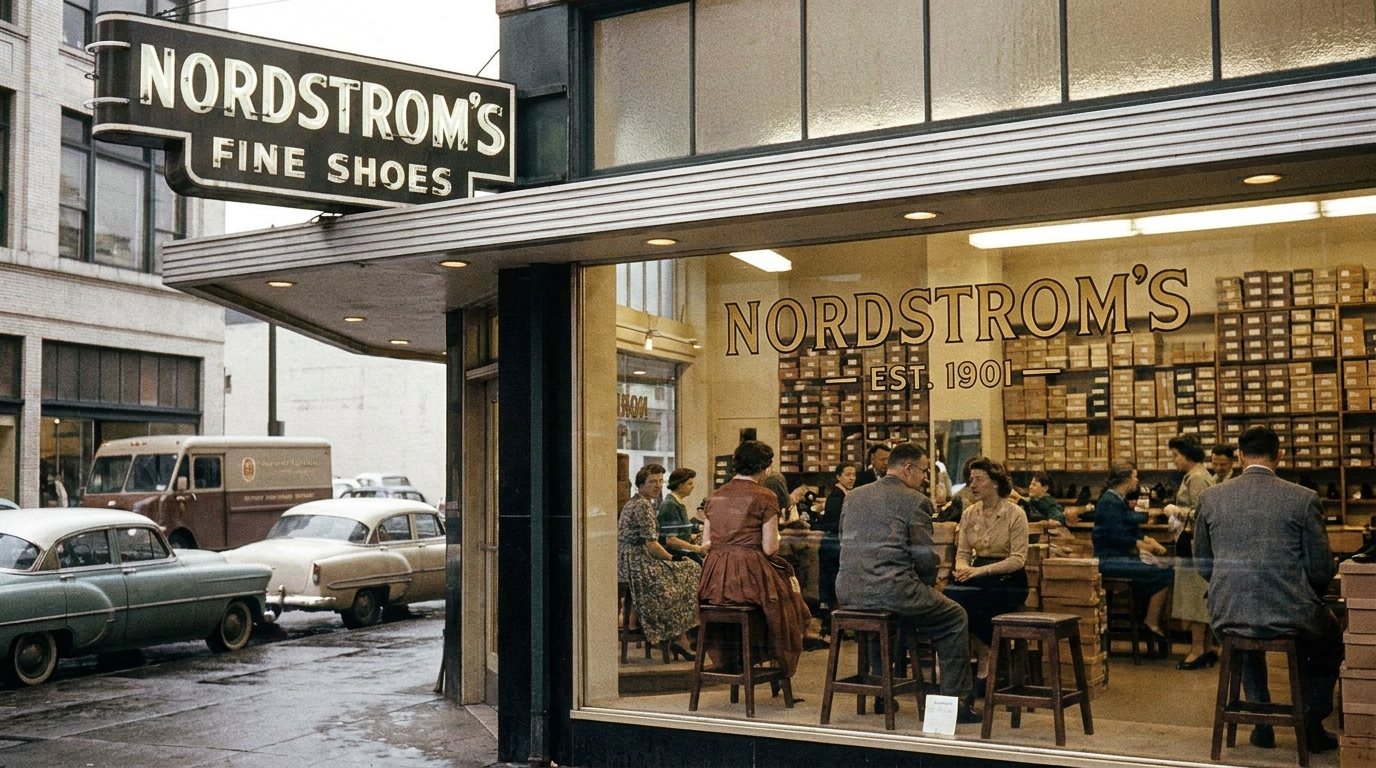
Nordstrom lands at #33 on the NRF Top 100 Retailers 2026 list, with $14.90 billion in 2025 U.S. retail sales, compiled annually by the National Retail Federation with Kantar. The company has been on that kind of list, in one form or another, for over a century, because it started as something much smaller: a single shoe store on a Seattle street corner, run by two men who had never sold apparel in their lives.
A Gold Claim Bought a Shoe Store
John W. Nordstrom left Sweden at 16 with almost nothing, arriving in the U.S. in 1887 with about $5 in his pocket. He worked logging camps and mines across the Pacific Northwest before joining the Klondike gold rush in 1897. He struck a claim, and rather than work it himself, sold his stake for $13,000, according to Wikipedia's account of the company's founding. He brought that money back to Seattle and, in 1901, went into business with a local shoemaker named Carl Wallin. Wallin & Nordstrom opened as a shoe store on Pike Street. Its first day of business rang up $12.50 in sales, per FundingUniverse's company history. Within four years, annual sales had climbed to $80,000.
The founders retired in the late 1920s and handed the business to John's sons, Everett and Elmer, who spent the next three decades doing one thing extremely well: selling shoes. By 1950, Nordstrom was the largest independent shoe chain in the country. By 1959, its Seattle flagship carried 100,000 pairs in stock, the deepest shoe inventory anywhere in the U.S., per FundingUniverse. Shoes stayed central to the identity of the company for decades after it stopped being a shoe store; even into the 1980s and 1990s, footwear still accounted for roughly a fifth of total sales.
The Pivot Nobody Saw Coming
The single decision that turned a regional shoe chain into a department store came in 1963, when the family acquired Best's Apparel, a Seattle women's clothing retailer. It was a strange move for a company whose entire identity was built around fitting feet, and it easily could have diluted a brand built on doing one narrow thing well. Instead, apparel and shoes turned out to share the same underlying skill: a salesperson kneeling down, taking a measurement, and building a relationship one customer at a time. By 1971, the year Nordstrom went public on NASDAQ, it operated as a full-line department store.
That transformation exposed something worth naming plainly, because it rarely shows up in retrospectives about Nordstrom's famous service culture: the company's legendary customer devotion was not primarily a training program or a slogan. It was a compensation structure. Nordstrom ran on commission sales from its earliest shoe-store days, and commission salespeople have every financial incentive to remember what a customer bought last time, follow up personally, and treat that customer as a long-term account rather than a transaction. Long before retailers had CRM software or loyalty databases, Nordstrom sales staff kept their own handwritten client books, called personal customers by name, and chased repeat business the way an independent insurance agent would. The famous stories, paying a customer's parking ticket, accepting a tire return at a store that never sold tires, were downstream of that incentive design, not the cause of it.
Growing Up, Then Growing Pains
Nordstrom expanded deliberately through the 1970s, 80s, and 90s: Alaska in 1975, Southern California in 1978, the Northeast by 1988, the Midwest by 1991, the Southwest by 1996, the Southeast by 1998. It launched Nordstrom Rack, its off-price division, out of a bargain basement in the downtown Seattle flagship in 1973, years before off-price became a retail category unto itself. The stock moved to the New York Stock Exchange in 1999 under the ticker JWN.
The commission model that built the company's reputation also produced its hardest chapter. In 1990, Washington State's Department of Labor and Industries found Nordstrom had systematically failed to pay employees for off-the-clock work, including tasks the commission structure implicitly demanded, like writing thank-you notes and attending sales meetings, according to FundingUniverse. The company set aside a $15 million reserve and ultimately settled class-action suits for a combined $50 million.
A decade later came a strategic misstep of a different kind. CEO John Whitacre pushed a youth-oriented merchandise overhaul under the tagline "Reinvent Yourself," alienating the core customers who had built the business. Whitacre was out by August 2000, and Bruce Nordstrom, a family member, stepped back in as chairman to steady the company. It was the clearest instance of a pattern that recurs across the company's history: professional management drifts, family stewardship corrects course.
Full Circle
That family control is now more literal than it has been in over half a century. In December 2024, the Nordstrom family announced a $6.25 billion deal to take the company private, retaining 50.1 percent ownership themselves, with the Mexican retailer El Puerto de Liverpool acquiring the remaining 49.9 percent. The stock came off the NYSE on May 20, 2025, ending a 54-year run as a public company that began the same year the family finished converting a shoe chain into a department store.
| Year | Pivotal bet |
|---|---|
| 1901 | Wallin & Nordstrom opens as a Seattle shoe store |
| 1963 | Best's Apparel acquisition begins the shift to full-line retail |
| 1971 | IPO on NASDAQ as a department store chain |
| 1973 | Nordstrom Rack launches as an off-price outlet |
| 2024 | Family and Liverpool take the company private again |
Not every retailer that leaves the public markets does so on its own terms. Nordstrom's second act as a private company started from a position most retailers would envy: a fourth generation of the founding family still running the stores, and a service model built into how salespeople get paid rather than what they're told to say.
Sources: Wikipedia, "Nordstrom"; FundingUniverse, "Nordstrom, Inc. History"; NRF Top 100 Retailers 2026.
This is one entry in an ongoing series on the companies behind American retail, the catalogs, stockrooms, and sales floors that most shopping never sees.