
Northeast Grocery: How Two Rival Grocers Became One Company
Northeast Grocery ranks #55 on NRF's Top 100 with $7.96B in sales. Here is how Price Chopper and Tops, once bitter rivals, ended up under one roof.
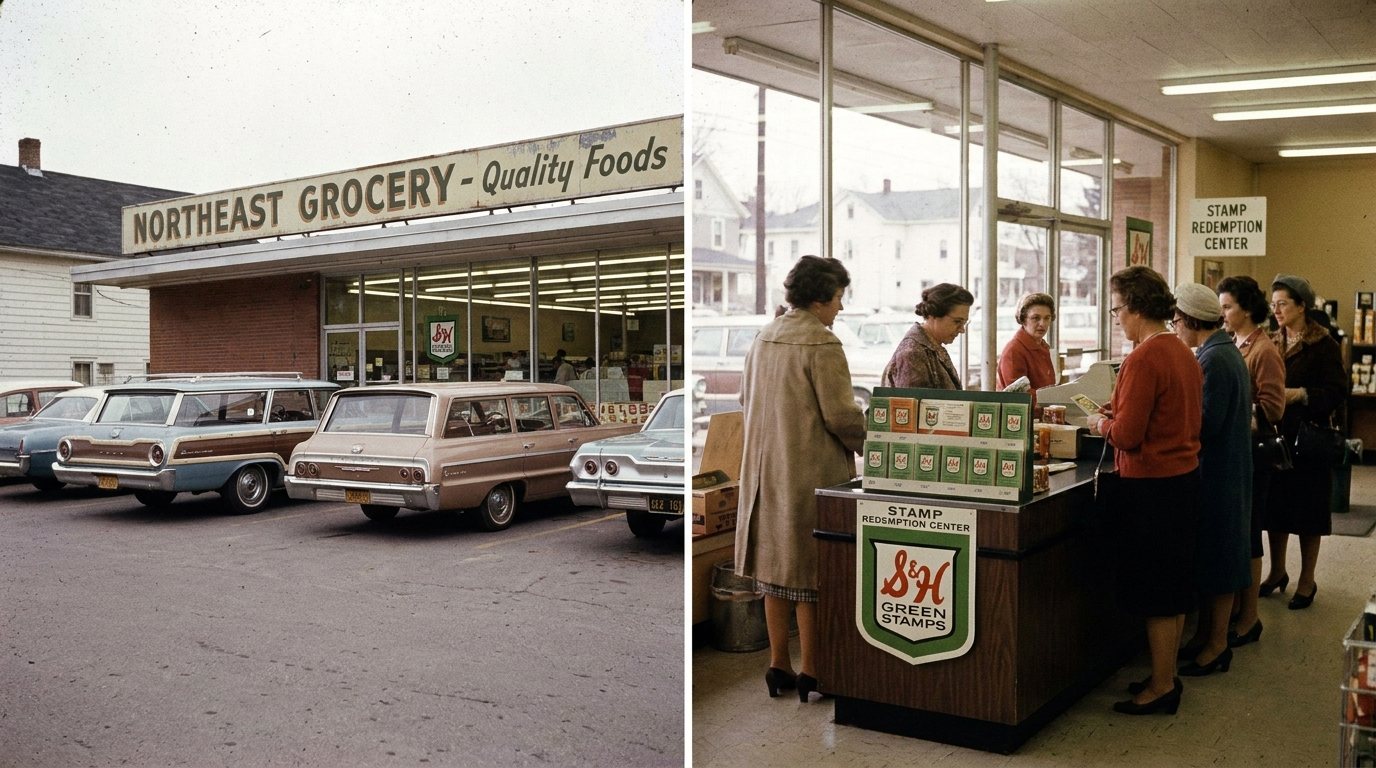
Part of Retailer Playbooks — history-first profiles of every company on the NRF Top 100 Retailers list.
Northeast Grocery lands at #55 on the NRF Top 100 Retailers 2026, the National Retail Federation's annual ranking compiled with Kantar, with $7.96 billion in 2025 U.S. retail sales. Most shoppers in upstate New York and New England have never heard the name. They know it as Price Chopper, Market 32, or Tops, three banners that spent nearly a century as competitors before a 2021 merger folded them into a single company. The story of how that happened is really two stories, and they could not be more different.
A wholesale grocer's sons learn self-service
Northeast Grocery's roots run to 1908, when Lewis Golub, a Russian immigrant, opened a wholesale grocery warehouse in Schenectady, New York. His sons William and Bernard took over after his death in 1930, and in 1932 they did something genuinely new: they opened the Public Service Market in Green Island, New York, one of the earliest self-service grocery stores in the country, letting customers pick their own goods off the shelf instead of handing a list to a clerk, per FundingUniverse's history of the Golub Corporation. The store expanded to three locations within months and was renamed Central Market.
The Golub brothers ran the business as a family enterprise for four decades, and after Bernard's death in the early 1970s the company rebranded as Price Chopper Discount Foods, built around everyday low prices and, notably, 24-hour operating hours meant to build loyalty in a crowded upstate market. By 1998 Price Chopper had grown past 100 stores across five states, generating $1.6 billion a year while staying independent through a wave of grocery consolidation that swallowed many of its regional peers.
The employee-ownership bet that avoided a labor war
The detail that rarely makes it into a company history is this: by 1998, Price Chopper's employees, called Associates, owned more than 44 percent of the company's stock. That is not a perk program. It is a structural choice that gave rank-and-file workers a direct financial stake in the chain's performance, and it appears to have paid off in an unusual way: FundingUniverse's history notes the company had no lost workdays to strikes or labor disputes going back to 1932, a stretch of labor peace almost unheard of in a unionized industry built on thin margins and hard-fought contracts. Price Chopper also built loyalty in less obvious ways, supporting 4-H youth farmers with free seeds and crop buyback programs starting in 1964, a program that reportedly helped more than 2,000 young farmers by the 1990s.
Tops: franchise roots, Ahold ownership, and a bankruptcy survived
Tops Friendly Markets started very differently. Armand Castellani and Thomas Buscaglia co-founded the chain in 1962 in Niagara Falls, opening a 25,000-square-foot store on Portage Road and growing it through franchising, per Wikipedia's history of Tops Friendly Markets. Tops went public on the American Stock Exchange in the late 1960s and expanded into Rochester and Pennsylvania, then went through a 1987 leveraged buyout that valued it at $196 million.
What followed was two decades of ownership turnover that Price Chopper never experienced. The Dutch retail giant Ahold bought Tops in 1991, when it had 145 stores, and expanded it further, but Ahold's 2003 accounting scandal forced a wave of divestitures and Tops eventually sold off its Ohio stores. Morgan Stanley Private Equity bought the chain in 2007 for $310 million and pushed further acquisitions, including 79 Penn Traffic stores in 2010. The debt load from that string of deals eventually caught up with the company: Tops filed for Chapter 11 bankruptcy in February 2018, citing $720 million in debt, and emerged nine months later after closing ten underperforming stores.
Two grocery cultures, one merger
In February 2021, Price Chopper and Tops announced they would merge, and the deal closed that November as Northeast Grocery, headquartered in Schenectady with Tops keeping its Williamsville offices, per Wikipedia's Northeast Grocery entry. The combined company operates close to 300 stores across six states under the Price Chopper, Market 32, and Tops banners, per Northeast Grocery's own site.
The merger carried a genuinely strange historical echo. The Federal Trade Commission required Northeast Grocery to divest twelve stores as a condition of approval, and most of those were sold to C&S Wholesale Grocers and reopened under the Grand Union banner, a chain Price Chopper itself had acquired locations from decades earlier during its 1990s and 2000s expansion. A brand that Price Chopper had once absorbed came back to life as the price of merging with its old rival.
Leadership also tells the story of two different companies converging. Scott Grimmett, Price Chopper's CEO, guided the initial integration before retiring in 2022. Frank Curci, the former Tops CEO, took over next. By 2024, John Persons was named president and CEO, per the same Wikipedia entry, a rotation between executives from both legacy companies rather than one side simply absorbing the other.
The unique thing to name plainly here: Northeast Grocery is not really a merger of two grocery chains so much as a merger of two opposite theories of how to survive as a regional grocer against national scale. One company bet on employee ownership and organic reinvestment for ninety years and never had a strike. The other bet on serial acquisition financed by outside capital, rode that strategy through an accounting scandal and a private-equity buyout, and survived a bankruptcy to keep growing. Both bets worked long enough that, when the math on standing alone against Walmart, Aldi, and Wegmans stopped adding up, the two survivors merged into each other rather than into a bigger predator.
Grocery history in America rarely gets told through ownership structure, but ownership structure is often the whole story: who holds the equity determines who can outlast a bad decade. Northeast Grocery's ledger books, from a Russian immigrant's wholesale warehouse to a Niagara Falls franchise store to one Schenectady headquarters, are as much a record of American retail infrastructure as its shelves are.