
O.E. Meyer: The Gas Distributor That Never Sold Out
O.E. Meyer made the 2026 MDM Top Distributors gases and welding supplies list. Its real story is the succession bet almost nobody else in the sector made.
Part of Distributor Playbooks — strategy teardowns of every company on the MDM Top Distributors lists.
O.E. Meyer Co. shows up on Modern Distribution Management's 2026 Top Distributors list in the Gases & Welding Supplies category, the annual ranking of North America's largest distributors across 20 verticals. MDM doesn't disclose the Sandusky, Ohio company's revenue, which fits: O.E. Meyer has spent more than a century operating well outside the spotlight that follows its much larger neighbors in the same aisle.
A welding shop on Lake Erie
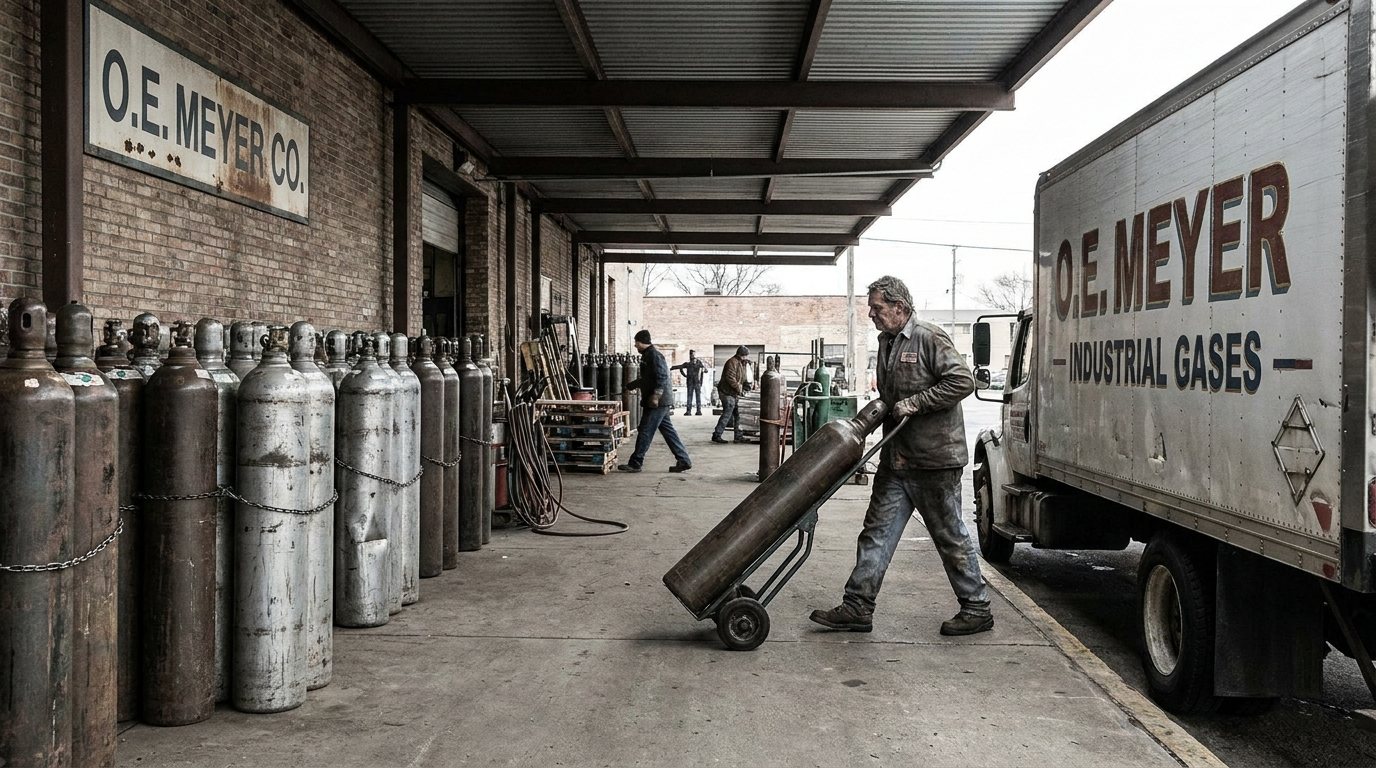
The company traces to 1918 in Sandusky, when Omar E. Meyer Sr., a former Great Lakes ship captain, went into business repairing welding equipment for the industrial operators dotting the lakeshore. According to the company's own account, the business "started as a welding shop, expanded into medical gas distribution, and has evolved to meet the expanding needs of our customers," eventually adding propane, automation and robotic welding solutions to the line card. That's the standard arc for a legacy gas distributor: acetylene and oxygen cylinders first, then the adjacent categories that share a delivery truck and a customer list.
What makes O.E. Meyer worth a closer look isn't the founding story. It's what the company did with the business once it had one worth keeping.
The vertical that consolidated around it
Industrial and specialty gas is one of the more thoroughly rolled-up corners of distribution. Airgas, once the largest independent U.S. gas distributor, sold to France's Air Liquide in 2016 for roughly $10.3 billion. Praxair merged into Linde in a $90 billion tie-up completed in 2018. Matheson Tri-Gas operates as a subsidiary of Japan's Taiyo Nippon Sanso. Regional gas houses that didn't sell to one of those three, or to a private equity roll-up chasing the same math, mostly got squeezed on cylinder pricing or bought anyway.
O.E. Meyer took a third path. The company describes itself as "100% employee-owned," a structure it has carried for decades rather than the more common private equity recapitalization or strategic sale that ends most family-owned distributor stories once the founding generation is ready to exit. An ESOP doesn't just change who holds the stock. It removes the sale as the default answer to the succession question, and it means the people loading cylinders and running delivery routes have a direct stake in whether the branch in Toledo hits its numbers this quarter. The company leans on this in its own hiring pitch, citing a "remarkably low turnover rate" and staff with long tenure and deep product knowledge, the kind of institutional memory that's genuinely hard to buy once a roll-up has flattened three regional distributors into one back office.
That's the insight worth naming plainly: in a vertical where the biggest names are French, German-merged, or Japanese-owned, one of the companies still making MDM's list is owned outright by the employees stacking the cylinders. It's an unusual answer to a question every closely held distributor eventually faces, and it's one almost none of O.E. Meyer's larger competitors chose.
Growing branch by branch, not deal by deal
The other tell is how O.E. Meyer has grown. Distribution's dominant playbook for adding scale is acquisition: buy a competitor, fold in their customer list, consolidate the back office. O.E. Meyer's footprint instead reads like organic branch-building. The company operates out of Sandusky headquarters with locations spread across northern and central Ohio, and as of this year has a Defiance, Ohio location listed as "coming soon" on its own site, a new branch opening the ordinary way rather than through a purchased book of business.
That's a slower growth model than the roll-up alternative, and it caps how fast the company can add territory. It's also a model that keeps culture and service consistency intact in a way that bolt-on acquisitions notoriously strain. For a company whose competitive pitch rests on employee tenure and "look you in the eye" account relationships, opening branches one at a time is arguably the only version of growth that doesn't undercut the thing making it competitive in the first place.
The diversification hedge
Welding gas and hardgoods are a cyclical business, tied to manufacturing capex and construction starts. O.E. Meyer's expansion into medical gas and residential/commercial propane isn't incidental. Hospitals and home heating customers don't stop ordering when a factory delays a capital project, which gives a small regional player a demand base that doesn't move in lockstep with its core welding-supply customers. It's the same logic the majors use at far larger scale, applied by a 130-employee company that can't spread risk across a continent, so it spreads it across categories instead.
What the industry can take from it
O.E. Meyer's placement on MDM's list sits next to companies backed by multinational parent corporations and private equity sponsors. Its answer to the same competitive pressure was to keep the equity with the people doing the work and grow the map one branch at a time. Neither choice is obviously right, but it's a live demonstration that the roll-up isn't the only route to relevance in a consolidating vertical, just the more common one.
This series looks at how the distributors on MDM's lists actually built what they run, one branch, one truck route, one catalog line at a time.