
Overstock.com: How a Liquidation Site Became a Brand Rescuer
Overstock.com is #88 on the NRF Top 100 with $4.76B in 2025 U.S. sales. Here's how a dot-com bust liquidator became a serial brand-revival machine.
Part of Retailer Playbooks — history-first profiles of every company on the NRF Top 100 Retailers list.
Overstock.com ranks #88 on the NRF Top 100 Retailers 2026, the National Retail Federation's annual sales ranking compiled with Kantar, with $4.76 billion in 2025 U.S. retail sales. The name still evokes a website selling closeout furniture and rugs. The company behind it has spent the last three years doing something almost no retailer attempts: buying the corpses of its dead competitors and bringing them back to life.
Born from a graveyard of dot-coms
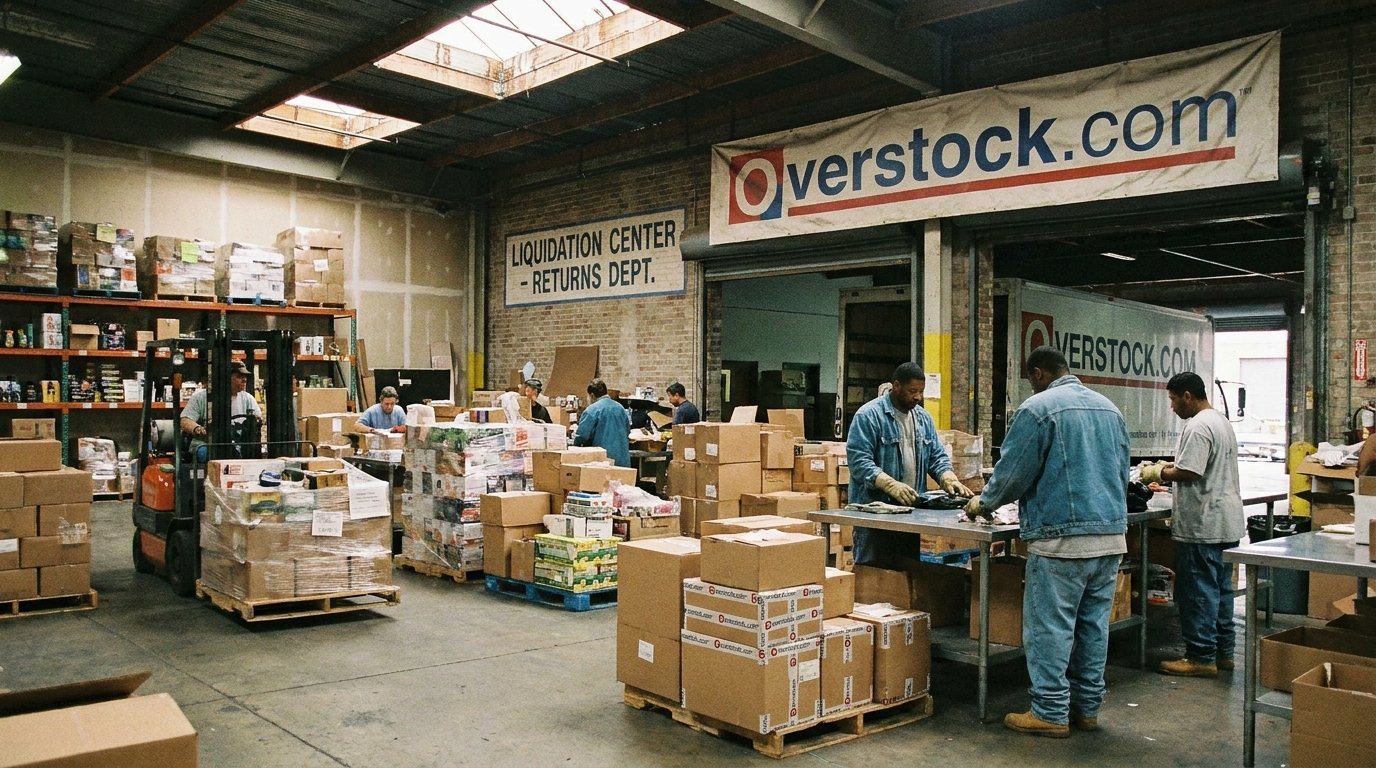
The company started in 1997 as D2: Discounts Direct, a small online furniture liquidator founded by Robert Brazell. It went bankrupt within two years, which is how Patrick M. Byrne, a Stanford-trained philosopher and son of former GEICO chairman John J. Byrne, ended up owning it. Byrne put in $7 million for a 60 percent stake in 1999, took the CEO chair, and renamed the operation Overstock.com.
The timing was accidental genius. The dot-com crash was littering the internet with dead startups that had warehouses full of unsold inventory and no buyers. Overstock became the liquidator of last resort, clearing out the merchandise of at least 18 failed dot-coms at below-wholesale prices. It was a business built entirely on other companies' failures, which makes its own eventual habit of buying failed retailers' assets feel less like a pivot and more like a return to first principles.
The growth years, and the odd bets
Overstock went public in May 2002 at $13 a share, using a Dutch auction IPO structure that let the company keep more of the proceeds instead of handing a bigger cut to underwriters. It crossed $1 billion in annual revenue for the first time in 2010. Along the way it launched a division called Worldstock in 2001 to sell handmade goods from artisans in developing countries, ran online auctions from 2004 to 2011, and in 2014 became the first major retailer to accept bitcoin, ringing up more than $126,000 in bitcoin sales on day one.
Not every bet landed. A 2011 attempt to rebrand as O.co was reversed within two years after it confused customers who had spent a decade learning the Overstock name. The company also tried and abandoned ventures in cars, travel, and real estate listings, none of which stuck the way the core liquidation business did.
The fight that defined an era
Starting in 2005, Byrne turned Overstock into the public face of a years-long legal war against what he called naked short selling, the practice of selling borrowed shares that were never actually delivered. He sued Wall Street research firms and hedge funds, drawing settlements that ran into the tens of millions of dollars over the following decade. It consumed enormous amounts of management attention and press coverage for a company that, in the same years, was also fighting to turn a reliable profit. Whatever the merits of the underlying claims, the episode is a reminder that a founder's personal crusades and a company's operating results can occupy the same headline for a very long time, whether or not that serves either one.
Byrne stepped down as CEO in August 2019 after twenty years running the company, and Jonathan Johnson took over. The handoff mattered more than it looked like at the time: it cleared the way for a much stranger second act.
Buying the competition, literally
In June 2023, Bed Bath & Beyond liquidated in bankruptcy, and Overstock won the auction for its intellectual property, brand name, and customer data for $21.5 million. Overstock didn't just license the name. It closed its own storefront, migrated its e-commerce operation onto the Bed Bath & Beyond nameplate on August 1, 2023, and in November renamed the parent corporation itself to Beyond, Inc., moving its stock listing to the NYSE. For a stretch, the company that started as a liquidation website had effectively erased its own name from the market.
That didn't last. In March 2024, Beyond relaunched Overstock.com as a separate, standalone brand again, positioned toward a different, higher-spending shopper than the value-focused Bed Bath & Beyond banner. The company had gone from being the buyer of dead brands' inventory to being the buyer of dead brands' identities, running both simultaneously as distinct storefronts under one roof.
It didn't stop at one acquisition. In 2025, Beyond bought the Kirkland's home-goods chain and began converting stores to the Bed Bath & Beyond banner, opening its first physical location in decades that August in Nashville, with plans for roughly 300 stores. In April 2026, the company agreed to acquire The Container Store for $150 million, with plans to rebrand many of its locations as Bed Bath & Beyond storefronts.
| Year | Move |
|---|---|
| 1999 | Patrick Byrne buys bankrupt D2, renames it Overstock.com |
| 2002 | IPO via Dutch auction |
| 2010 | First $1 billion revenue year |
| 2019 | Byrne resigns; Jonathan Johnson becomes CEO |
| 2023 | Buys Bed Bath & Beyond IP out of bankruptcy; renames parent Beyond, Inc. |
| 2024 | Relaunches Overstock.com as a separate brand |
| 2025 | Acquires Kirkland's; opens first physical stores |
| 2026 | Agrees to acquire The Container Store |
The insight most retail histories miss
Read the press releases and it looks like a company chasing brand names. Look at the balance sheet logic and something sharper emerges: Beyond, Inc. has built a repeatable playbook for acquiring distressed retail brands cheaply out of bankruptcy, stripping them down to intellectual property and customer lists, and redeploying that equity across a shared physical and digital footprint it already owns. Overstock.com, the company that gave its name to an entire retail category, is now the smallest and least strategically important of the three storefronts it operates. The liquidator became the thing it used to liquidate from, and turned that into the whole business model.
Every retailer on this list is, at bottom, a bet on what to do with things nobody else wants anymore, whether that's excess inventory, empty store leases, or a brand name nobody thought was worth saving.
Sources: Beyond, Inc. — Wikipedia, Patrick M. Byrne — Wikipedia, Marcus Lemonis — Wikipedia, NRF Top 100 Retailers 2026