
How Piedmont Plastics Keeps Finding New Markets for Old Plastic
Piedmont Plastics made the 2026 MDM Top Distributors Plastics list. Its real edge: selling the same sheet, rod, and film into whatever market booms next.
Part of Distributor Playbooks — strategy teardowns of every company on the MDM Top Distributors lists.
Piedmont Plastics started in 1968 with one branch in Charlotte, North Carolina, and five employees. Fifty-seven years later it has 55-plus branches across the United States and Canada and a spot in the Plastics category of Modern Distribution Management's 2026 Top Distributors list, the industry's annual accounting of North America's largest wholesale distributors. MDM's Plastics list is one of the shorter ones in the report, which tells you something about how consolidated performance-plastics distribution already is, and how long Piedmont has been in the room.
The product line hasn't changed. The customers keep changing.
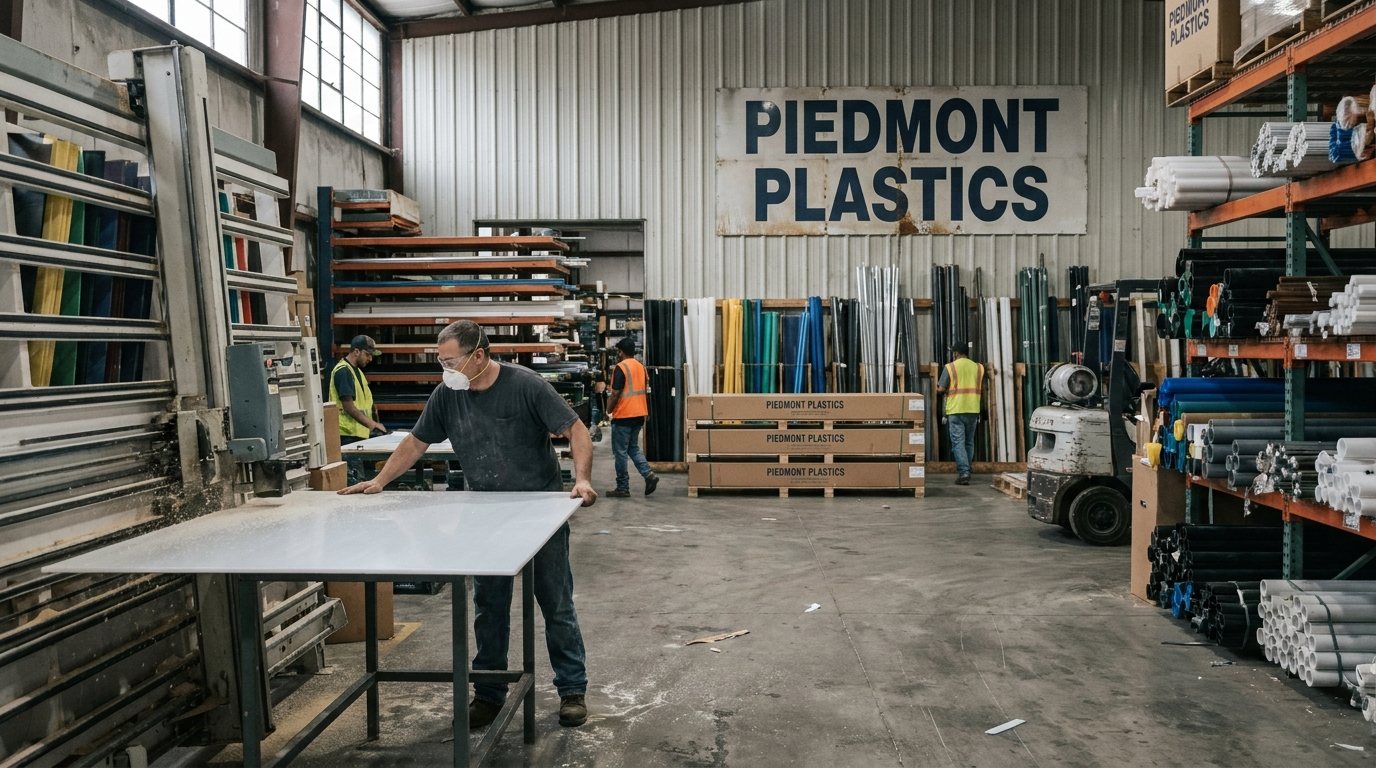
Cut a sheet of acrylic, a rod of PVC, a length of polycarbonate tube, and you have most of what Piedmont sells. These are commodity substrates, available from dozens of mills and a long list of competing distributors. What Piedmont has done since 1968 is refuse to let that commodity status define the business. Instead of adding new product lines, it keeps finding new industries willing to pay for the same handful of materials, cut, fabricated, and delivered on short notice.
The current company line is that it serves more than 75 commercial and industrial industries out of its branch network, a figure the company cited when it opened its 58th North American branch in San Antonio in October 2024. That is not a rounding-error claim. In 2025 and 2026 alone, Piedmont's trade-show calendar ran from IBEX (marine) to ISA Sign Expo (signage and graphics) to PACK EXPO Las Vegas (packaging) to Sign Experience Canada, and then, in April 2026, to Data Center World in Washington, D.C., where the company showed up with twinwall polycarbonate for hot-and-cold-aisle containment, solid polycarbonate sheet for equipment guards, GPO-3 for busbar supports and switchgear barriers, and clear PVC for containment panels. Bert Hagy, Piedmont's director of sales and market development, framed the pitch there around airflow management and cooling efficiency — the same electrical-grade plastics the company has sold into industrial switchgear for decades, repositioned for the AI data-center buildout.
That is the unique thing about how Piedmont wins: it is not a product-diversification story, it is an application-diversification story. Most distributors grow by adding SKUs. Piedmont has grown largely by finding the next vertical that needs the SKUs it already stocks. Signage in the 1970s and 80s, marine and RV in the 1990s, point-of-purchase display through the 2000s, and now semiconductor cleanroom components and data-center infrastructure, a pivot the company's blog has been making the technical case for through 2026 with posts on GPO-3 busbar standoffs and front-end and back-end semiconductor applications. Same warehouse, same saws, new buyer.
Staying private in a rolled-up sector
The second thing worth naming plainly: Piedmont has stayed independently, privately owned through the entire 57-year run, according to the company's own account of its history. That is not the norm in industrial plastics distribution, a sector where private equity has spent two decades buying up regional players and stitching them into national platforms to sell again in five to seven years. Piedmont took the opposite path: it built its own national network branch by branch, without a sponsor's balance sheet or exit clock forcing the pace.
The tradeoff is real. Without outside capital, growth has to come from cash flow and patient reinvestment, which is a slower way to build 55 branches than buying ten regional distributors in a single roll-up year. But it also means nobody at Piedmont is managing the business toward a sale. The company can open a 58th branch in a mid-sized Texas market, relocate its Dallas branch to Grand Prairie and its Chicago branch to Bolingbrook in early 2026, and generally make branch-network decisions on a decade-long time horizon rather than a hold-period horizon. For a business whose entire value proposition is local inventory and fast local service, that patience is probably not incidental.
The moat is the counter person, not the material
Piedmont's other recurring theme is training. In October 2025 the company won the International Association of Plastics Distribution's Education Circle of Champions award at Silver level, its second straight year receiving IAPD recognition for workforce development. That is a trade-association award, not a Fortune ranking, but it points at the real defensibility question for a distributor selling commodity plastic: if the material is undifferentiated, the advice has to be the product. A counter rep who can tell a data-center contractor which grade of polycarbonate will not haze under UV, or tell a sign shop which acrylic will router-cut cleanly at volume, is what keeps a customer from price-shopping the next branch of a national competitor.
That is the strategic tension underneath Piedmont's whole model. Expanding into semiconductor and data-center work means competing for technical credibility against materials specialists who have sold into those industries far longer. Piedmont's bet is that five decades of application-switching, plus a workforce trained to make that switch look easy, travels better than any single vertical's specialist reputation. Fifty-five branches and counting say the bet has worked so far.
Distribution's biggest advantages rarely show up in the product itself. They show up in the branch that's already stocked, the fabrication order already routed, and the person on the phone who has seen this exact material problem before.