
How Piggly Wiggly Invented the Supermarket, Then Lost It
Piggly Wiggly ranks #78 on NRF's 2026 Top 100 with $5.85B in sales. Here is how a Memphis grocer invented self-service, then lost it on Wall Street.
Part of Retailer Playbooks — history-first profiles of every company on the NRF Top 100 Retailers list.
Piggly Wiggly lands at #78 on the NRF Top 100 Retailers 2026, the National Retail Federation's annual ranking compiled with Kantar, with $5.85 billion in 2025 U.S. retail sales. That number belongs to a chain of independently owned grocery stores still operating under a name a Memphis grocer coined in 1916, half joking that he wanted people to ask where it came from. The full story is stranger than the name: a single inventor built the modern grocery store, lost it to a Wall Street trading floor, and then spent the rest of his life trying to invent it again without any employees at all.
The Store With No Clerks
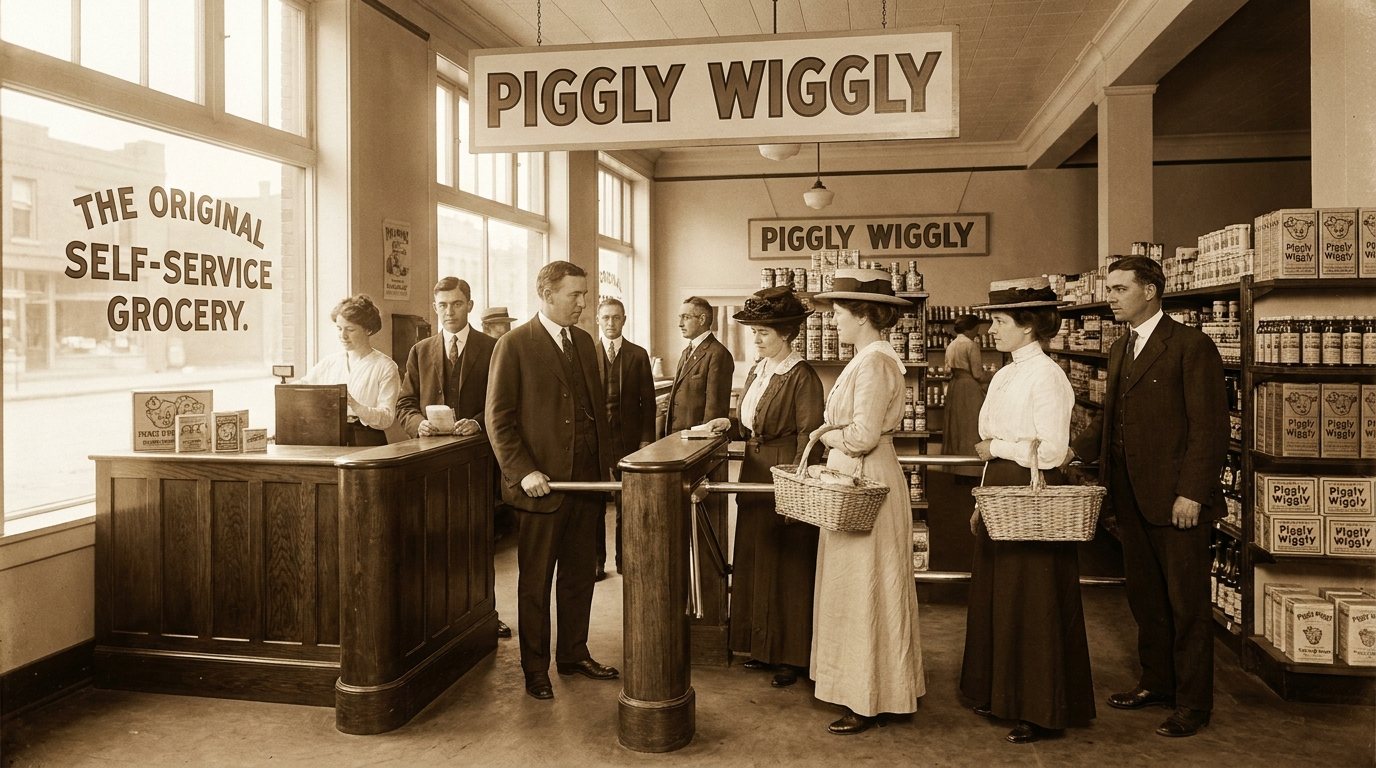
Before September 1916, grocery shopping meant standing at a counter and reciting a list to a clerk, who fetched each item from behind him. Clarence Saunders, a Virginia-born autodidact who had entered the wholesale grocery trade as a teenager and built a Memphis buying cooperative called United Stores, tore that model out by the roots. On September 6, 1916, he opened a 1,125-square-foot store at 79 Jefferson Avenue in Memphis and called it Piggly Wiggly. Shoppers pushed through a turnstile, walked a single continuous aisle past roughly 605 packaged items, and picked up whatever they wanted themselves, each item marked with its own price. There was no clerk to negotiate with and no list to hand over. Saunders patented the concept the following year as US Patent 1,242,872, the "self-serving store," according to Wikipedia's account of Piggly Wiggly.
It worked immediately, and it worked at a speed retail rarely allows. By 1923, Piggly Wiggly operated more than 1,260 stores across 40 states, and by 1932, even after Saunders himself was long gone, the chain had grown to 2,660 stores doing over $180 million a year, according to Wikipedia's entry on Clarence Saunders. Saunders franchised the format aggressively, letting independent grocers license the Piggly Wiggly name and layout for a fee, which made this one of the earliest true franchise systems in American commerce, arriving years before the concept became standard in other industries.
The Squeeze That Broke the Founder
Saunders lost the company he built not because shoppers stopped coming, but because of a fight that had nothing to do with groceries. In early 1923, a cluster of Piggly Wiggly franchise outlets in New York failed, and Wall Street speculators, reportedly including Merrill Lynch, began aggressively short-selling the stock. Saunders fought back with financial muscle: a $10 million loan from Southern bankers that he used to buy up 196,000 of the 200,000 outstanding shares, cornering the market and driving the price from around $39 to $124 by March 20, 1923.
The New York Stock Exchange then intervened, ruling that a corner existed and granting the short sellers extended time to deliver their shares rather than forcing them to buy at the inflated price Saunders had engineered. Stock poured in from distant corners of the country to cover the shorts, the price collapsed, and Saunders faced a September 1 repayment deadline he could not meet. He resigned and surrendered his personal assets to creditors, including the half-built pink marble mansion he was constructing in Memphis, which creditors seized and which became the city's first public museum in 1930. He had built the best grocery format in the country and lost it to a trading-floor ruling, a business failure that had almost nothing to do with retail and everything to do with margin loans.
Building the Self-Checkout Store, Decades Early
The part of Saunders' story that rarely makes it past the founding anecdote is what he did next, and it is the detail worth naming plainly: the same man who invented the self-service grocery store spent his last three decades trying to remove the cashier too. In 1935 he opened Keedoozle, a store where shoppers walked past glass display cases, inserted a key into a keyhole beside each item they wanted, and had their selections recorded on punched tape that triggered a conveyor system to assemble the order at checkout. It was clever and it was too expensive to scale. At his death in 1953 he was still designing Foodelectric, a system he described as letting "the customer collect her groceries herself, wrap them and act as her own cashier." That is, in plain language, self-checkout, sketched out roughly 40 years before any retailer actually built one that worked. Saunders never got to see it succeed, but the ambition was correctly aimed.
The Brand Outlives the Founder
After Saunders' exit, the Piggly Wiggly corporate structure split into regional units that were sold off piecemeal: divisions went to Kroger, Safeway, National Tea, and Colonial, three Texas stores went to a young chain called H-E-B in 1927, and the Canadian operations went to Canadian Safeway in 1935. The name kept moving through corporate hands for decades, from Malone & Hyde in 1982 to Fleming Companies in 1988. When Fleming collapsed into bankruptcy in 2003, wholesaler C&S Wholesale Grocers acquired the Piggly Wiggly trademark and has since consolidated regional operators, including Piggly Wiggly Carolina in 2013 and Piggly Wiggly Midwest in 2021, per Wikipedia and Piggly Wiggly's own site.
What Piggly Wiggly Is Today
Today Piggly Wiggly is more than 500 independently owned and operated stores across 18 states, concentrated in the Southeast and Midwest and licensed under Piggly Wiggly LLC and C&S Wholesale Grocers. Its own marketing leans into that longevity with the tagline "Local Since Forever," and it is a fair claim: the company has outlasted every ownership structure it has ever had by staying what it was on day one, a franchise brand loaned out to independent grocers rather than a single corporate chain. The $5.85 billion in 2025 sales that earns it a spot on the NRF list is really the aggregate of hundreds of small, locally run businesses trading under one sign, which is a strange but fitting inheritance for a founder who invented the format and then couldn't hold onto it.
Every company on this list runs on something unglamorous underneath the storefront, whether it is a supply chain, a catalog, or in Piggly Wiggly's case, a name licensed out over more than a century. That infrastructure rarely gets the credit the storefront does.