
Polymershapes: The Distributor GE and SABIC Built First
Polymershapes lands on the 2026 MDM plastics list, but its real history is stranger: born from two firms, raised inside GE and SABIC, freed in 2017.
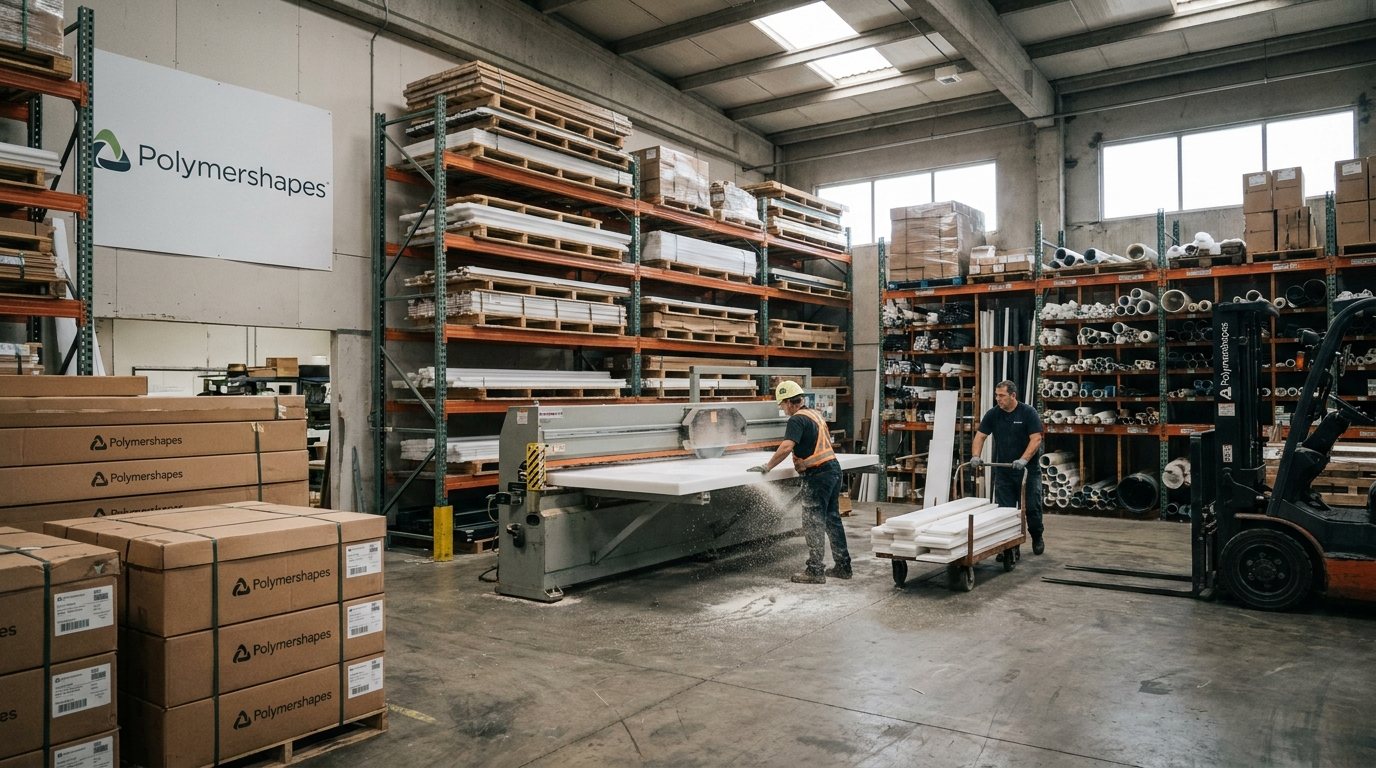
Part of Distributor Playbooks — strategy teardowns of every company on the MDM Top Distributors lists.
Polymershapes shows up in the Plastics vertical of Modern Distribution Management's 2026 Top Distributors report, the annual ranking of North America's largest distributors across 20 product categories. MDM doesn't disclose the company's 2025 revenue, which is fitting for a distributor that spent most of its history answering to someone else's balance sheet before it ever had one of its own. That lineage, more than any branch count, is the story worth telling.
Two Companies, Not One
Polymershapes did not start as a single entrepreneurial bet. Its own company history traces back to 1949 and two separate regional fabricators: Cadillac Plastics in Detroit and Commercial Plastics in Philadelphia, each building a business around cutting and selling sheet, rod, and tube plastic to industrial customers near home. For half a century they ran as competitors, not siblings, growing branch by branch the way most distributors do.
The merger that made them one company didn't come from either founder. It came from General Electric.
Eighteen Years Inside Someone Else's P&L
In 1999, GE bought Cadillac Plastics outright. A year later, GE folded Commercial Plastics into it and rebranded the combined operation GE Polymershapes, at the time the largest plastics distributor in North America, according to the company's own history page. For the next two decades, Polymershapes existed as a distribution arm bolted onto a materials manufacturer's income statement rather than as a freestanding company answering to its own board.
That arrangement changed hands once more before it changed shape. In 2008, SABIC, the Saudi petrochemicals major, acquired GE's plastics division in one of the largest industrial deals of the decade, and Polymershapes came with it. For nine more years it stayed a captive channel, this time inside a state-linked chemical giant on the other side of the world from most of its branches.
Cut Loose in 2017
Polymershapes only became an independent business, run for its own account rather than a manufacturer's, in 2017, when it separated from SABIC. Today it operates as a privately held distributor, and industry deal-tracking databases list Blackfriars Corp, a Northbrook, Illinois investment firm, among its owners in the years since.
Run the arithmetic and the tension is obvious: a company that markets "over 70 years of industry-leading heritage" has been an independent, self-directed distributor for less than a third of that span. For most of its life, Polymershapes wasn't building a distribution business so much as running one on behalf of whoever owned the plant.
The Insight: A Distributor Built by a Materials Company, Not a Trucking Company
Here's what that lineage actually explains. Most large industrial distributors were assembled by operators who started with a truck and a warehouse and scaled branch density and logistics as the moat. Polymershapes spent its formative decades inside two companies whose core competency was making the material, not moving it. GE Plastics and SABIC weren't logistics shops; they were chemistry shops that happened to own a distribution channel.
That shows up in what Polymershapes actually sells today. Its current catalog, per the company's own site, leans toward engineering and high-performance substrates: UHMW polyethylene, PETG, expanded foam PVC, and engineered polycarbonate sit alongside standard acrylic and PVC sheet, rather than commodity sheet goods being the whole story. A distributor built purely around trucks and branch count tends to compete on service radius and delivery frequency. One that spent decades inside a polymer manufacturer's org chart tends to compete on knowing the material science behind the SKU, which is closer to how Polymershapes still talks about itself, with a network of roughly 80-plus locations, 17,000 SKUs, and 37,000 customers across the Americas, backed by five film-conversion centers and two fabrication shops rather than pure cut-and-ship.
Betting on Nearshoring, Not Just Sheet Goods
The clearest recent evidence of that engineering-first posture is where Polymershapes has chosen to expand. In early 2026, the company grew its footprint in Chihuahua, Mexico, inside the Saucito industrial park, adding storage and processing capacity aimed squarely at aerospace, automotive, and industrial manufacturing customers relocating production closer to the U.S. border, according to trade coverage of the expansion. That's a nearshoring bet, not a construction-boom bet. Reports on the move describe the company framing it as moving beyond straight logistics into higher-value industrial transformation, which is exactly the posture you'd expect from an operator whose DNA runs through GE Plastics rather than a regional lumberyard chain.
The Trade-off Worth Naming
The honest tension is that Polymershapes' materials-science lineage cuts both ways. Engineering plastics tied to aerospace and automotive production carry more margin than commodity sheet, but they also move with industrial capex cycles rather than steadier MRO or construction demand. A distributor whose growth chapter is only nine years old, and whose ownership has changed hands twice since it left SABIC, is also still proving out what kind of company it is when nobody bigger is steering it. The branch network and the SKU count are real. The independent operating track record is comparatively thin.
That's not a knock. It's the actual shape of the bet: a 75-year-old brand name running a startup's worth of independent decision-making, in a category where the material itself, not just the truck fleet, is the thing customers are actually buying.
Distribution's advantages rarely show up in a mission statement. They show up in the catalog depth, the branch map, and the data behind both, which is what this series keeps coming back to look at.