
Publix: How a Rejected Idea Built a $62.75B Grocery Chain
Publix ranks #12 on NRF's 2026 Top 100 with $62.75B in U.S. sales. The story of its founder's rejected idea and the ESOP that outlasted Winn-Dixie.
Part of Retailer Playbooks — history-first profiles of every company on the NRF Top 100 Retailers list.
George Jenkins pitched an idea to his bosses at Piggly Wiggly in 1930 and got nowhere. So he quit, borrowed less than $2,000, and opened a 27-by-65-foot store in Winter Haven, Florida, where he promised that every idea from every employee would get a hearing. Ninety-six years later that store is Publix Super Markets, and per the National Retail Federation's Top 100 Retailers 2026 list, it ranks #12 in the country with $62.75 billion in 2025 U.S. retail sales, compiled with Kantar. It got there without ever selling a share to the public.
A Depression-era bet on comfort
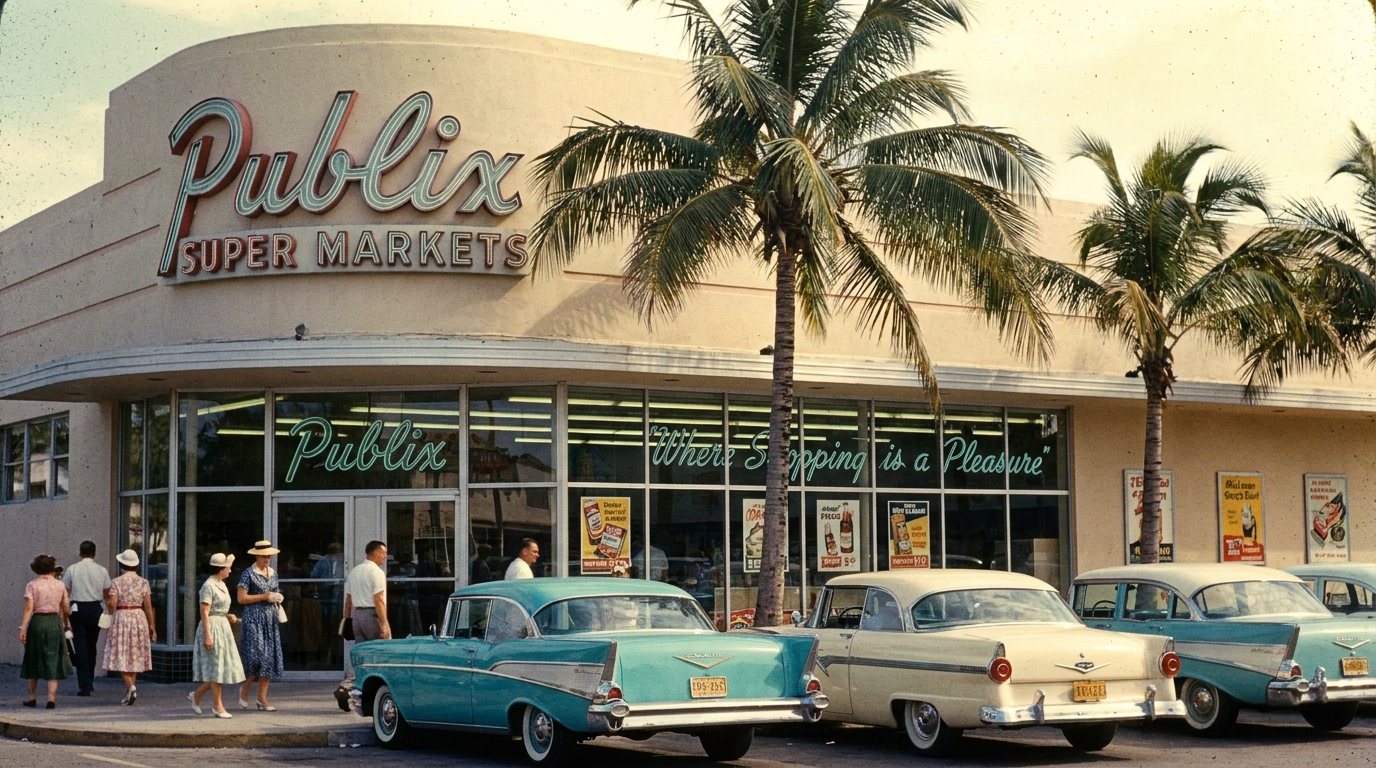
Jenkins named his store after a struggling New York movie theater chain because, as he put it, he liked the sound of the word. The choice mattered more than it seemed. Publix was going to sell an experience, not just groceries, and Jenkins built the first store to prove it: air conditioning, Art Moderne styling, and a level of polish that had no business existing in a Depression-era grocery, according to Wikipedia's history of the company.
By 1935 he had five stores. Then in 1940 he made his real bet. Jenkins mortgaged an orange grove, a genuinely risky move for a citrus-country grocer, to build what's often called Florida's first true supermarket: 11,000 square feet with electric doors, frozen-food cases, piped-in music, and a paved parking lot. Competitors were still running counter-service groceries where a clerk fetched your items. Jenkins let shoppers walk the aisles themselves and feel the temperature drop as they walked in. The motto he coined then, "Where shopping is a pleasure," still hangs over the door of every store.
The ownership decision that outlived a rival
The pivotal chapter isn't a store format. It's a balance sheet decision made across the late 1950s: Jenkins began selling stock to his own employees rather than to Wall Street, laying the foundation for what would become the nation's largest employee stock ownership plan, per FundingUniverse's company history. By the 1990s, roughly 85 percent of Publix was owned by current and former employees. No public listing, no analysts to please every quarter, no outside board pushing for leverage to fund faster growth.
That decision is easiest to see in contrast with the company Publix eventually eclipsed in its own backyard. Winn-Dixie, founded in 1925, was Florida's dominant chain for decades and the first Florida-based industrial company on the New York Stock Exchange, growing to nearly 700 stores across eleven states by the late 1950s, according to Wikipedia's account of Winn-Dixie's history. It was public, acquisitive, and for a long stretch, bigger than Publix. Then came the 2000s: 11,000 jobs cut in 2000, a Chapter 11 filing in 2005, a second bankruptcy under parent Southeastern Grocers in 2018, and by 2023 its remaining stores were being sold off to Aldi. Publix, meanwhile, never had a public shareholder base demanding the kind of debt-fueled expansion or margin extraction that hollowed out its rival. It just kept building stores, funded out of its own earnings, one Florida county at a time. That's the unique thread this piece wants to name plainly: Publix didn't just survive Winn-Dixie, it inherited its market by refusing to play the public-company game at all.
The unglamorous machinery behind the pleasant part
The "shopping is a pleasure" branding tends to overshadow how mechanically disciplined Publix has been underneath it. The FundingUniverse history credits the company with adopting bar-code scanners and ATMs ahead of most competitors in the 1980s, expanding frozen-food and yogurt sections before rivals spotted the trend, and running a merchandising operation precise enough to place high-margin items at eye level in every store, consistently. Decentralized store management gave individual managers real authority over their departments, an echo of the "every idea gets heard" promise Jenkins made on day one.
The growth numbers tell the compounding story. $1 billion in sales by 1974. $5 billion by 1989. The 1,000th store opened in 2009. Today the company runs roughly 1,442 stores across eight Southeastern states with about 260,000 employees, according to Wikipedia's history page, and it has never conducted a layoff since 1930.
A hard chapter, told straight
None of this was frictionless. In 1995, eight women filed a gender discrimination suit alleging Publix clustered women into cashier and deli roles while systematically denying them promotion into management. A federal judge certified it in 1996 as a class action covering 120,000 current and former employees, at the time the largest sex discrimination case in U.S. history, per FundingUniverse. Publix settled in January 1997 for $81.5 million, the fourth-largest settlement of its kind nationally, and a separate EEOC racial discrimination claim was resolved for $3.5 million. It's a real scar on the company's record from the very decade it was being celebrated as one of America's best places to work. The company's response afterward, restructuring its management pipeline and diversity practices, is part of how it got from that lawsuit to the employer it is cited as today.
Why the model still works
Succession has mattered as much as ownership structure. When George Jenkins retired after a stroke in January 1990, his son Howard Jenkins took over at 38, inheriting 370 stores and $5.38 billion in sales, and pushed the company outside Florida for the first time, into Georgia in 1992. By 1996 Publix held 18 percent of the Atlanta market, second only to Kroger. The expansion pattern held: build slowly, fund it internally, keep the workforce that built the last store around to help build the next one.
That patience is the real export of the Publix story. Retail chains chase quarterly growth all the time; almost none of them can resist the debt that eventually comes with it.
Retail's biggest stories rarely happen at the register. They happen in the ledgers, warehouses, and ownership structures that decide who's still standing a century later.