
Raley's: The $121 Grocery Bet That Stayed a Family Business
Raley's opened in 1935 with $121 and a mentor's credit line. Ninety years later it's family-owned, No. 80 on the NRF Top 100, still betting on independence.
Part of Retailer Playbooks — history-first profiles of every company on the NRF Top 100 Retailers list.
Thomas Raley had $121 and a borrowed idea when he opened a grocery store in Placerville, California, in February 1935. Ninety-one years later, Raley's lands at #80 on NRF's Top 100 Retailers 2026 list, with $5.63 billion in 2025 U.S. retail sales, compiled annually by Kantar. What's unusual isn't the size. It's that the company is still privately held by the founder's family, in an industry where almost every regional chain of this vintage got bought, merged, or liquidated decades ago.
A store manager's $121 experiment
Raley was the 13th of 14 children from Arkansas. He drifted to Los Angeles, worked as a file clerk, a delivery driver, a produce clerk, and eventually caught the attention of Safeway president M.B. Skaggs, who made him a store manager and mentored him through the late 1920s. When Raley struck out on his own during the Depression, it was Skaggs who extended him the credit to do it, according to FundingUniverse's company history.
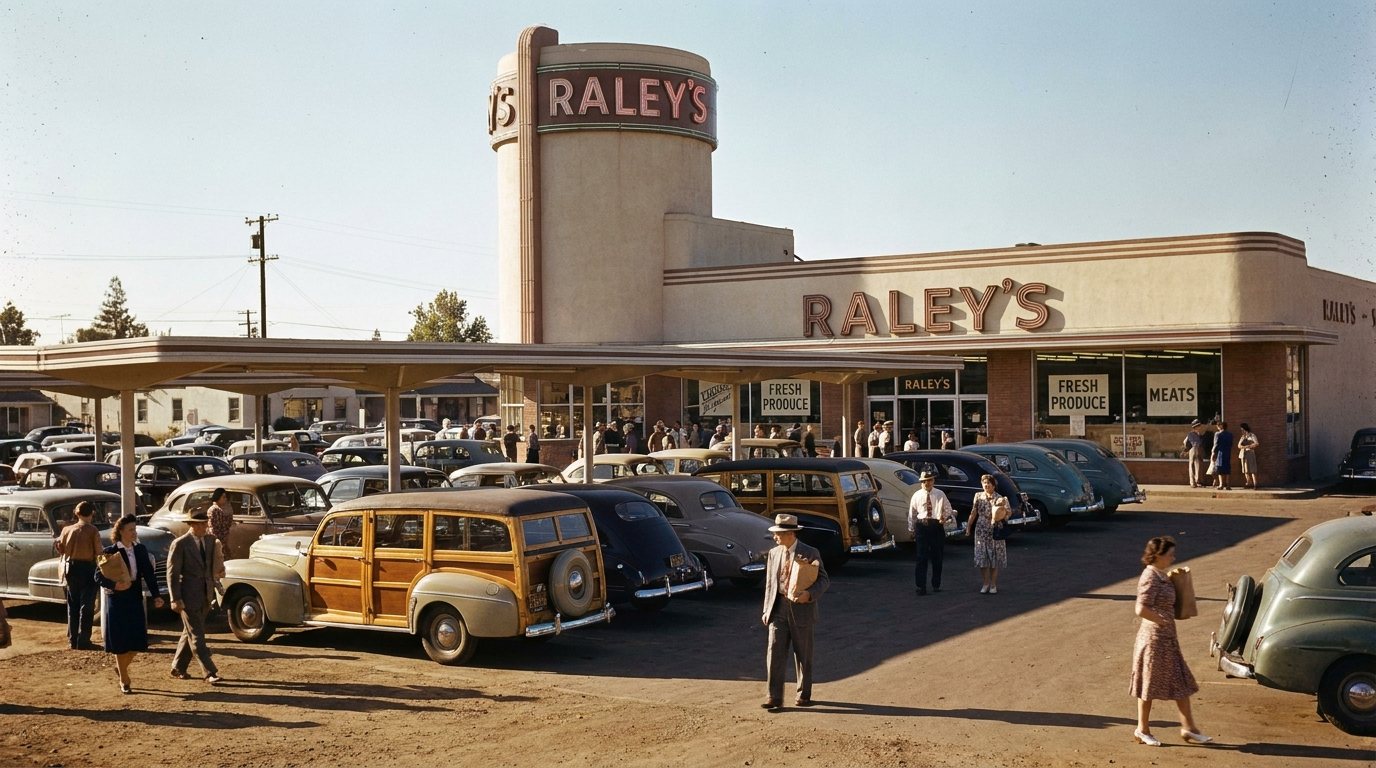
The Placerville store advertised itself as the nation's first drive-in market. Raley built the counters himself. He leaned hard on fresh meat and produce rather than competing on packaged goods, and the store cleared $4,500 in profit its first year, a serious sum in the middle of the Great Depression.
That opening move set the pattern the company would return to again and again over the next nine decades: bet on freshness and service, not price, and let that carry you through downturns other grocers don't survive.
Wartime, self-service meat, and a near-death by hotels
World War II hit Raley's the way it hit every small chain: rationing, employees drafted away, and in 1942 a fire took out the original Placerville store. Raley kept opening anyway, adding Roseville and Grass Valley locations through the disruption.
The postwar years produced the company's first real technical claim to fame. Raley's became the first store in Northern California to wrap meat in plastic for self-service display, according to FundingUniverse, a small operational shift that let customers pick up meat themselves instead of waiting on a butcher. By 1956 the chain had grown to nine stores and more than $8 million in annual revenue.
Then came the closest the company came to unraveling. In the 1960s, Raley diversified into hotels, buying the Mayfair in Los Angeles and the MiraMar in Santa Barbara. Both bled money and threatened to take the grocery business down with them. Raley worked with a trusted lieutenant, Charles Collings, to restructure, sell off the hotel ventures, and refocus entirely on food retail. It's the kind of chapter that rarely makes a company's own history page, and it's arguably the most instructive one: the founder's instinct to chase a real estate side bet nearly erased the thing he'd actually built.
Buying its way to scale, then buying its way back home
Raley's spent the back half of the 20th century growing mostly through acquisition rather than de novo stores, a timeline worth laying out plainly:
| Year | Move |
|---|---|
| 1973 | Bought the 10-store Eagle Thrifty Drug chain |
| 1992/93 | Acquired Bel Air Markets, pushing sales past $1.8 billion |
| 1995 | Launched the Food Source discount banner |
| 1997/98 | Purchased Nob Hill Foods |
| 1999 | Bought 19 Albertsons stores in Las Vegas and 8 in New Mexico, briefly becoming the 38th-largest U.S. supermarket chain |
| 2002/03 | Sold the Las Vegas stores to Kroger, retreating to concentrate on Northern California and Reno |
| 2021 | Acquired the Bashas' Family of Stores in Arizona |
The 1999 Las Vegas expansion and the 2003 retreat from it is the most honest data point in the whole history. Raley's grew into a market, discovered it couldn't win there against bigger competitors, and pulled back rather than bleed slowly. That's a harder discipline than expanding, and most chains don't manage it.
The 2021 Bashas' deal is the inverse move done right. Bashas', founded in 1932 in Goodyear, Arizona by Ike Basha and Eddie Basha Sr., had survived a 2009 bankruptcy and by 2020 faced what its leadership described as three options: buy, merge, or sell, per Wikipedia's account of the deal. Raley's structure let Bashas' avoid disappearing into a national chain. The Bashas', AJ's Fine Foods, and Food City banners kept their names, their Chandler headquarters, and their existing leadership. Raley's added roughly 130 stores across three banners without erasing any of them, betting that regional identity was worth preserving rather than folding into one master brand.
What the ownership structure actually buys them
Here's the detail that doesn't show up on a typical retailer profile: Raley's is still 100 percent owned by the Raley family, four generations after Thomas Raley signed his first lease. Leadership passed from Raley himself to Charles Collings, then to grandson Michael Teel, who became majority shareholder and chairman in 2015 and now holds Owner, Chairman, President, and CEO titles, per Wikipedia.
That's the unique insight worth naming plainly: Raley's competitive advantage isn't a format or a technology, it's patience that public ownership structurally cannot offer. A public grocer answering to quarterly earnings would have been under permanent pressure to sell the multi-banner sprawl, standardize everything under one name, or cash out to a private equity buyer the way dozens of regional chains did in the 1990s and 2000s consolidation wave. Raley's kept six-plus banners (Raley's, Bel Air, Nob Hill, Bashas', AJ's Fine Foods, Food City) running with distinct identities across seven states and three tribal nations because nobody with a board seat was demanding the simplification a Wall Street analyst would have insisted on. The Bashas' deal terms it offered, keep your name, keep your HQ, keep your leadership, are only credible coming from a buyer that has run its own business the same way for ninety years.
Retail history is full of grocers that scaled fast and lost themselves in the process. Raley's scaled slowly, badly diversified once, corrected hard, and kept the keys in the family the whole way through. That's not a strategy most operators can copy. It's one worth understanding anyway.
This is the kind of durability that rarely gets attributed to the boring machinery behind it: the private ledgers, the store banners kept alive on purpose, the quiet discipline of knowing when to retreat from a market instead of doubling down.