
Right product, right buyer, right moment: the real job of product data
Product data has one job: get the right buyer to the right product at the moment of intent, then remove every reason not to buy.

Most retail and distribution teams talk about product data as a compliance exercise — fill in the fields, pass the marketplace validator, ship the catalog. That's backwards. Product data has exactly one job: get the right buyer to the right product at the moment they're ready to act, then eliminate every remaining reason they might not buy. Everything else — schema completeness, attribute counts, PIM hygiene — is a means to that end, not the end itself. Once you frame it that way, you also get a map for how to measure it, because each stage of the funnel fails for a specific, traceable reason.
The funnel product data actually gates
Think of the buyer's path as four gates, and product data is the thing that opens or blocks each one.
Discovery. The buyer doesn't find you if your data doesn't match how they search. That's organic search (titles, structured data, category taxonomy), on-site search (synonyms, attribute-based filtering, spec normalization), marketplace search (Amazon, Faire, industrial distributors' own catalogs), and increasingly AI answer engines that summarize and cite product pages — one more discovery surface among the rest, not a replacement for them. If a distributor lists a fitting by an internal SKU code instead of the trade name a buyer actually searches, that product is invisible no matter how good it is.
Relevance and matching. Getting found isn't enough — the buyer has to land on the right product, fast. This is where attribute depth and structured spec data matter most: filters, comparison tables, fitment and compatibility data. A buyer searching for a 1/2 in NPT fitting who lands on a page missing thread type or pressure rating either bounces or, worse, buys the wrong part.
Decision. Once the buyer is on the right PDP, they're deciding whether to trust it. This is images, dimensions, materials, certifications, compatibility, reviews, and — for B2B especially — spec sheets and documentation. McKinsey's B2B Pulse research has tracked buyers using an average of 10.2 interaction channels during a purchase, up from five in 2016, and Gartner's 2026 sales survey found 67% of B2B buyers now prefer a rep-free buying experience. That means the PDP is doing the job a salesperson used to do — answering the objections before anyone asks them out loud.
Conversion, and what happens after. The buyer adds to cart or calls procurement. But data's job isn't done at "add to cart" — incomplete or wrong data creates costs downstream: returns, support tickets, chargebacks, and churn. A Retail Dive-sponsored study of over 1,500 consumers found 40% had returned an online purchase because of inaccurate product content, and among shoppers who received inaccurate information, 86% said they were unlikely or very unlikely to buy from that retailer again. That's not a one-time lost sale — it's a lost customer.
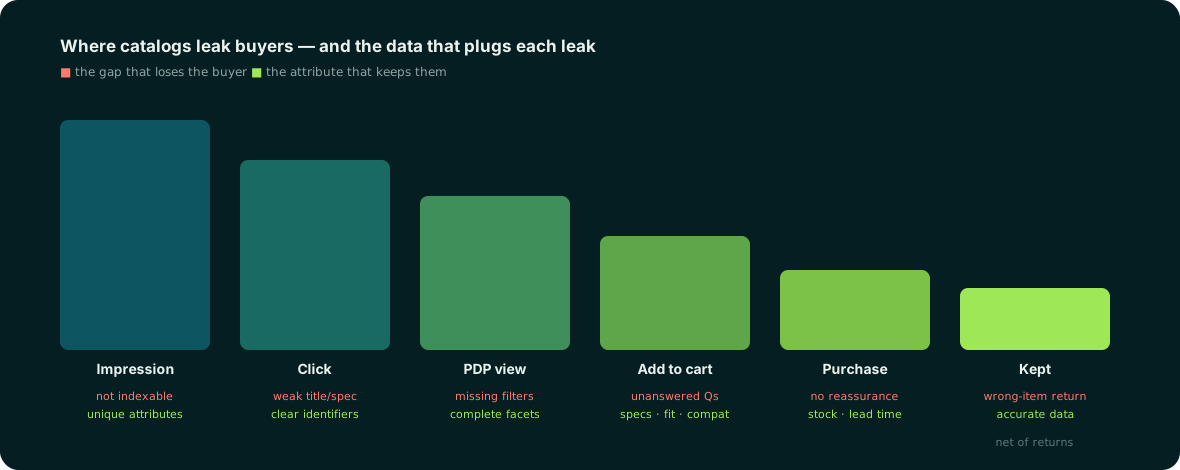
What gates each stage, concretely
| Funnel stage | What it depends on | Data-quality failure mode | How you measure it |
|---|---|---|---|
| Discovery | Titles, categories, structured data, keyword coverage | Missing/inconsistent naming, thin taxonomy | Organic sessions to PDPs, marketplace search impressions, AI-source referral traffic (GSC, marketplace seller dashboards, referrer analysis) |
| Relevance/matching | Attributes, filters, fitment/compatibility data | Sparse or wrong specs, broken filters | On-site search zero-result rate, filter usage vs. bounce, search-to-PDP click-through |
| Decision | Images, dimensions, certs, spec sheets, reviews | Stock/missing imagery, absent specs, no docs | PDP scroll depth, spec-sheet downloads, session recordings, support-ticket topics pre-purchase |
| Conversion | All of the above, resolved with no open objection | Any gap surviving to checkout | Add-to-cart rate, PDP conversion rate, cart abandonment reasons |
| Post-purchase | Accuracy of what was promised on the PDP | Data that oversold or under-specified | Return rate by reason code, support tickets citing "not as described," repeat purchase rate |
Why "complete" and "correct" are two different failure modes
Retailers tend to measure completeness — percent of required fields filled — because it's easy to dashboard. But incompleteness and incorrectness cause different downstream damage, and you need to separate them in your reporting. A missing dimension field costs you a discovery or relevance moment: the buyer never gets matched, or bounces from a thin page. A wrong dimension field costs you a return, a support ticket, and possibly the customer relationship — because they got far enough to trust the page. Site search data backs up how much sits on relevance and matching alone: shoppers who use on-site search convert at meaningfully higher rates than those who don't, but only when the search index has the attributes to match intent — a search that returns zero results, or the wrong category, sends that high-intent buyer straight to a competitor's marketplace listing instead.
Both failure modes are visible if you're willing to instrument for them. Discovery and relevance failures show up in organic/marketplace impressions vs. click-through and in on-site search zero-result logs. Decision failures show up in scroll depth, time-on-page, and abandoned-cart reasons where "not enough information" is a selectable exit survey option — most cart-abandonment research puts unclear or missing product descriptions in the same tier of blame as shipping cost and delivery time. Post-purchase failures show up in return-reason codes (specifically "item not as described," not just "changed my mind") and in support tickets that reference a spec the PDP got wrong or never listed.
Where this connects back to enrichment
None of these four gates are things a PIM alone solves — a PIM is the system of record, but it doesn't know that a spec is missing, a title doesn't match buyer search language, or a description is thin enough to cause a return. That's the enrichment layer's job: continuously scoring catalog data against exactly these failure modes, gap-filling from supplier docs, and flagging what's wrong before it becomes a return or a lost customer — without touching what the PIM already does well. Anglera plugs into whatever PIM a team runs, or none at all, and does that work in weeks rather than a multi-quarter project. The rest of this measurement series walks through how to instrument each stage of this funnel in detail — this piece is the map.