
How RNDC Built a National Footprint, Then Sold Off a Third of It
RNDC made MDM's 2026 Food & Beverage list by merger. In 2026 it is unwinding that same footprint, and the reason why is a lesson in three-tier economics.
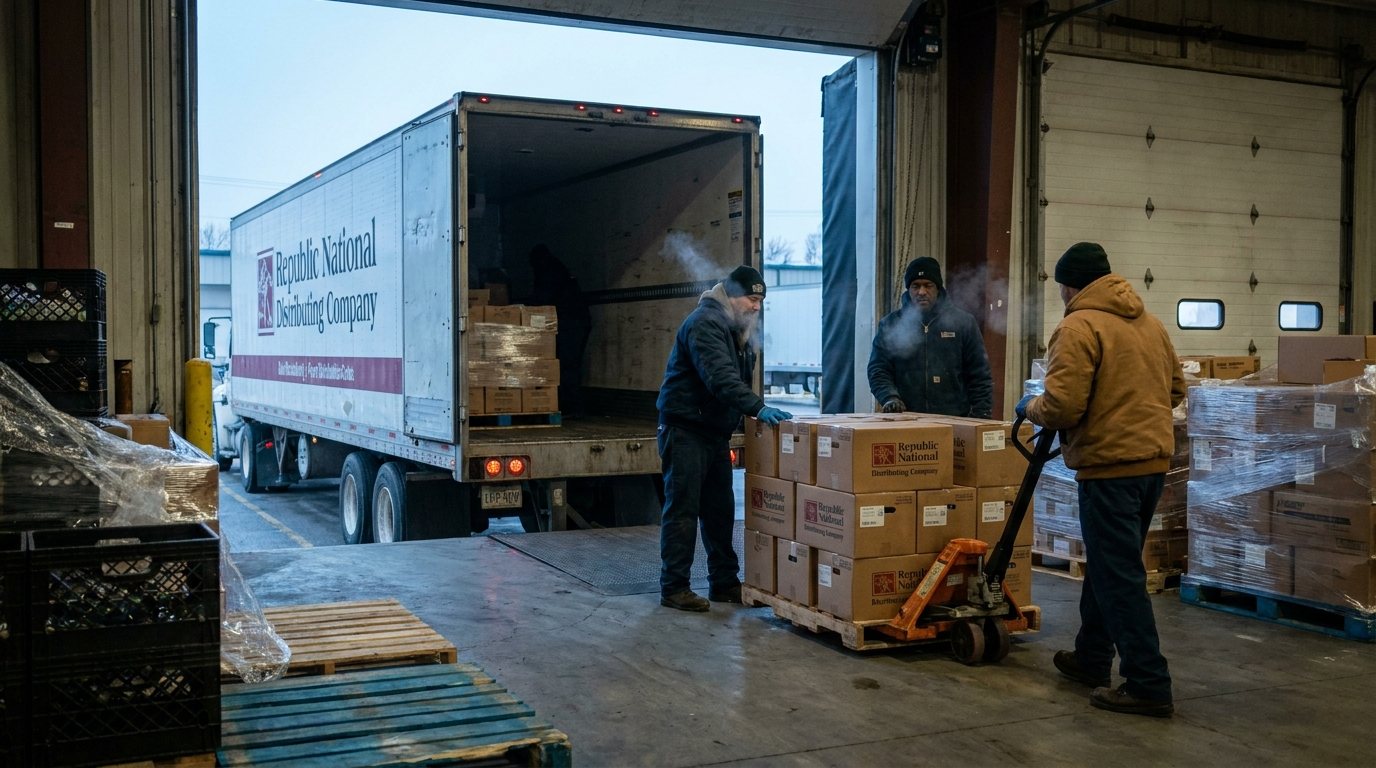
Part of Distributor Playbooks — strategy teardowns of every company on the MDM Top Distributors lists.
Republic National Distributing Company shows up on Modern Distribution Management's 2026 Top Distributors list in the Food & Beverage category, one of the largest wine and spirits wholesalers in the country. It is also, right now, in the middle of the fastest contraction a company its size has undergone in years. Both facts are true at once, and the second one explains more about how beverage-alcohol distribution actually works than the first.
A company assembled by merger
RNDC's lineage runs back to 1898 in Pensacola, Florida, but the company as it exists today was created on May 1, 2007, when Republic Beverage Company and National Distributing Company merged. The combined entity inherited supplier relationships and state licenses from both predecessors and immediately became one of the two or three largest wine and spirits distributors in the United States, according to Wikipedia's summary of the company.
The growth pattern after that was consistent: buy your way into states you don't operate in yet. RNDC entered a joint venture with Young's Market Company in 2019 to gain a foothold across the West, then in November 2022 bought the remaining 50 percent of Young's Market outright, picking up sole ownership of distribution in Alaska, Arizona, California, Hawaii, Montana, Oregon, Utah, Washington, and Wyoming. Trade press coverage at the time of the deal put the combined company at roughly 38 states plus D.C., with projected revenue north of $12 billion. By 2021, Forbes ranked RNDC 25th among America's largest private companies, up from 71st in 2010, a jump driven almost entirely by acquisition rather than organic growth in existing markets.
Scale in three-tier distribution is modular, not monolithic
Here is the part that matters for anyone studying how distributors compete: in most distribution categories, scale is a single integrated network. You can't easily carve a warehouse chain in half and sell part of it, because the routes, the systems, and the customer relationships are fused together.
Beverage alcohol under the U.S. three-tier system doesn't work that way. Each state is its own license, its own supplier franchise agreements, and often its own warehouse and route structure. That is exactly why RNDC could assemble a near-national footprint through a string of acquisitions over 15 years, state by state, brand by brand. It is also exactly why, when the company needed to shrink, it could do so the same way: by selling entire state operations to a single buyer in one transaction, rather than restructuring a single network end to end.
That is the non-obvious observation this profile is built around. The M&A engine that built RNDC's scale and the mechanism now dismantling part of it are the same mechanism, run in reverse. Distribution rights under the three-tier system are a portfolio of state franchises, and portfolios can be traded piece by piece without killing the parent company.
The 2025-2026 unwind
That is precisely what has happened over the last year. RNDC filed WARN notices in mid-2025 tied to a full exit from California, and by the fall the company was working through financing pressure that forced facility closures in Washington state, Alaska, and South Florida, according to reporting aggregated by MDM's news desk. Illinois was reported by The Spirits Business in June 2026 to be headed toward a permanent shutdown for the same reason.
The largest single move closed on May 29, 2026, when Reyes Beverage Group announced it had completed the acquisition of RNDC's operations in 11 markets: Arizona, Colorado, Florida, Hawaii, Louisiana, Maryland, Oklahoma, South Carolina, Texas, Virginia, and Washington, D.C. The deal brought Reyes roughly 5,200 employees, more than 135,000 customer accounts, and about 38 million annual cases, extending Reyes's own footprint to 16 states covering nearly 52 percent of the U.S. legal-drinking-age population. For RNDC, it meant handing a rival more than a third of the state licenses it had spent almost two decades assembling.
| Year | Event |
|---|---|
| 2007 | Republic Beverage Co. and National Distributing Co. merge to form RNDC |
| 2019 | Joint venture launched with Young's Market Company across the West |
| 2022 | RNDC buys remaining Young's Market stake; footprint reaches ~38 states |
| 2025 | WARN notices filed; California exit; facility closures begin |
| 2026 | Reyes Beverage Group closes acquisition of 11 RNDC state markets |
Still standing, smaller
RNDC named Marc Sachs as permanent President and CEO in December 2025 after he had served as interim chief since October, a leadership change that landed squarely in the middle of the restructuring. Despite the contraction, the company kept signing new supplier business through the period, including a distribution partnership for Tequila Centinela across Florida and Texas announced in April 2026. That combination, shedding a third of its footprint while still onboarding new brands elsewhere, is consistent with a company doing triage on its weakest markets rather than winding down.
What RNDC's last two years demonstrate is that the three-tier system's biggest structural quirk, state-by-state licensing that looks like fragmentation from the outside, is actually the release valve that lets a distributor resize without a bankruptcy filing. Few other channels in distribution get that option.
Every company in this series made MDM's list by moving physical product at scale. What separates the ones that keep their footprint from the ones that have to sell pieces of it usually comes down to something duller than any acquisition: whether the catalog, pricing, and account data underneath the trucks were ever built to survive a shock.