
Ross Stores: How a Near-Death Crisis Built an Off-Price Giant
Ross Stores nearly collapsed in 1986 after reckless expansion. The turnaround discipline it forged became the off-price playbook still running today.
Part of Retailer Playbooks — history-first profiles of every company on the NRF Top 100 Retailers list.
Ross Stores lands at #22 on NRF's Top 100 Retailers 2026 list, with $22.70 billion in 2025 U.S. retail sales. The name on the door dates to 1950. The company that actually built that number didn't exist until three decades later, and it was nearly destroyed within its first four years.
A name that survived two owners and one total reinvention
In 1950, a man named Morris "Morrie" Ross opened a junior department store in San Bruno, California. He sold it in 1958 to William Isackson, who grew it to six stores around the Bay Area over the next two decades, per Wikipedia's account of the company's founding. By the early 1980s it was still a modest regional chain selling mid-tier department-store merchandise, nothing like the business that carries the Ross name now.
That original Ross Department Store had no off-price model, no treasure-hunt buying strategy, and no relationship to the retailer described in this piece beyond a signature painted on six storefronts. The name is essentially all that carried forward.
The 1982 buyout that invented the real Ross
In August 1982, a group of investors led by Stuart Moldaw and Donald Rowlett bought those six stores. Moldaw had already built and sold three off-price concepts, including Pic-A-Dilly and Country Casuals. Rowlett had run F.W. Woolworth's J. Brannam off-price division, growing it to 36 units. Among the backers was Mervin Morris, founder of Mervyn's, according to Funding Universe's company history. Together they saw an underserved gap in California retail: branded, designer-label apparel sold at 20 to 60 percent off, in stripped-down stores that skipped the fitting-room fuss and full-price overhead of department stores.
The pace of what followed is the part that reads like a dare. Two stores converted in fall 1982. Eighteen more opened in 1983, alongside a push into Nevada. By 1984 the chain had jumped into Arizona, Washington, Texas, and Oklahoma, adding a Texas and Oklahoma footprint through the acquisition of 15 Handyman division stores from Edison Brothers Stores. Headquarters moved into a 494,000-square-foot facility in Newark, California that same year. Ross went public on Nasdaq on August 8, 1985, priced at $17 a share, with 107 stores open and sales up 79 percent to $375.9 million.
The crash that taught Ross what off-price actually means
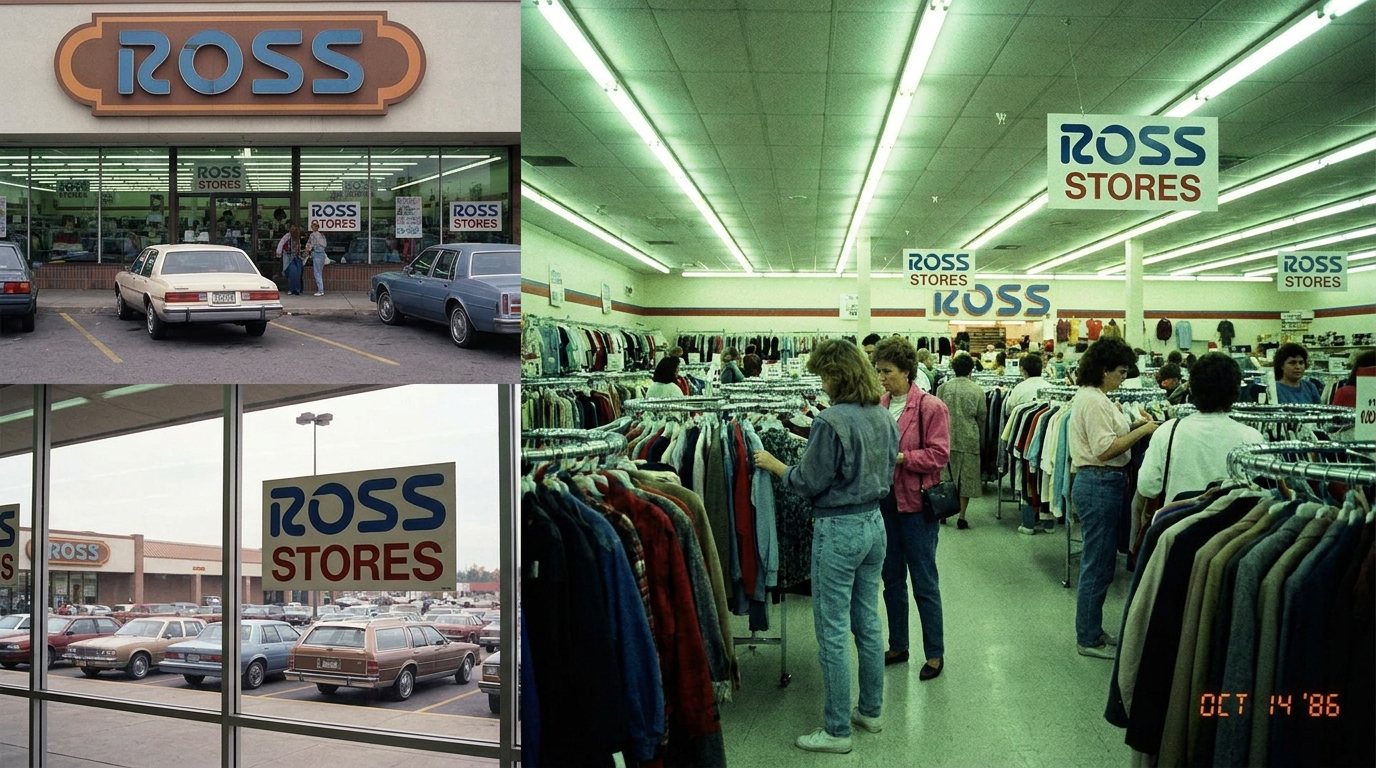
Growth this fast eventually meets ground it hasn't tested. Texas and Oklahoma's economies weakened in 1986, and Ross had planted stores across both on the strength of momentum rather than proven demand. The chain still opened 39 new locations that year, pushing to 121 stores in 16 states, but 25 of the new Sun Belt units were unprofitable enough to require closure. The company posted a $41.4 million loss for 1986, per Funding Universe's history. Rowlett, one of the two founders, left in 1987.
Norman Ferber, the merchandising executive who was promoted to president and COO that year and became CEO in January 1988, ran the recovery alongside Moldaw. Their fix wasn't a new gimmick. It was restraint: only 11 new stores opened in 1987, and expansion narrowed to three proven regions, the West Coast, the Washington D.C. area, and Florida. They cut domestics departments that weren't earning their shelf space and added higher-margin categories instead, cosmetics, fragrance, sport coats, silk dresses. By 1989, 95 percent of the chain's 140 stores carried full cosmetics and fragrance sections staffed with beauty consultants. Ross turned an $11.5 million profit in 1987, one year after the loss.
This is the part of the story worth naming plainly, because it's not on Ross's own About page: the buying discipline that defines off-price retail today, narrower assortments bought deeper on fewer, better categories rather than broad selection chasing every customer, wasn't the founders' original 1982 concept. It was a scar left by a near-collapse in Texas and Oklahoma. Ross didn't invent treasure-hunt merchandising as a strategy; it stumbled into the strategy while stopping the bleeding, then kept it because it worked.
Scaling the discipline
The 1990s vindicated the recovery. Ross crossed $1 billion in annual sales in 1992, reached 292 stores across 18 states by 1995 with $1.4 billion in revenue, and pushed sales per square foot from roughly $214 in 1991 to $230 by 1995, a climb that happened during a national recession rather than in spite of one. Michael Balmuth, who'd joined the company in 1989, took over as CEO in September 1996 and ran the company through its scale-up into the 2000s, sharpening the buying model that now defines the chain: opportunistic purchases from overproduction, canceled orders, and closeouts across thousands of vendors, resold fast in no-frills stores with low occupancy costs.
Headquarters moved from Newark to Pleasanton in 2003, then to neighboring Dublin in 2014, the same year Barbara Rentler took the CEO seat and became the 25th female Fortune 500 chief executive. The company had also built out dd's DISCOUNTS, a value-tier banner aimed at even more price-sensitive Sun Belt shoppers, now running 353 locations alongside roughly 1,800 Ross Dress for Less stores, per Ross's own investor materials referenced in its Wikipedia entry and confirmed store counts. James Conroy, who previously ran Boot Barn, succeeded Rentler as CEO in February 2025.
By 2026, Ross reported roughly $22.8 billion in annual revenue and around 111,000 employees, according to Forbes' company profile, a business more than fifty times the size of the six Bay Area stores that got bought out in 1982.
Every catalog line, every SKU, every store's worth of inventory that Ross buys deep and sells fast started as somebody else's overrun. That unglamorous plumbing of retail, matching surplus goods to shelf space at speed, is the same problem this series keeps finding at the center of every great American retailer's story.