
Saks Global: Two Retail Dynasties, One Hard Lesson Repeated
Saks Global ranks #51 on NRF's Top 100 Retailers 2026 with $8.97B in U.S. sales. The history behind the merger of Saks Fifth Avenue and Neiman Marcus.
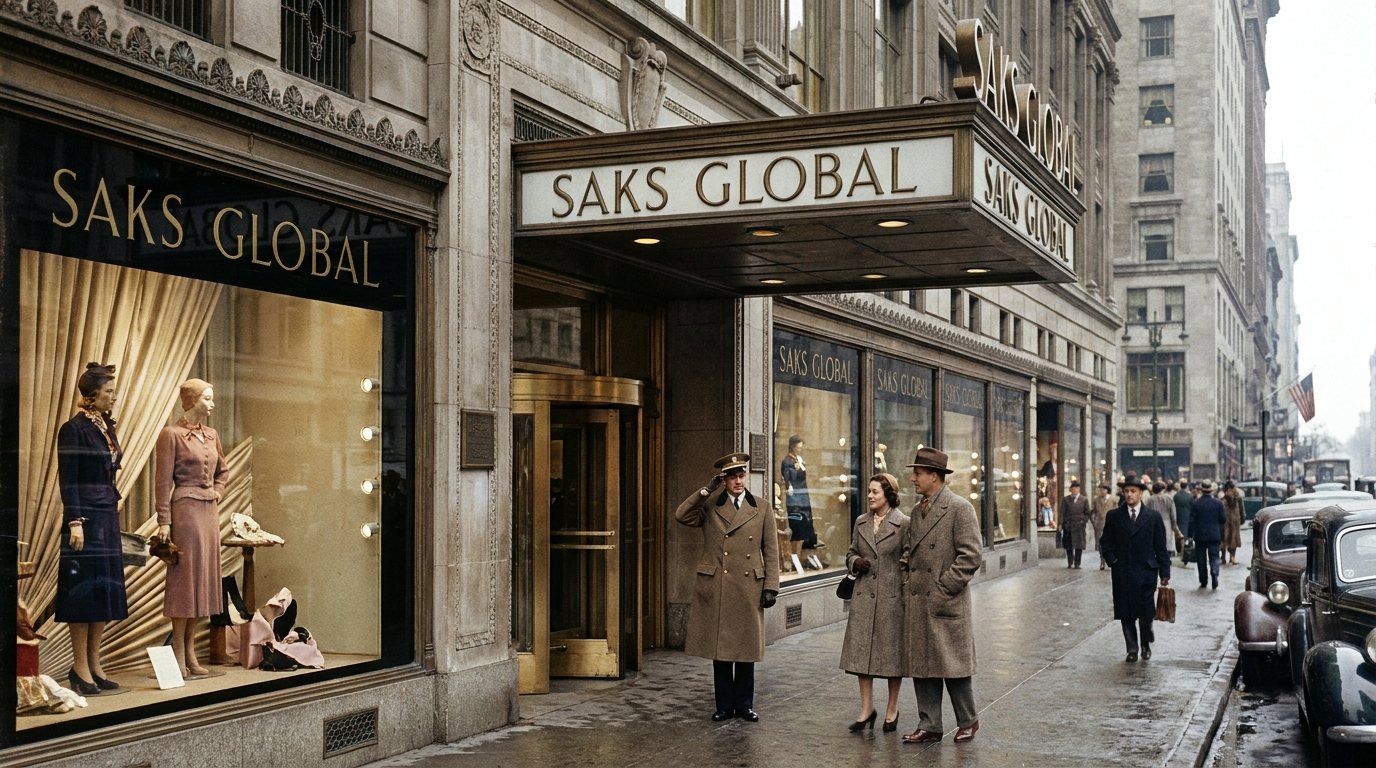
Part of Retailer Playbooks — history-first profiles of every company on the NRF Top 100 Retailers list.
Saks Global lands at #51 on NRF's Top 100 Retailers 2026 list, with $8.97 billion in 2025 U.S. retail sales, compiled annually by the National Retail Federation with Kantar. The name is new. The two businesses inside it are not. Saks Fifth Avenue and Neiman Marcus are each well over a century old, and the story of how they ended up under one roof says as much about the perils of debt-funded consolidation as it does about American luxury retail.
Two shopkeepers, two founding scenes
Saks traces back to 1867, when brothers Isadore and Andrew Saks opened "A. Saks & Co." in Washington, D.C.'s shopping district, built on then-radical ideas: one fixed price for everyone, and merchandise refunds. By 1896 the store had spread to Norfolk, Richmond, New York, and Indianapolis. In 1902 it planted a flag at Herald Square in Manhattan, and Andrew's sons Horace and William carried the business forward, according to Wikipedia's history of Saks Fifth Avenue.
Forty years later and a thousand miles south, Herbert Marcus Sr., his sister Carrie Marcus Neiman, and her husband Abraham Lincoln Neiman pooled $25,000 from a sales-promotion venture in Atlanta and opened a Dallas department store on September 10, 1907. Family lore holds that the trio had been offered stock in a fledgling beverage company called Coca-Cola and chose the store instead, a decision one later Neiman Marcus executive joked was "founded on bad business judgment." The store opened weeks into the Panic of 1907 and thrived anyway. A fire leveled the original building in 1914; the company rebuilt at Main and Ervay and kept growing, per Wikipedia's Neiman Marcus history.
Golden eras, built on spectacle
Both stores figured out early that luxury retail sells theater as much as merchandise. Saks merged with Gimbel Brothers in 1923 under Bernard Gimbel, a cousin of Horace Saks, and opened its famous Fifth Avenue flagship in September 1924, designed by Starrett & van Vleck and still the brand's signature address. Neiman Marcus, under Stanley Marcus's leadership from the 1950s through the 1970s, built a national reputation on Fortnight, its elaborate international theme showcases, and the Christmas Book, whose absurdist "His and Hers" gifts (his-and-hers submarines, camels, jets) turned a mail-order catalog into a cultural event.
The merger that should have been a warning
Here is the part of the story most retail profiles skip, and it is the piece worth naming plainly: Saks had already lived through almost this exact playbook once before, and it went badly.
In 1998, Proffitt's Inc., a Tennessee-based chain built through years of acquiring regional department stores (Younkers, Parisian, Carson Pirie Scott, and others) under CEO Brad Martin, bought Saks Fifth Avenue from Investcorp in a stock swap worth roughly $2.1 billion and renamed itself Saks Inc. The integration was rough. A national luxury nameplate did not behave like a regional department chain, merchandise strategy clashed, and the stock fell 55% within a year, according to FundingUniverse's company history of Saks Inc. A planned spin-off was floated in 2000 and shelved in 2001 when luxury sales softened further.
Saks eventually found steadier footing, sold to Hudson's Bay Company for $2.9 billion in 2013. Neiman Marcus, meanwhile, had its own reckoning: buried under leveraged-buyout debt from a prior private-equity ownership chain, it filed Chapter 11 in May 2020, citing the pandemic, and emerged four months later under new owners Davidson Kempner Capital Management and Sixth Street Partners.
Saks Global, and the debt came due again
HBC spun off its American assets in November 2024 to form Saks Global, which then acquired Neiman Marcus for roughly $2.65 billion, completing in December 2024 with backing from Amazon (which took about a 23% stake), Authentic Brands Group, G-III Apparel Group, and Salesforce. The pitch was scale: one company controlling the two most storied names in American luxury department stores, with data and supply-chain leverage neither could build alone.
The debt from that deal did not disappear, and within a year the strain surfaced in the oldest, most unglamorous place it always does: unpaid vendor invoices. By January 2026, Saks Global owed major suppliers hundreds of millions of dollars, including roughly $136 million to Chanel and nearly $60 million to Kering, according to Wikipedia's account of the company. Leadership churned fast: CEO Marc Metrick, a Saks veteran since 1995, was out on January 2, 2026; Richard Baker took over and lasted about two weeks; Geoffroy van Raemdonck, who had guided Neiman Marcus through its own 2020 bankruptcy, stepped in on January 14. The company filed for Chapter 11 the day before, on January 13, 2026, and emerged in June 2026 restructured under a new name, Exemplar Luxury Group, having cut its debt load by roughly 75%.
The unique insight
The two-founding-story version of this profile is the easy one. The less obvious read is that Saks was rescued from a debt-funded department-store roll-up once before, in 1998, and twenty-six years later walked into the same mechanism from the acquirer's chair, buying a second debt-laden asset it could not carry. Scale looked like the answer both times. Both times, the balance sheet decided otherwise before the strategy got a fair test.
Every ledger, catalog, and vendor invoice in this story is a version of the same problem: knowing exactly what you have, what you owe, and what it is worth, before the math catches up with you. That is the quiet infrastructure question underneath a century of retail history, and it rarely makes the headlines until the day it does.