
Signet Jewelers: How a Bad Joke Rebuilt an Industry Giant
Signet Jewelers is #74 on NRF's Top 100 with $6.20B in 2025 U.S. sales. Its path to owning Kay, Zales, and Jared ran through a near-fatal joke.
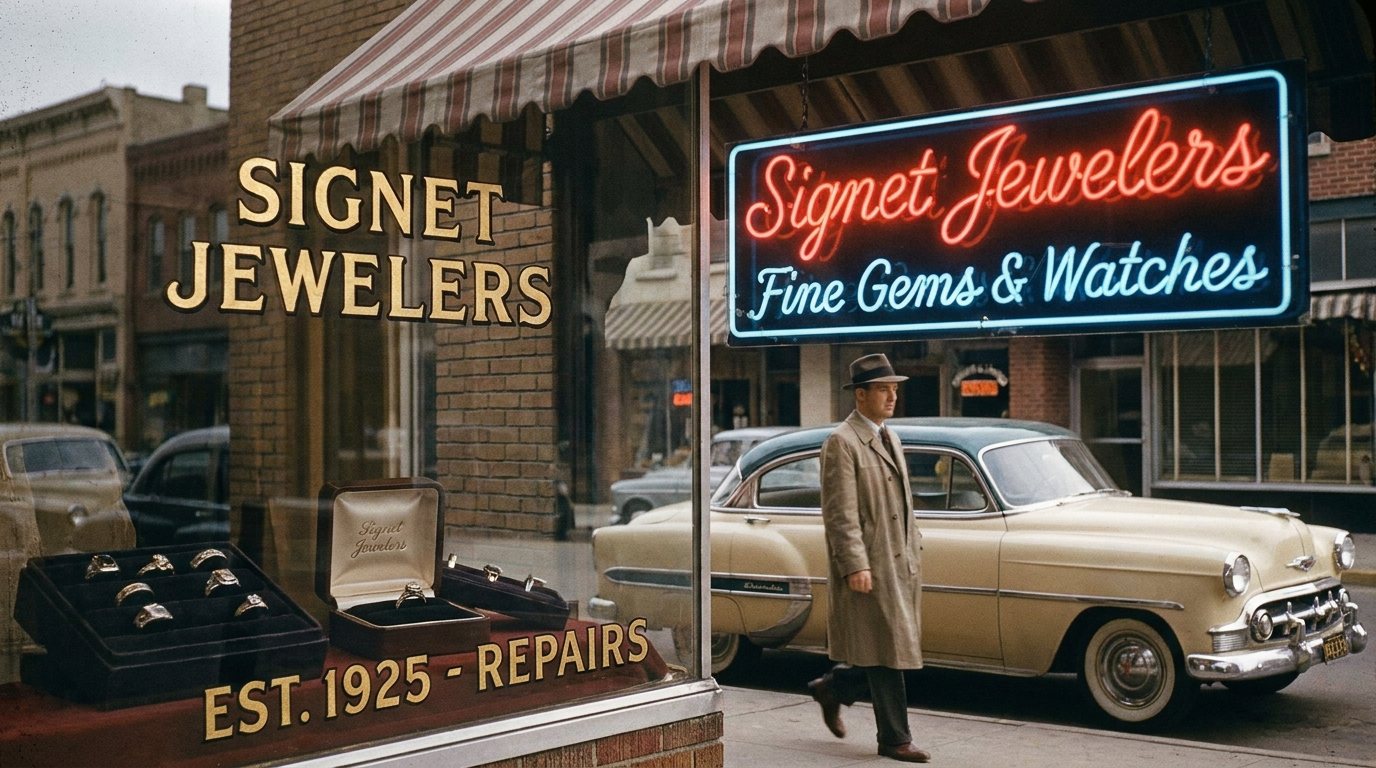
Part of Retailer Playbooks — history-first profiles of every company on the NRF Top 100 Retailers list.
Signet Jewelers ranks #74 on the NRF Top 100 Retailers 2026, the National Retail Federation's annual ranking compiled with Kantar, with $6.20 billion in 2025 U.S. retail sales. Almost nobody recognizes the Signet name. Nearly everybody recognizes what it owns: Kay, Jared, Zales. Getting all three under one roof took a British suburb, a brutally honest joke that erased half a billion pounds in market value, and a decades-long habit of buying America's jewelry counter one distressed chain at a time.
A shop in Richmond, 1949
Leslie Ratner opened a jewelry store in Richmond, Surrey, in 1949, and his son Gerald joined the business soon after. It grew the ordinary way at first: by the early 1970s, Ratners ran 45 shops and had crossed £2 million in sales; by the end of that decade, it had passed 150 stores. Nothing about that trajectory suggested a company that would one day own half of American mall jewelry, and nothing about it suggested a founder's son would nearly destroy it with a single sentence, either, according to FundingUniverse's company history.
The buying spree that built the company
Gerald Ratner took control in 1985 and turned Ratners into an acquisition machine. H. Samuel, then the UK's largest jeweler with over 350 stores, came in 1986. Ernest Jones followed in 1987 for the higher end of the market, the same year Ratners entered the United States by buying Ohio-based Sterling Inc., roughly 120 stores strong. In 1988 came a UK chain bought from Next along with the Zales operation, then Seattle's Weisfeld's in 1989. In 1990, Ratners bought Kay Jewelers, adding roughly 500 stores and pushing US operations past 1,000 locations. By 1988, UK holdings alone topped 650 stores and group sales had reached £360 million, per FundingUniverse.
There's a detail buried in that list worth pulling out: Sterling Jewelers, the vehicle that would eventually carry the Kay brand, traces to 1910, when Henry Shaw founded LeRoy's Jewelers in Lorain, Ohio, according to Wikipedia's account of Kay Jewelers. Ratners, the British company doing the buying, was 39 years younger than the American company it bought.
"Total crap"
On April 23, 1991, Gerald Ratner addressed the Institute of Directors at the Royal Albert Hall. Explaining how the company could sell jewelry so cheaply, he told the room one of his products was "total crap," and that a set of earrings was "cheaper than a prawn sandwich from Marks and Spencer's, but the sandwich will probably last longer." The line traveled everywhere. Customers stopped walking into stores bearing the Ratners name. The company's market value fell by an estimated £500 million, and by November 1992 the board had removed him, according to Wikipedia's entry on Ratner. The phrase "doing a Ratner" entered British business vocabulary as shorthand for talking your own company into the ground.
Rebuilding under a new name
In September 1993 the company renamed itself Signet Group, a clean break meant to separate the business from a name that had become a punchline. New management converted the old Ratners storefronts to the H. Samuel and Ernest Jones formats, closed nearly 300 UK stores by 1994, and sold off Watches of Switzerland and the Salisbury's chain. Shareholders pushed for a breakup twice, in 1995 and 1997, and lost both times. Signet returned to profitability in 1999, per FundingUniverse's history.
The center of gravity shifts west
Terry Burman took over as group CEO in 2000 and bet on a format called Jared, the Galleria of Jewelry: freestanding superstores roughly five times the size of a mall-based Kay location, built around onsite jewelers and a showroom feel rather than a kiosk counter. Signet bought Marks & Morgan Jewelers in 2000 for $161 million and converted most of its stores to Kay. By 2003, Jared accounted for a quarter of the company's US selling floor across 70 locations, with executives projecting it toward $1 billion in revenue.
In September 2008, Signet moved its primary stock listing from London to the New York Stock Exchange, renamed itself Signet Jewelers Limited, and redomiciled to Bermuda, while keeping its operating headquarters in Ohio, per Signet's Wikipedia entry. That single sequence of moves is the least obvious part of the company's story: a business born as a British high-street chain had, within two decades, converted itself into a Bermuda-domiciled, NYSE-listed holding company whose real center of gravity, its headquarters, its oldest brand, its largest market, sat in Ohio the whole time. Signet's corporate shell followed its American acquisitions rather than the other way around.
Completing the roll-up
The acquisitions kept coming. ULTRA Diamonds arrived in 2012 and was folded into Jared Vault and Kay outlet formats. Zale Corporation, the Texas company founded in 1924 by Morris and William Zale and Ben Lipshy in Wichita Falls, came next. Zale had built its own American footprint on an innovation of its own, a "penny down and a dollar a week" credit plan that made jewelry affordable to working families, per Wikipedia's history of Zale Corporation. Zale had also survived its own near-death moment, a Chapter 11 filing in January 1992, coincidentally the same year Ratner was ousted an ocean away. Signet bought Zale in February 2014 for $1.4 billion, merging two companies that had each been rebuilt after their own crisis.
Signet kept pushing into digital retail from there, buying R2Net, parent of JamesAllen.com, for $328 million in 2017. When the pandemic hit, Signet closed more than 80 UK stores and leaned hard into e-commerce; online sales reached $1.2 billion for the fiscal year ended January 30, 2021.
What Signet is today
Signet now operates more than a dozen banners across roughly 2,600 locations and employs close to 28,000 people worldwide, with J.K. Symancyk as CEO following Virginia Drosos, who took over in 2017 from Mark Light. The through-line across 75 years is consistent even as the map has changed: buy a jeweler in trouble, fold it into an existing format or let it stand alone, and keep the name that customers already trust on the storefront.
Every ring case at Kay, Zales, or Jared is really an inventory of small, individually certified objects, each with its own provenance, grading, and appraisal paperwork trailing behind it, the least glamorous kind of retail data there is. This series covers the companies that built modern American retail store by store, deal by deal, and system by system.