
Singer Industrial: A Roll-Up That Won't Erase Its Brands
Singer Industrial ranks No. 3 in Hose on MDM's 2026 list. Its real edge is Coordinated Autonomy: buying old rubber and hose shops without renaming a single truck.
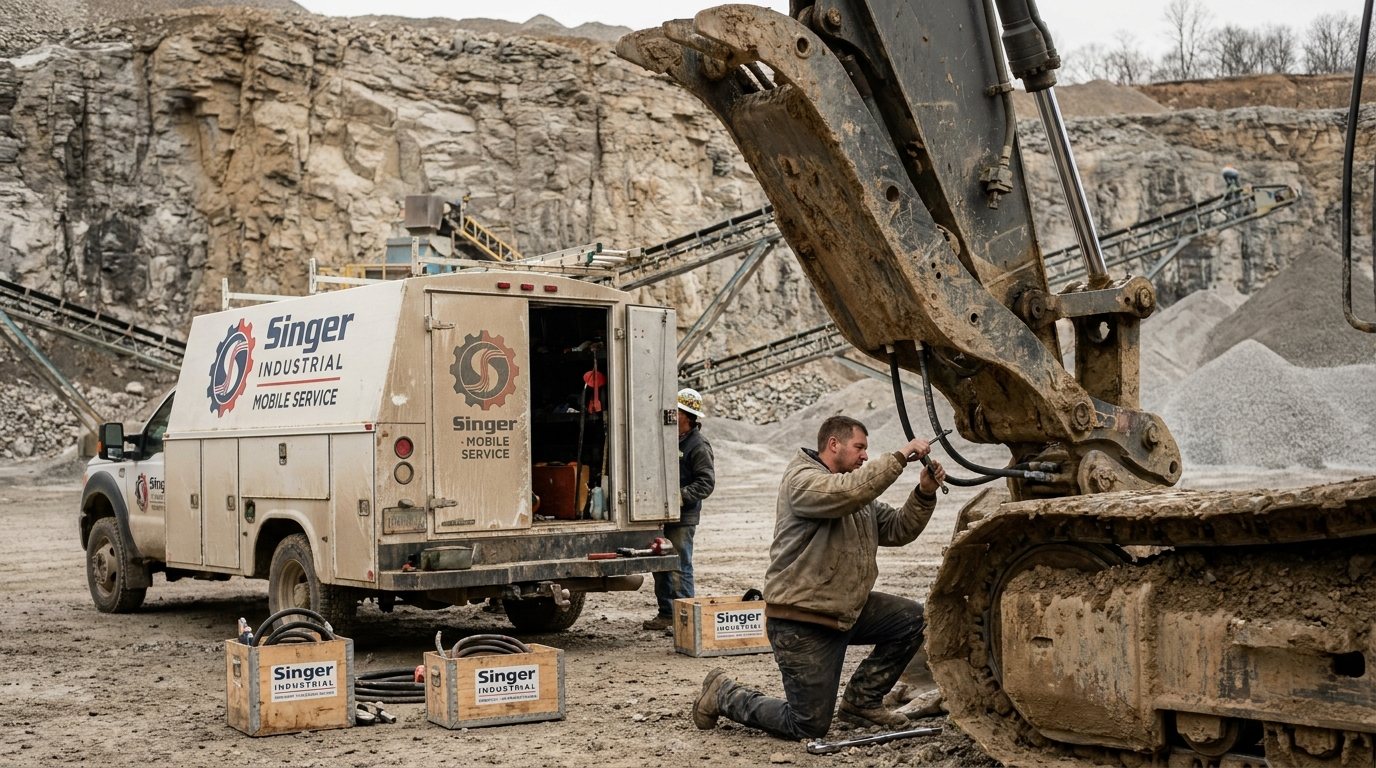
Part of Distributor Playbooks — strategy teardowns of every company on the MDM Top Distributors lists.
In February 2026, Singer Industrial's leadership published a company post arguing that "growth isn't limited to acquisitions, new markets, or expanded capabilities. It's about people." That is an unusual thing for a company built almost entirely through acquisitions to say out loud. Modern Distribution Management's 2026 Top Distributors list backs up the results either way, placing Singer Industrial No. 3 in Hose, No. 14 in Fluid Power, and No. 33 in Industrial Supply — up three spots in Industrial Supply from the year before — ranking it against every large distributor in North America across 20 verticals.
From Singer Equities to a 48-brand federation
Singer Industrial traces back to 1999 as Singer Equities, a hose and rubber distributor that caught the attention of AEA Investors, a New York private equity firm, which made its first investment in the company in 2011. Under AEA, the company operated for years as Singer Bishop Products (SBP) Holdings before formally rebranding to Singer Industrial in 2023. By AEA's own count, the platform has completed nearly 30 acquisitions since that 2011 investment, according to the firm's continuation fund announcement. The company today runs nearly 1,500 employees across more than 100 U.S. and Canadian locations, organized into more than 48 operating brands spanning industrial rubber, hose, gaskets, conveyor belting, fluid power, and automation.
| MDM 2026 category | Rank |
|---|---|
| Hose | 3 |
| Fluid Power | 14 |
| Industrial Supply | 33 |
The moat: Coordinated Autonomy
Singer Industrial's leadership calls its operating model Coordinated Autonomy, and the name is meant literally. The company centralizes the functions that benefit from scale across a fragmented, low-margin distribution category: payroll, banking relationships, health benefits, and a shared ERP system built on Epicor Prophet 21. Everything closer to the customer, pricing calls, hiring, local supplier relationships, even the name over the door, stays with the operating company. As leadership frames it on the company's site: "Why acquire great leaders and then tell them how to run their business?"
That is the standard pitch of any decentralized roll-up. What makes Singer's version worth studying is how far it goes. Browse the brand list and you find PRC Industrial Supply, which marked 130 years in business, Hanna Rubber at 100 years, Hampton Rubber at 70, and Smith Industrial Rubber and Plastics celebrating 50 this July. These are not shells wearing a new logo. They are independent, often family-founded hose and rubber shops that Singer bought and then left alone to keep being the local hose guy a plant manager has called for three decades.
The unique bet: heritage as an asset, not friction
Most industrial roll-ups eventually flatten what they buy. A national brand and a single go-to-market motion are easier to sell, easier to market, and easier to explain to a board. Singer Industrial has spent a quarter century doing close to the opposite. Twenty-five years and roughly 30 acquisitions in, it still operates under 48 separate names instead of one master brand, and it is still adding to that list: this spring it announced a partnership with Conveyor Consulting and Rubber Corporation, a Florida and Ohio operator that keeps its own identity too. The bet is that a century of local trust in a specific plant or county is worth more intact than folded into a corporate rebrand, and that a shared back office is enough glue to hold a federation of that size together without anyone needing to agree on a common name.
The financial structure backs the same conviction. When AEA revisited its stake in 2023, it did not sell Singer Industrial to a new sponsor, the usual move at the end of a five-to-seven-year private equity hold. It rolled the company into a $384 million continuation fund, bringing in Apollo S3 and LGT Capital Partners alongside existing investors, and kept building. A continuation vehicle is a bet that the platform is worth compounding for another cycle rather than flipping, and Singer's leadership succession reads the same way. When President Pete Haberbosch was named CEO in April 2026, the company promoted from inside rather than recruiting an outside operator, with Chairman Don Fritzinger crediting Haberbosch as the person who built the Coordinated Autonomy model in the first place.
Where the model gets tested
A federation of 48 named brands has a real cost. National accounts that want one contract, one item master, and one online storefront across a multi-state footprint do not care that the local rubber shop has a great reputation with the plant down the road. They want one point of contact and one part number that resolves the same way in Texas and Ontario. Singer Industrial's diversification post frames its spread across industries and geographies as deliberate insulation against any single end market's downturn, which is a reasonable read of the same structure. Whether Coordinated Autonomy can also produce a unified digital front end for large, multi-site customers, without asking Hanna Rubber or PRC Industrial Supply to stop feeling like themselves, is the open question for the next decade of the roll-up.
A hose distributor's real product is rarely the hose. It is the truck that shows up before the line goes down, the branch that answers the phone, and, increasingly, the catalog and part data behind both. This is the Distributor Playbooks series.