
Sprouts Farmers Market: The Grocer Reborn From Its Own Breakup
Sprouts Farmers Market, NRF's #53 US retailer, traces back to a 1943 fruit stand split apart by the Whole Foods-Wild Oats antitrust fight of 2007.
Part of Retailer Playbooks — history-first profiles of every company on the NRF Top 100 Retailers list.
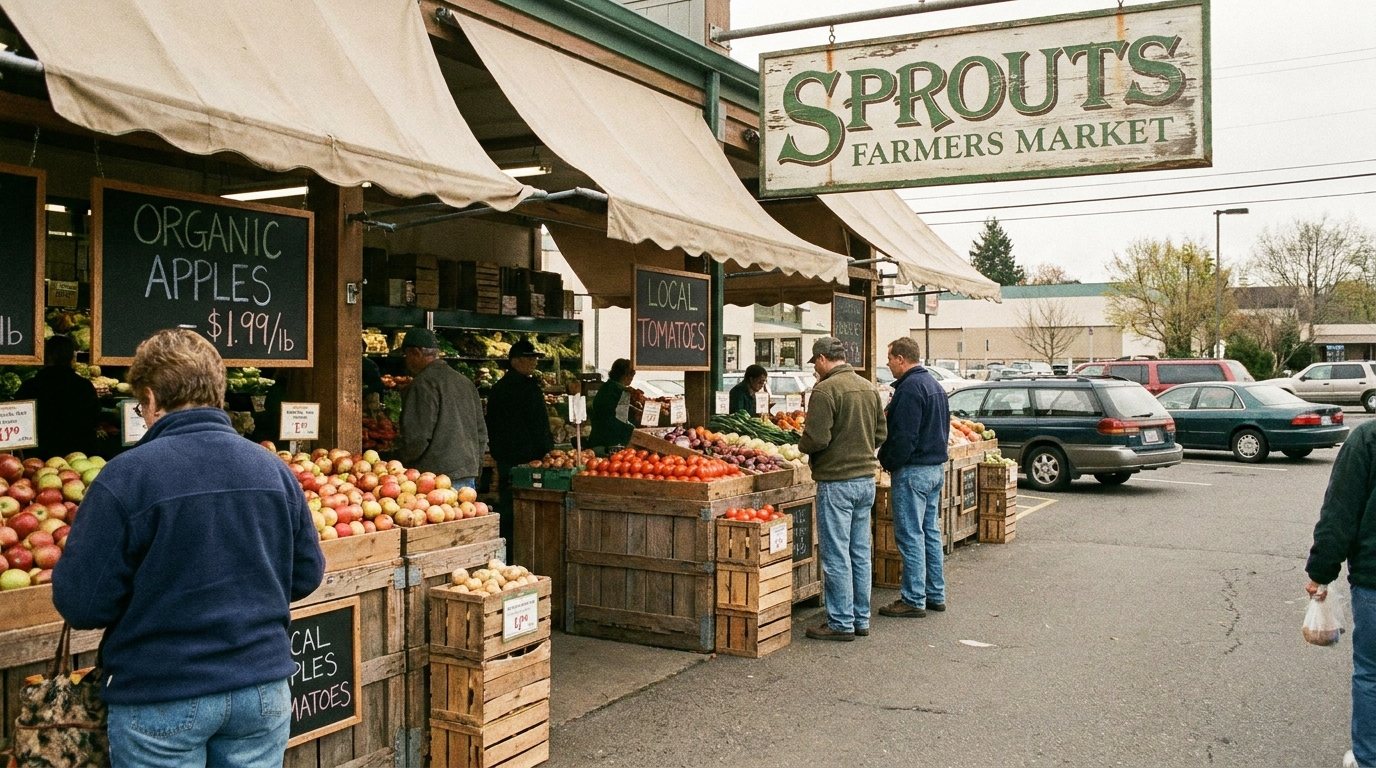
Sprouts Farmers Market lands at #53 on NRF's Top 100 Retailers 2026 list, with $8.81 billion in 2025 U.S. retail sales. The chain markets itself as an upstart alternative to conventional supermarkets, all farm stands and open bins of produce. The real story is stranger: Sprouts is a family grocery business that got broken apart by one of the most consequential antitrust cases in American retail, then quietly reassembled itself around the wreckage.
A fruit stand, twice
In 1943, Henry Boney set up a fresh-fruit stand on a street corner in San Diego, starting with a single truckload of peaches. His sons grew it into Boney's Market, a neighborhood grocery chain, and by 1997 the family had rebranded its stores as Henry's Farmers Market, honoring the founder while keeping his produce-forward, open-air layout as the organizing idea of the store (Wikipedia).
In 1999, with 23 Henry's stores across Southern California and one in the north, the Boney family sold the chain to Wild Oats Markets, the Boulder-based natural foods retailer that was racing Whole Foods to consolidate the health-food category (Wikipedia). Most founders would have stopped there. The Boneys instead started over. In July 2002, they opened the first Sprouts Farmers Market in Chandler, Arizona, rebuilding the same produce-centered concept from scratch under a new name in a new state, with no legal claim on the stores that still carried their father's name (Wikipedia).
The deal that never should have happened
Five years later, the business the Boneys had sold walked into a landmark fight. On February 21, 2007, Whole Foods Market announced a roughly $565 million deal to acquire Wild Oats, its only real national competitor in premium natural and organic groceries. The Federal Trade Commission moved to block it that June, arguing the merger would eliminate competition in a market of "mission driven" shoppers willing to pay a premium for natural and organic goods. Whole Foods closed the deal anyway while the case proceeded, and lost on appeal in July 2008, when the D.C. Circuit sided with the FTC and recognized premium natural-and-organic supermarkets as their own distinct market, a decision still cited in antitrust cases today (Wikipedia).
Along the way, in October 2007, Whole Foods sold off the Henry's Farmers Market and Sun Harvest banners it had just inherited through Wild Oats, unloading 35 stores to Los Angeles grocer Smart & Final for $166 million (Wikipedia). The stores Henry Boney's sons had built were now three owners removed from the family, sitting inside a private-equity-owned discount grocery conglomerate.
Reunited by the buyer who owned both sides
That buyer was Apollo Global Management, which had backed both the Sprouts side of the business and, through its Smart & Final holdings, the old Henry's and Sun Harvest stores. In the second quarter of 2011, Apollo merged them. The combined company took the Sprouts name, not Henry's, and launched with 98 stores and more than 7,000 employees (Wikipedia). The Boney family's original stores had come home, absorbed into the company the family had rebuilt after losing them, under a private equity firm's spreadsheet rather than any family reunion.
That is the detail that rarely makes it into a Sprouts profile: the retailer's growth story is inseparable from the Whole Foods-Wild Oats antitrust case, one of the few grocery mergers ever unwound by a federal court. Without that fight scattering the old Henry's stores back into private-equity hands, there is no easy 2011 path for Apollo to staple them onto Sprouts and double the store count in a single transaction.
From merger to public company
The pace didn't slow after the merger. In 2012, Sprouts acquired the Sunflower Farmers Market chain and converted its stores to the Sprouts banner, extending the format into new markets without building from the ground up. In 2013, Sprouts went public on Nasdaq, and by 2015 Apollo had fully exited, selling its remaining roughly 10.4 percent stake and severing the private equity thread that had run through the company since the 2011 merger (Wikipedia).
What survived every ownership change was the format itself: a smaller box than a conventional supermarket, produce as the visual and financial center of the store, an assortment built around natural, organic, and specialty-diet shopping rather than a full-basket trip. Sprouts today runs more than 400 stores carrying its own private label across more than 2,400 items, still organized around the same open-bin produce section Henry Boney's sons put at the front of Boney's Market decades ago (Sprouts).
The unglamorous through-line
Every merger, divestiture, and rebrand in this history was really a fight over the same asset: a produce-forward store format that a family had already proven twice, in two different decades, under two different names. The corporate ownership changed hands five times. The idea inside the box barely moved.
Retail history keeps circling back to the same unglamorous machinery: which format survives, which supply chain holds, which store layout keeps customers coming back regardless of who owns the name on the door. This series exists to trace that machinery, one retailer at a time.