
How Staples Built the Office Superstore, Then Outgrew the Store
Staples ranks #75 on NRF's 2026 Top 100 with $6.10B in U.S. retail sales. The history behind the warehouse chain that split itself in two to survive.
Part of Retailer Playbooks — history-first profiles of every company on the NRF Top 100 Retailers list.
Staples sits at #75 on the National Retail Federation's Top 100 Retailers 2026 list, compiled with Kantar, with $6.10 billion in 2025 U.S. retail sales. That figure only tells you about the stores you can walk into. The more interesting story is the one where Staples split itself into pieces to keep the parts that mattered.
A printer ribbon on the Fourth of July
Thomas Stemberg was a grocery executive, a Harvard MBA who'd spent his career at Jewel Company's Star Markets division learning how supermarkets used scale and warehouse logistics to beat corner stores on price. In the summer of 1985 he needed a printer ribbon for a home computer and discovered every office supply dealer in town was closed for the holiday. The frustration crystallized an idea he'd already been circling: office supplies, sold the way groceries were sold, in a warehouse format, direct from manufacturers, at prices small businesses couldn't get from a local stationer.
He needed a partner who knew the format, and he found one in an old rival. Leo Kahn had competed against Stemberg in the Boston grocery business for years. Kahn put in $500,000, and together with Myra Hart they opened the first Staples in Brighton, Massachusetts on May 1, 1986, backed by venture money that included a young Bain Capital, where Mitt Romney sat on the board for the next fifteen years, according to Wikipedia.
The idea almost didn't take
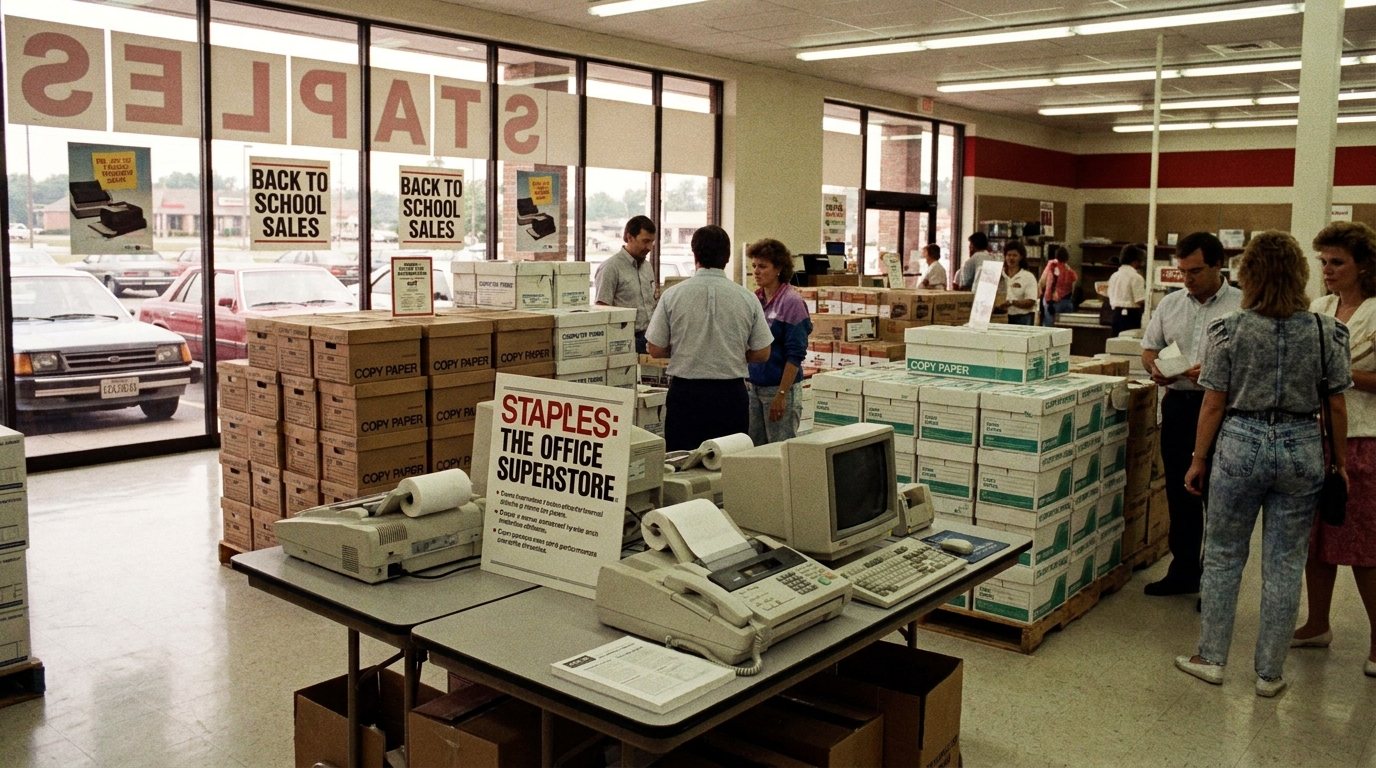
The first store was 14,000 square feet of exposed warehouse shelving stocked with paper, pens, and toner, priced as much as half off what a traditional stationer charged. It looked nothing like a store people trusted. An early marketing push mailed 35 gift certificates to nearby businesses; nine came back, according to FundingUniverse's company history. Staples responded by pouring more than a million dollars into database systems and telemarketing to build a customer list from scratch, essentially building a direct-response infrastructure business underneath the retail one before either had proven itself.
It worked, slowly. Staples didn't turn a profit until January 1989, after racking up $14.1 million in losses. That same year it went public, raising $37 million, with sales at $120 million. From there the climb was fast: California in 1990, a Canadian arm (Business Depot) in 1991, UK stores in 1992. By 1995, Staples had crossed $3 billion in sales inside ten years of opening its first store, a pace FundingUniverse credits as unmatched by any retailer before it. The 1,000th store opened in 1999.
Blocked twice, and it didn't matter
Staples tried to buy its way to dominance in 1996, offering $3.36 billion for Office Depot in a deal that would have created a combined chain of 1,100 stores. The Federal Trade Commission blocked it in 1997, arguing the merger would let the combined company raise prices as much as 10 percent in markets where the two chains were the only superstore competition. Staples tried again in 2015, in a deal aimed at fending off Amazon's growing office-supplies push, and the FTC blocked that one too.
Both rejections read, in hindsight, like a company trying to solve an e-commerce problem with a real-estate merger. The superstore format that made Staples's name was built on undercutting local dealers through scale purchasing and warehouse logistics. Two decades later, Amazon was running the same play against Staples itself, minus the buildings. No merger with Office Depot would have fixed that.
The quieter acquisition that mattered more
While the Office Depot deals dominated headlines, Staples's most consequential purchases were less glamorous. Quill Corporation, a business-to-business mail-order office supplier, came aboard in 1998 for roughly $685 million. Corporate Express, a Dutch office-products wholesaler, followed in 2008 and was folded into what became Staples Advantage. Neither had a single retail storefront. Both were delivery-and-catalog businesses selling directly to companies' purchasing departments, the exact model Stemberg had set out to disrupt with a warehouse aesthetic twelve years earlier.
That's the detail easy to miss reading a company history that leads with the stores: Staples spent three decades building two different businesses under one name, a walk-in superstore chain and a B2B supply and delivery operation, and the second one turned out to be the more durable asset. When Sycamore Partners bought Staples for $6.9 billion in 2017, it didn't just take the company private. It split the U.S. retail stores, Staples Canada, and the B2B business into three separately managed entities under common ownership, according to Wikipedia. The name over the door and the operation shipping toner to a law firm's mailroom stopped being one company in any operational sense.
What #75 actually measures
The NRF ranking counts U.S. retail sales, which is why Staples shows up at $6.10 billion rather than the roughly $8 billion the broader enterprise reported in 2024 across all three units. The 827 U.S. stores still standing today are a fraction of the footprint at Staples's peak, and they're now just one leg of a company that makes at least as much of its living selling to businesses that never set foot in one.
Stemberg died in 2015, a year before Sycamore's buyout closed, having already moved on to a second career in venture capital a decade earlier, according to Wikipedia. He didn't live to see the format he invented get restructured into something closer to what Kahn and he had actually built from the start: a supply chain wearing a storefront.
Every company on this list is, underneath the brand, a bet on how goods move from a warehouse to a customer. Staples just happens to have run that bet twice, in public, forty years apart.