
Stater Bros.: How Two Brothers Built a Grocery Institution
Stater Bros. ranks #86 on the NRF Top 100 with $4.81B in 2025 sales. The history behind twin founders, a union-backed proxy fight, and a strike it sidestepped.
Part of Retailer Playbooks — history-first profiles of every company on the NRF Top 100 Retailers list.
Stater Bros. sits at No. 86 on the NRF Top 100 Retailers 2026, the National Retail Federation's annual ranking compiled with Kantar, with $4.81 billion in 2025 U.S. retail sales. That's a serious number for a company that has spent ninety years operating almost entirely within one corner of California. The story of how it got there runs through a Depression-era down payment, a boardroom fight settled by grocery clerks, and a labor strike the company simply opted out of.
A $300 loan from the store across the street
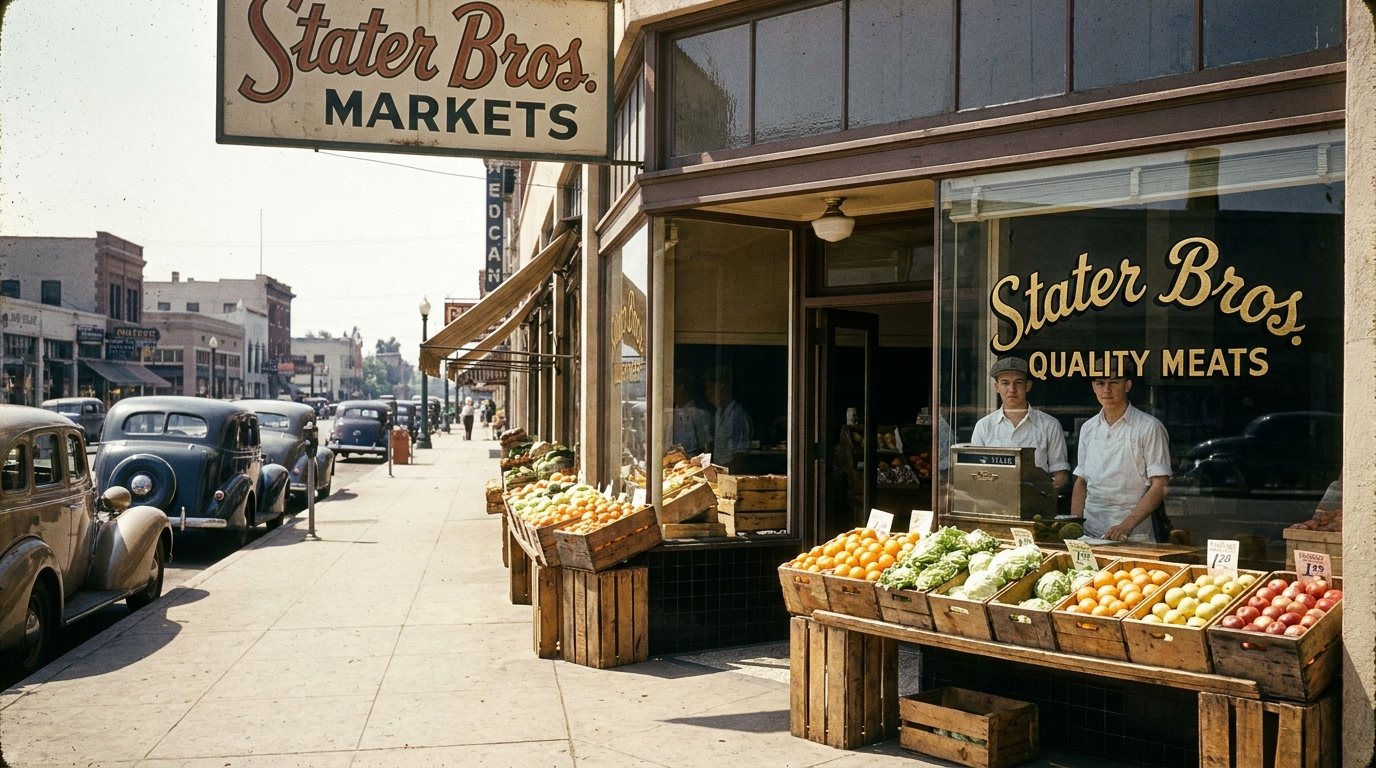
In August 1936, 24-year-old Cleo Stater worked for a small grocer named W.A. Davis in Yucaipa, California. Cleo and his twin brother Leo wanted to buy Davis out, but they were short. Davis wanted $10,000 down. The brothers could only scrape together $300, and according to the Wikipedia account of the company's founding, it was the owner of a competing market across the street who fronted them the rest so the deal could close. That is how Stater Bros. began: one grocer helping two kids buy out a third, on handshake credit, in the middle of the worst economy of the twentieth century.
The Staters ran the business on strict cash terms and a simple promise of the lowest possible prices to working families, and it worked. Through the late 1930s they added stores in Redlands, Bloomington, Colton, and Fontana, per FundingUniverse's company history. When World War II came, Cleo and Leo left to fly for the Army Air Corps, and their parents kept the stores running until they came home.
The supermarket bet
The real inflection point came in April 1948, when the brothers opened a 12,500-square-foot store in Riverside, a genuine supermarket with air conditioning, fluorescent lighting, and piped-in music, all novel amenities for a grocery store at the time. It threw off close to a 100 percent return on investment, and the Staters used that cash to keep expanding without taking on debt. By 1967 the chain ran 32 stores across 20 cities and did nearly $77 million in sales.
That growth attracted a buyer. In July 1968 the Stater brothers sold the company to Petrolane, Inc., a Long Beach energy conglomerate, for roughly $32 million. Under corporate ownership the chain kept opening stores, reaching 83 locations by 1980, but it lagged the rest of the industry on basics like barcode scanning, which Stater Bros. didn't adopt until 1979.
The fight that unions won for management
The company's most unusual chapter starts in 1981, when Petrolane brought in Jack Brown, a career grocery man who had started bagging at age 13, to fix the chain's profitability. Brown moved fast. In 1983 he led an investor group, alongside financier Bernard Garrett, that bought Stater Bros. outright for $110 million. Garrett held 51 percent of the new company and Brown's group held 49.
The company went public in late 1985. Within months, Garrett accused Brown of manipulating the stock and moved to force him out in a boardroom fight. Brown fought back by going to the people who actually ran the stores: the Teamsters and the United Food and Commercial Workers. Both unions bought Stater Bros. stock specifically to back Brown's side of the proxy contest, an arrangement rare enough that it's the detail most retail histories of the company skip past. Brown won after five months, and with financing from Craig Corporation, La Cadena Investments took the chain private again in 1987. La Cadena became the sole owner in 1993 and controls the company to this day.
It's a small, underappreciated fact about Stater Bros.: the company's independence in the late 1980s was preserved not by a white-knight financier but by its own rank-and-file workforce placing a direct bet on management. That relationship with labor didn't stay a one-time event.
Sitting out the strike
In 1999, regulators forced Albertsons to divest stores as part of its merger with American Stores, and Stater Bros. picked up 43 of them, 33 Albertsons and 10 Lucky locations, for $147.2 million, pushing the chain to 155 stores and opening up Antelope Valley and San Diego County as new territory, per the Encyclopedia.com company history entry.
Then, heading into contract talks in 2002 and 2003, Brown made a quieter but sharper move. Rather than negotiate its own union contract, Stater Bros. simply agreed in advance to accept whatever terms the "Big Three" Southern California chains, Kroger's Ralphs, Albertsons, and Vons, worked out with the same unions. When those three chains locked out and struck against the UFCW in October 2003, in what became one of the longest supermarket labor disputes in U.S. history, Stater Bros. stayed open and fully staffed the entire time. Shoppers who couldn't cross picket lines at Ralphs or Vons had somewhere else to go, and Stater Bros. picked up customers for months without ever entering the fight. It's the same instinct that showed up in 1986, just aimed outward instead of inward: treat labor stability as a competitive weapon rather than a cost to be minimized.
What that patience bought
By 2004 the chain had grown to about 158 stores and $2.75 billion in annual sales, and it broke ground on a $200 million distribution center designed to consolidate eight older facilities into one, a project that grew into a two-million-square-foot complex near San Bernardino International Airport. That single warehouse still anchors a company Fortune ranked at No. 493 in 2006, the first Inland Empire-based company ever to make that list. Jack Brown ran the company for 35 years before his death in 2016; Pete Van Helden has led it since. Stater Bros. now operates 171 stores, all still concentrated in the Southern California counties where two brothers borrowed $300 to buy a corner grocery.
Every retailer on this list has a distribution center, a supply contract, or a catalog nobody sees. Stater Bros.'s is a warehouse the size of forty football fields, built with the same patience that got the company through 1936, 1986, and 2003 without ever leaving its home turf.