
Stauffer Glove and Safety: Five Generations, Still Family-Run
How Stauffer Glove and Safety, family-run since 1907 and ranked #18 in Safety on MDM's 2026 Top Distributors list, stayed independent as its channel consolidated.
Part of Distributor Playbooks — strategy teardowns of every company on the MDM Top Distributors lists.
Stauffer Glove and Safety runs nine distribution centers out of Red Hill, Pennsylvania, and lands at #18 in the Safety category on Modern Distribution Management's 2026 Top Distributors list, down three spots from #15 in 2025, the trade publication's annual ranking of North America's largest distributors across 20 verticals. The company has been in the same family's hands since 1907. In a channel that has spent the last two decades being bought, rolled up, and taken public, that alone is worth a closer look.
A hand-protection shop that outlasted its own name
The name is a fossil record. A business called "Glove" a century after founding almost always started as exactly that: a hand-protection specialist, before the category widened into head, eye, hearing, respiratory, and fall protection that today's PPE distributors carry. Stauffer's own materials describe more than 110 years of experience and five generations of continuous family ownership, still headquartered at 361 E. Sixth Street in Red Hill, the same small town in Montgomery County where it presumably began. Companies that survive five ownership transitions inside one family tend to have done it through discipline rather than drama: no dramatic pivot, just a narrow specialty expanded one adjacent category at a time until it could plausibly call itself a full-line safety distributor.
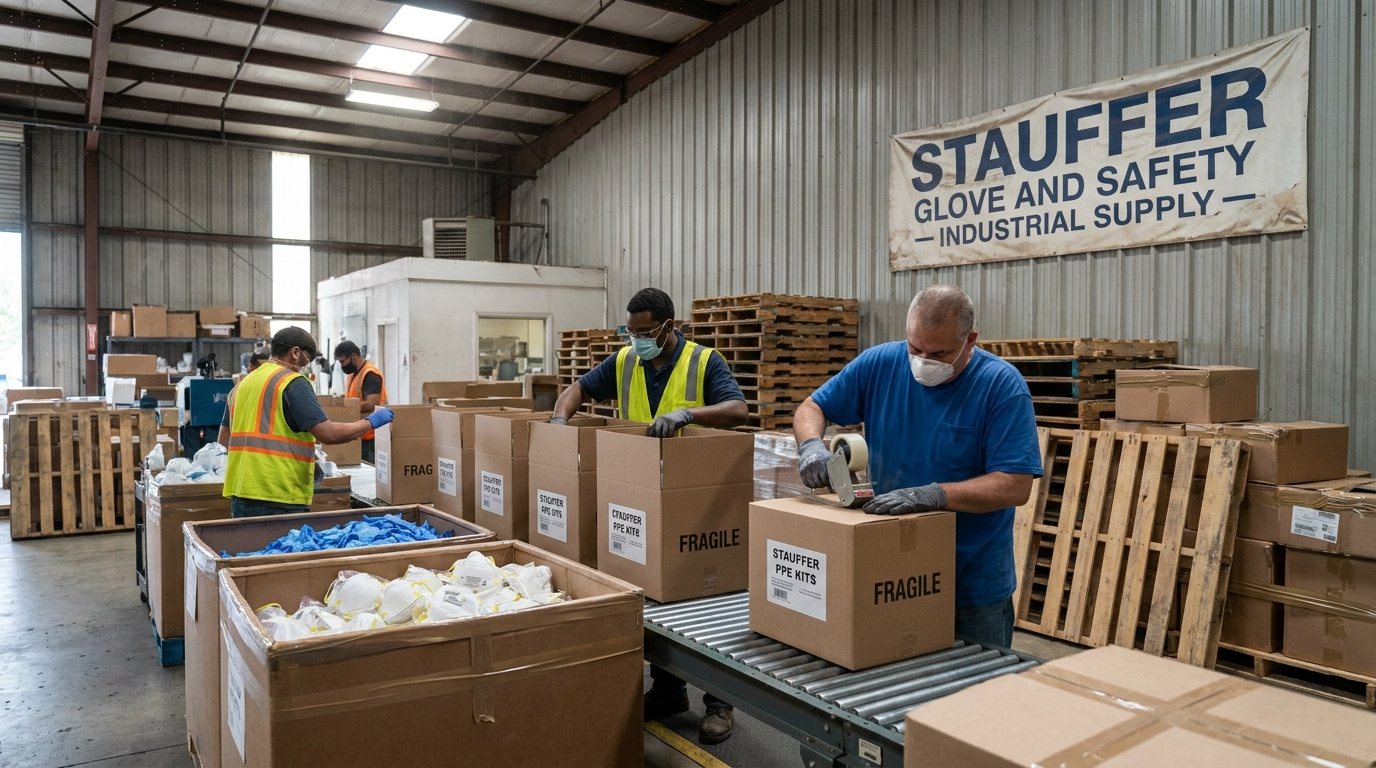
That expansion shows up in the supplier list. Stauffer carries 3M, Ansell, DuPont, Protective Industrial Products, Honeywell, MSA, Martor, and Master Lock, which is the roster of a distributor that sells relationships and inventory depth, not a proprietary brand. Nine facilities today, stretching from Michigan City, Indiana and Canton, Ohio to Rocky Mount, North Carolina, Buford, Georgia, Springdale, Arkansas, and Fresno, California, backed by roughly 300,000 square feet of warehouse space and a workforce in the low-to-mid hundreds. That is a company sized to serve regional industrial and manufacturing accounts well, not to chase the biggest national contracts against Grainger or Fastenal on price alone.
The insight: "family-owned" means wildly different things in this channel
Here is the part worth naming plainly. Safety and industrial-supply distribution loves to describe itself as family-owned, and on paper that is often true. Sonepar, one of the largest electrical, industrial, and safety distributors on the continent, calls itself "an independent family-owned company with global market leadership." It also posted roughly $37.9 billion in worldwide sales in 2025, $16.5 billion of that in the US alone, across more than 570 American locations. Airgas, another safety-adjacent giant, spent decades building scale before Air Liquide bought it for $13.4 billion in 2016. Both are proof that "family-owned" and "consolidated" are not opposites in this industry. They can describe the same company.
Stauffer's version of family ownership is a different animal entirely: nine branches, a few hundred employees, one family, no financial sponsor, no roll-up strategy, and (per MDM's own reporting) revenue the company doesn't disclose publicly. That is the real strategic choice on display here, and it is easy to miss because the marketing language sounds identical to Sonepar's. Staying at this scale, deliberately or not, is what let Stauffer stay a Pennsylvania company with a Pennsylvania address rather than becoming a subsidiary line item inside a European conglomerate's 10-K.
The trade-off nobody puts on the About page
Staying independent and mid-sized in a channel where the biggest players are either public companies or globally financed platforms is not a free lunch. It caps access to the kind of capital that funds rapid branch expansion, ERP overhauls, or a national e-commerce buildout in a single budget cycle. It means competing for supplier allocation and freight terms against companies with ten times the purchasing volume. And it puts a lot of weight on succession: five generations in, the sixth eventually has to want the job, or a family-run distributor becomes an acquisition target itself. Every regional safety distributor that got absorbed into Vallen, Grainger, or a Sonepar affiliate over the past fifteen years started out looking a lot like Stauffer looks today.
What that scale buys back is control and speed. A nine-branch operation can make a stocking decision, take a customer risk, or shift a delivery route without a regional VP signing off through three layers of a holding company. For customers buying gloves, hearing protection, and cut-resistant gear by the pallet for a plant floor, the person on the other end of the phone at a family-run distributor has usually been doing that specific job, in that specific territory, for a long time. That is a real service advantage, and it is the trade-off Stauffer has apparently decided is worth the ceiling on scale.
Recent posture
Stauffer's public footprint in 2025 and 2026 reads like a company still building out the basics rather than announcing acquisitions: active hiring across its distribution centers, steady product content on gloves, hearing protection, and cutting solutions, and no signs of the leadership turnover or M&A activity that typically precede a sale. For a fifth-generation operator with 110-plus years behind it, quiet continuity may be the whole strategy.
Distribution's biggest stories are usually about scale. This one is about the choice not to chase it, and what that choice costs and buys in a channel where "family-owned" can mean either a nine-branch business or a multibillion-dollar continental platform. Every distributor on the MDM list, family-run or PE-backed, wins or loses on the same unglamorous infrastructure: what's in the warehouse, what the catalog says about it, and how fast it moves.