
Target: How a Minneapolis Dry-Goods Store Invented Cheap Chic
Target ranks #8 on NRF's 2026 Top 100 with $102.72B in U.S. sales. Its real edge traces to a department-store pedigree its 1962 rivals never had.
Part of Retailer Playbooks — history-first profiles of every company on the NRF Top 100 Retailers list.
Target is No. 8 on the NRF Top 100 Retailers 2026 list, with $102.72 billion in 2025 U.S. retail sales, compiled annually by the National Retail Federation with Kantar. The bullseye is one of the most recognized logos in American commerce, but the company behind it started 60 years before that logo existed, as a dry-goods store in downtown Minneapolis run on Presbyterian principles.
A minister who became a merchant
George Draper Dayton wanted to be a minister. Business found him instead. Born in 1857 in Clifton Springs, New York, he moved to Minnesota in 1883 and built early wealth in mortgages and banking before turning to retail. In 1902 he bought a struggling operation called Goodfellow & Co. on Nicollet Avenue and reorganized it as Dayton's Dry Goods Company, according to Wikipedia's history of Dayton's. The store didn't sell liquor and didn't open on Sundays, per FundingUniverse's company history. Dayton ran it as an extension of his belief in "the service of others," a philosophy he carried into the Dayton Foundation and decades of civic giving in Minneapolis.
By the 1920s the store was a multimillion-dollar business. When George's son Nelson took over in 1938, the company was already valued at $14 million. Nelson died in 1950, and leadership passed to five Dayton cousins, a generational handoff that could easily have calcified into a comfortable, regional department-store chain. Instead the cousins modernized aggressively. In 1956 they opened Southdale Center in suburban Edina, the first fully enclosed, climate-controlled shopping mall in the United States, a format that would reshape American retail geography for the next half-century.
The bet that mattered: 1962
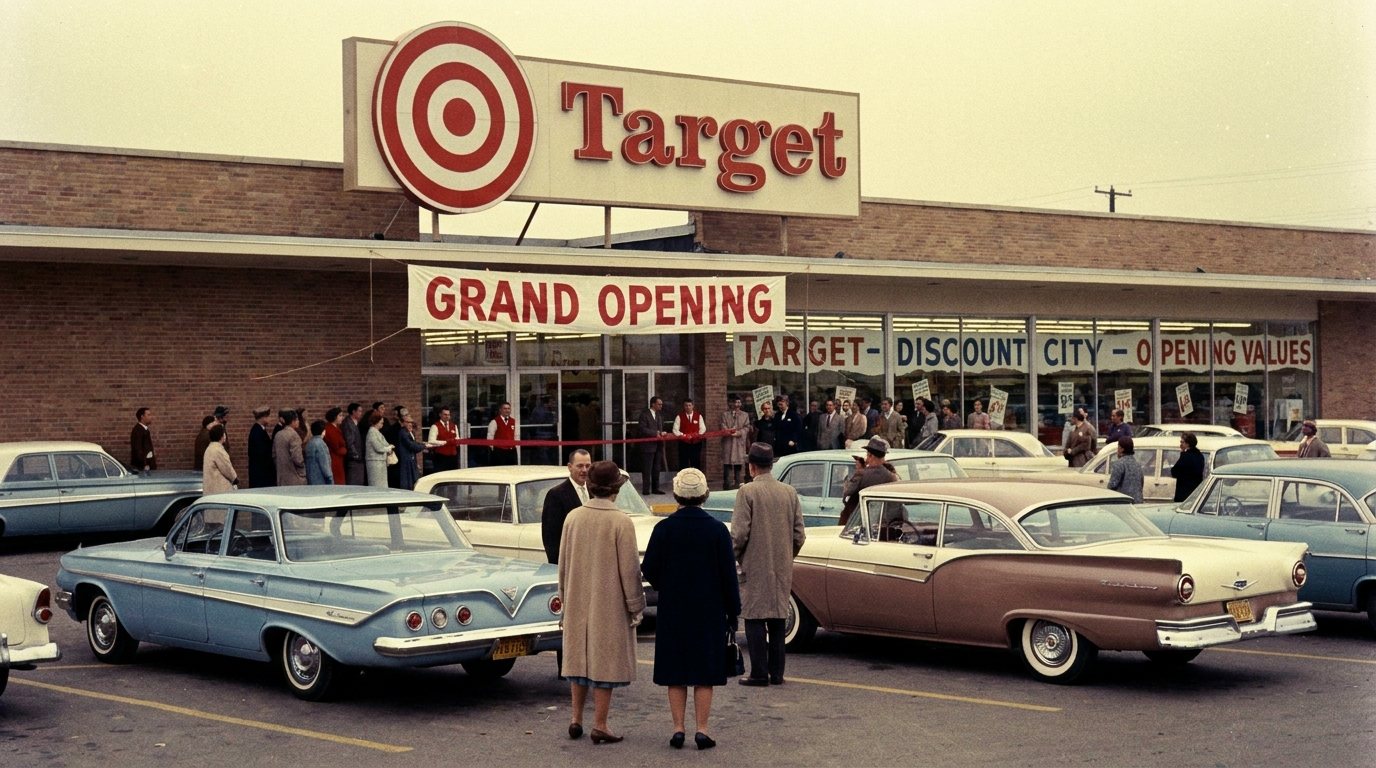
Then came the bet that actually defines the company today. In 1962, the Dayton Company opened its first Target discount store in Roseville, Minnesota, under retail executive John Geisse and Douglas Dayton. Four stores were operating across Minnesota suburbs by year's end. The pitch, in Geisse's own words as recorded by Wikipedia, was "high-quality merchandise at low margins because we are cutting expenses," not cutting quality.
Here is the detail that gets lost in most retellings: 1962 wasn't just the year Target launched. It was the year discount retailing itself was born, in triplicate. Sam Walton opened his first Walmart in Rogers, Arkansas. S.S. Kresge Company opened its first Kmart in Garden City, Michigan, on January 25 of that year, according to Wikipedia's Kmart history. Three chains, one year, one new format: the big-box discount store.
The unique insight worth naming plainly: the three founders came from opposite ends of retail, and that pedigree is still visible in each chain's DNA six decades later. Kresge had spent 60 years running five-and-dime variety stores, small-format, low-margin, no design ambition. Walton had run rural Ben Franklin variety-store franchises. Target alone came out of a full-line, fashion-forward metropolitan department store that had just built America's first indoor mall. Dayton's brought merchandising instincts, visual display standards, and a taste level that discount retail had never had to cultivate before, because none of its other competitors had it in their institutional memory. That's the real explanation for why Target became "cheap chic" and its 1962 classmates didn't: it isn't a marketing accident from the 1990s, it's an inheritance from 1902.
Turning taste into a business model
That inheritance sat dormant for decades while Target simply grew. The parent company merged with Detroit's J.L. Hudson Company in 1969 to form Dayton Hudson Corporation, then added Mervyn's in 1978 and Marshall Field's in 1990, per FundingUniverse. By 1979 Target had already become the largest revenue generator inside a company that still bore other names.
The design bet got explicit under Robert Ulrich, who became chairman and CEO in 1994. Ulrich pushed Target to commission name designers for everyday goods, most famously Michael Graves' teakettles and housewares, positioning Target as visibly, deliberately different from Kmart and Walmart on the same shelf category. It worked well enough that Target became a genuine cultural reference point, nicknamed "Tar-zhay" by shoppers who wanted to needle the pretension of a discount store with department-store manners. By 2000, discount stores generated roughly 80% of corporate revenue, and the company retired the Dayton Hudson name entirely to become Target Corporation.
Target's grocery push followed a similar slow-build pattern: Target Greatland in 1990, the first SuperTarget hypermarket format in 1995, and PFresh in 2008, which roughly tripled grocery selection inside standard stores, according to Wikipedia. Each step made Target a more credible one-stop grocery and general-merchandise trip without abandoning the design differentiation that built the brand.
The two hard chapters
Not every bet paid off. Target's 2013 entry into Canada, built on acquired Zellers store leases, collapsed within two years, closing in 2015 after accumulating roughly $2 billion in losses, per Wikipedia's account, a widely cited cautionary case in retail market-entry planning. The same December 2013 brought a data breach affecting up to 110 million customers, ultimately costing Target $10 million in consumer settlements and $39 million to settle with banks. Both chapters are part of the record, not incidental footnotes, and both preceded a period of real self-correction: continued investment in e-commerce (Target.com relaunched independently in 2011), a raised minimum wage reaching $15 an hour by 2020, and a deepened bench of owned brands like Good & Gather and Cat & Jack that now anchor entire categories.
Target also made a notable structural trade in 2015, selling its pharmacy and clinic business to CVS Health for about $1.9 billion, converting more than 1,600 in-store pharmacies to CVS operation, a bet that focus in general merchandise and grocery mattered more than owning every department under one roof.
Every catalog line, every store shelf, and every mall built around a discount chain rests on the same unglamorous infrastructure: the data, the supply routes, and the buying decisions nobody sees from the sales floor.