
Tariff Agility Is Measured in Attributes: Country-of-Origin and Cross-Reference Data Decide Who Requotes First
Tariffs don't decide who requotes fast — catalog attributes do. Country-of-origin and cross-reference data are the real tariff-agility gap for distributors.
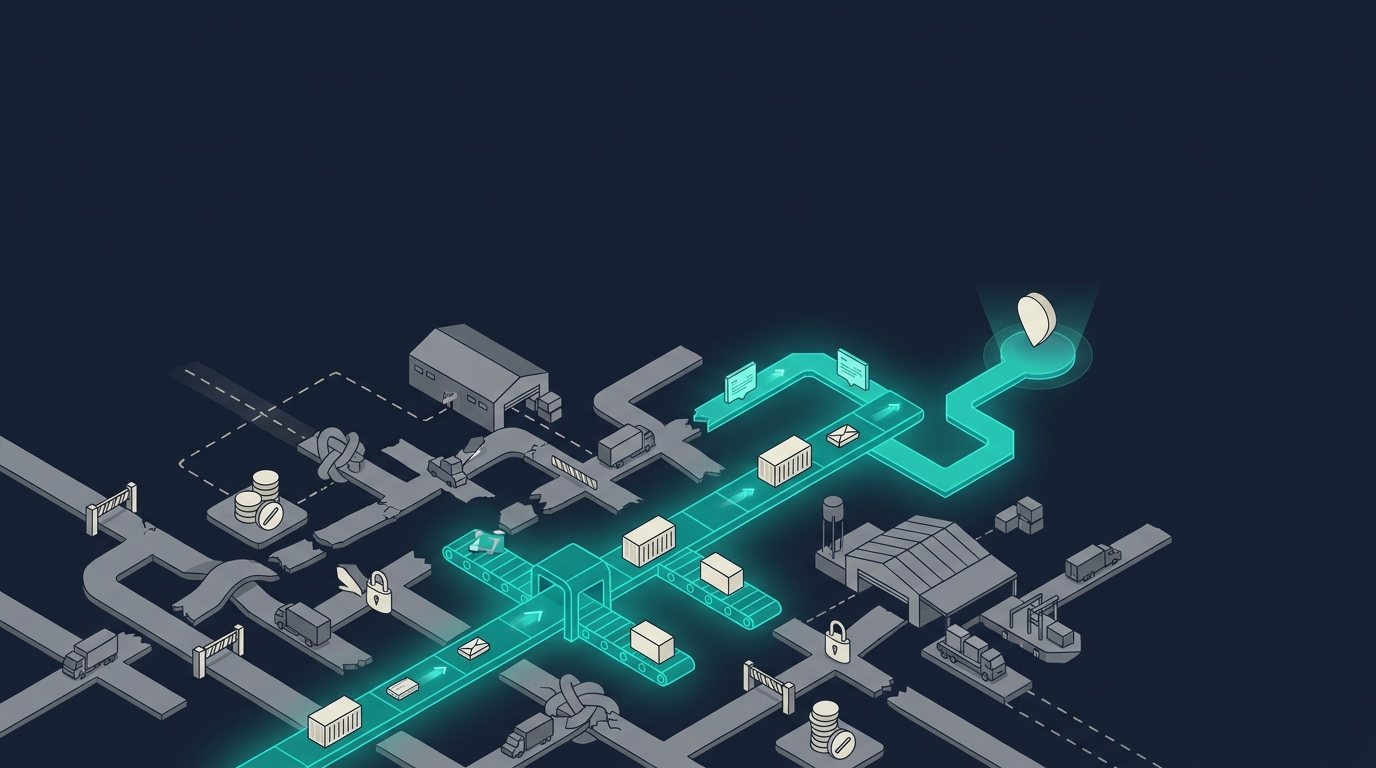
Tariffs move margin overnight. But the thing that actually decides whether you requote in a day or a month isn't your pricing team or your customs broker — it's your catalog. Distribution Strategy Group has been covering this as a pricing-and-compliance emergency. We think that framing skips the layer underneath it: whether a distributor's product data can even answer the question "what am I exposed on, and what can I sell instead."
The trade press has the panic right and the mechanism wrong
Distribution Strategy Group's recent coverage is honest about the bind distributors are in. In "The Distributor's Dilemma", the argument is that distributors sit in the middle of the supply chain with "almost none of the same flexibility" manufacturers and retailers have, because they've already promised delivery dates to customers who won't wait for a workaround. In "What Distributors Should Do Now Regarding Tariffs", the prescription is procedural: file Post-Summary Corrections before the 180-day window closes, verify Harmonized Tariff Schedule codes so you're not overpaying, have candid pricing conversations with suppliers. And in "Tariffs, Metals Costs Keep Pressure on MRO Distributors", the lens is margin compression from steel, aluminum, and copper inputs.
All three pieces treat the tariff shock as something that happens to pricing and to compliance. That's true as far as it goes. But it treats data readiness as a footnote — a line about verifying HTS codes — when it's actually the precondition for everything else on the list. You cannot have a candid pricing conversation about a cost increase you can't compute. You cannot file a refund claim on origin you didn't record. The compliance and pricing response is downstream of a catalog question: do you know, at the SKU level, where the product came from and what could stand in for it?
Country-of-origin is a computation, not a lookup
Tariff exposure isn't a single number you check once. It's HTS classification times country of origin times whatever rate table Washington published this week — recomputed every time the rate table changes, which in 2026 has been often. If country-of-origin data lives on the purchase order but not on the item master, or lives at the brand level but not the SKU level, you cannot run that computation. You can only estimate it, and estimates don't survive a customer asking for a number by Friday.
The scale of the gap is bigger than most distributors assume. A 2026 survey of 504 product-business decision-makers by Doss found that only 11 percent can reprice goods in under a week after a tariff change; 48 percent take three weeks or more, and 17 percent haven't repriced at all. Nearly a third of respondents in that same research still model tariff costs in spreadsheets rather than any system of record. That's not a staffing problem. Three weeks of research time on a rate change usually means someone is manually reconstructing origin data that should have been captured once, at intake, and never re-derived.
It's also getting harder to trust the origin data you do have. Trade-compliance researchers at Thomson Reuters have reported that 27 percent of overseas suppliers have started obscuring true country of origin specifically to dodge tariff enforcement, and that customs authorities are now asking a question most trade systems were never built to answer: what is this product made of, and where did each component actually originate, down to the sub-assembly. A distributor whose COO field is "supplier-reported, unverified, last touched in 2022" is not tariff-ready. It just looks tariff-ready until an auditor or a customer asks a second question.
Cross-reference data decides who keeps the order
Knowing your exposure only wins you the first half of the conversation. The second half is what you say next: here's the substitute, in stock, at a price that holds. That requires alternate and equivalent SKU mappings — cross-reference data — that most distributors maintain unevenly across brands and categories. We've written before about what happens when that mapping is thin: wrong-part returns in electronic components are the same failure mode as a lost tariff requote, just triggered by a different event. Either way, the customer needed an equivalent part fast, and the catalog couldn't produce one with confidence.
| Catalog-ready distributor | SKU-archaeology distributor | |
|---|---|---|
| Exposure check | Query by HTS + COO, minutes | Pull POs, call suppliers, days |
| Substitute offer | Cross-ref surfaces equivalents same call | Sales rep searches memory and spec sheets |
| Requote turnaround | Same day to 2-3 days | 1-4 weeks, per Doss's 48% cohort |
| Customer outcome | Keeps the order, maybe the relationship | Loses the order to whoever answered faster |
The distributors who reprice fast aren't running a smarter pricing desk. They're running a catalog where COO and cross-reference are structured fields with actual coverage, not tribal knowledge held by one buyer who's been there twenty years.
This is a measurable gap, and it's the same one we already track
This isn't a hypothetical readiness axis. It's the same data plumbing we measure across 200-plus distributors in our Top Distributors 2026 index, scored through the Digital Readiness Index methodology — attribute completeness and structured spec coverage, pulled from each distributor's own live site rather than self-reported claims. Distributors that score well on catalog structure for search and AI-agent readiness are, by construction, the ones whose product data can answer a tariff-exposure query without a research project. Catalog quality isn't a nice-to-have next to tariff response. It's the input tariff response runs on.
Where this lands
Your PIM is very likely the right place for country-of-origin and cross-reference data to live — the problem is almost never the schema, it's the coverage. Fields exist and sit empty for half the catalog, or get filled inconsistently across suppliers who each format origin differently. That's the gap Anglera closes: enriching and normalizing exactly those attributes at scale, on top of whatever PIM you already run, without a rip-and-replace project. Tariffs will keep moving. The distributors who requote first won't be the ones who reacted fastest to the headline — they'll be the ones whose catalog was never the bottleneck to begin with.