
TJX Companies: The Discount Chain That Bet the Farm on Off-Price
TJX ranks #15 on NRF's 2026 Top 100 with $46.30B in U.S. sales, built from a failing discounter's side project into the empire behind TJ Maxx and Marshalls.
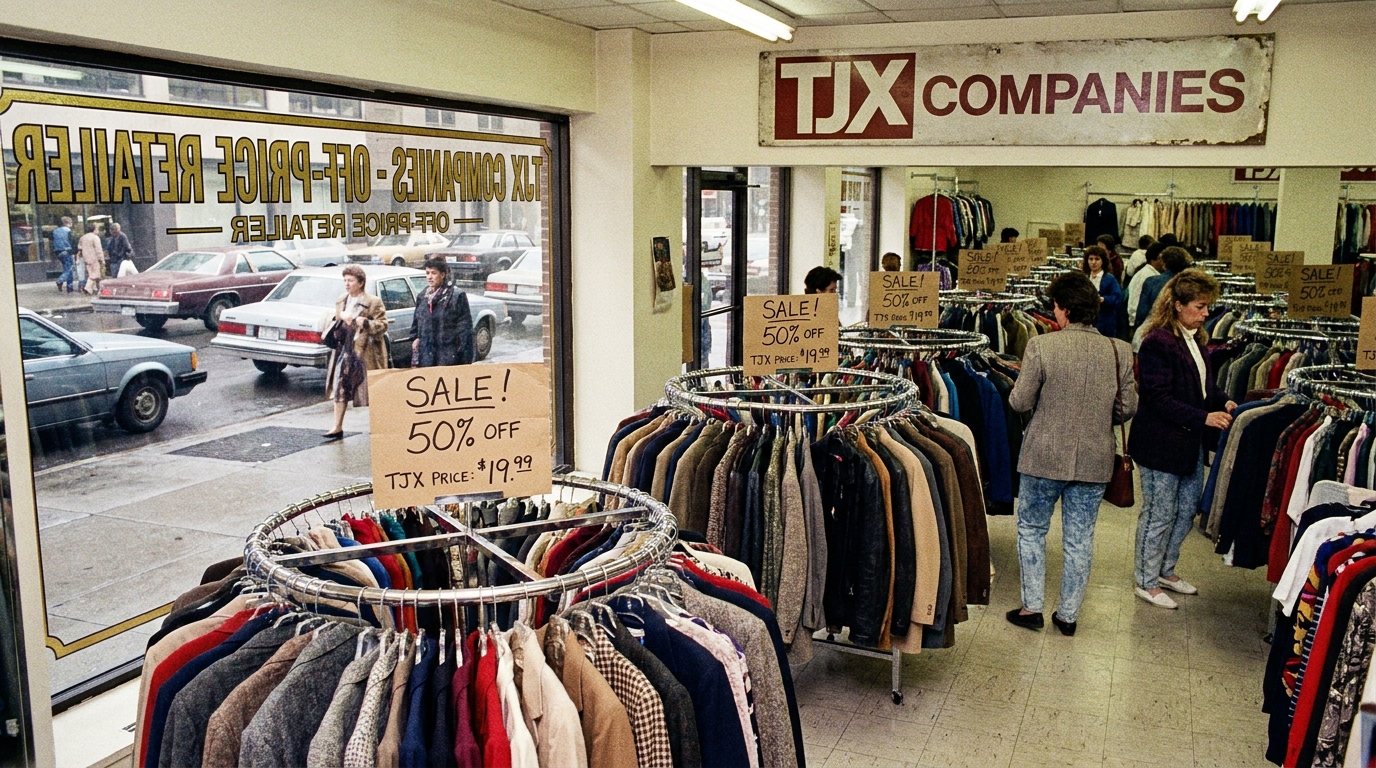
Part of Retailer Playbooks — history-first profiles of every company on the NRF Top 100 Retailers list.
TJX Companies lands at #15 on the National Retail Federation's Top 100 Retailers 2026 list, with $46.30 billion in 2025 U.S. retail sales. That number belongs to a company that almost didn't survive the 1980s under its own name, because for its first three decades it wasn't TJX at all. It was Zayre, a discount chain that had to nearly fail before its most promising side project was allowed to take over the house.
Two Cousins and a Discount Store
The story starts in Hyannis, Massachusetts, in 1956, when cousins Stanley and Sumner Feldberg opened the first Zayre store. "Zayre" is Yiddish for "very good," and the name suited the moment: postwar America wanted brand-name goods at prices below what department stores charged, and Zayre grew fast on that promise, passing 200 stores by the early 1970s, according to FundingUniverse's company history.
The pivotal move came earlier than most people assume. In 1969, Zayre acquired Hit or Miss, a small women's apparel chain built on selling overstocked, closeout, and off-price brand-name clothing rather than goods bought new from manufacturers at full wholesale terms. It looked like a minor bolt-on at the time. It wasn't. When the 1970s recession hit, shoppers traded down, and Hit or Miss thrived on exactly the value proposition department stores couldn't match. By 1983 it was generating nearly 45 percent of Zayre's operating income, per FundingUniverse, teaching the parent company a lesson that would define its next fifty years: off-price wasn't a bargain-bin afterthought, it was a business model that got stronger when the economy got worse.
The Launch That Zayre Almost Didn't Need
Zayre poached Bernard Cammarata from rival chain Marshalls to build on that lesson, and in 1977 he opened the first two T.J. Maxx stores in Auburn and Worcester, Massachusetts. Wikipedia dates the public announcement of the concept to April 1977 and the store openings to May 19 of that year, offering "family apparel, giftwares, and domestic goods" at 20 to 60 percent below department store prices, per Wikipedia's TJX entry. T.J. Maxx wasn't conceived as the future of the company. It was conceived as another Hit or Miss, a hedge against a discount-store business that was starting to show its age.
The hedge worked better than the thing it was hedging. By the late 1980s, Zayre's core discount stores were bleeding money, an estimated $69 million in operating losses on $1.4 billion in sales, undone by outdated inventory systems and a format that had simply stopped being competitive. T.J. Maxx, meanwhile, kept making money. Management made the reorganization official in June 1987, spinning the off-price stores into a subsidiary called The TJX Companies and taking it public, while the original Zayre chain kept operating under its own name a while longer.
The Deal That Nearly Undid It
Here's the part of TJX's history that rarely makes it into the retrospectives, and it's the one worth sitting with. In October 1988, Zayre sold its entire 400-store discount chain, the company's original identity, to Ames Department Stores for $431.4 million, clearing the way for the 1989 merger that made TJX the whole company. It looked like a clean divorce: hand off the dying format, keep the profitable one, walk away with cash and a preferred-stock stake in the buyer.
Then Ames filed for bankruptcy in 1990. TJX had taken part of its payment in Ames preferred stock, and when the acquirer collapsed, TJX had to book a $185 million reserve against that investment, according to FundingUniverse's account. The company that had just reinvented itself as a pure off-price retailer came within a couple of fiscal quarters of watching its own founding transaction blow a hole in the balance sheet. That's the non-obvious lesson in TJX's history: the "clean exit" from a failing legacy business is rarely clean, because whoever buys your discards inherits your same structural problems, and if you're financing that sale yourself, their failure becomes your liability. TJX survived it, but the scare shaped a company that has run with famously little debt and no love for financial engineering ever since.
Building the Portfolio, One Off-Price Format at a Time
Once the Ames wound was behind it, TJX spent the next three decades doing one thing over and over: proving the off-price model could be repeated in adjacent categories and countries without breaking it.
| Year | Move |
|---|---|
| 1990 | Acquires Winners, bringing off-price to Canada |
| 1992 | Launches HomeGoods, extending the model to home decor |
| 1994 | Founds TK Maxx, the first off-price entry into the U.K. |
| 1995 | Acquires Marshalls for $606 million, uniting the format's two biggest U.S. banners |
| 1998 | Launches A.J. Wright for moderate-income shoppers |
| 2001 | Introduces HomeSense in Canada |
| 2012 | Acquires Sierra Trading Post, adding outdoor and footwear |
Each addition followed the same logic Hit or Miss had proved decades earlier: buy deeply discounted, brand-name inventory opportunistically, keep assortments unpredictable enough that shoppers have to visit often to see what's new, and never over-commit to any one supplier or season. By 2002 the company operated nearly 1,850 stores and had crossed $11.98 billion in sales, per FundingUniverse. Today TJX runs roughly 5,000 stores across nine countries under CEO Ernie Herrman, with Carol Meyrowitz, who ran the company through much of its 2000s and 2010s expansion, now serving as executive chairman, according to Wikipedia.
What the History Actually Teaches
TJX's foundational insight wasn't off-price retail itself, plenty of chains tried that. It was recognizing, twice, once with Hit or Miss and once with T.J. Maxx, that the side business built to hedge against a declining core format could become durable enough to become the entire company, and then having the discipline to let it. Most retailers protect the flagship until it drags everything down with it. TJX let its flagship go.
Behind every off-price rack is a supply chain built on buying what nobody planned for. That's the unglamorous infrastructure this series keeps circling back to: the data, the sourcing, and the systems retailers build when the goods themselves refuse to be predictable.