
Total Plastics International: 47 Years of Branch-by-Branch Growth
Total Plastics International made MDM's 2026 Top Distributors Plastics list, grown from a 1978 Kalamazoo warehouse without one disclosed acquisition.
Part of Distributor Playbooks — strategy teardowns of every company on the MDM Top Distributors lists.
Total Plastics International made Modern Distribution Management's 2026 Top Distributors list in the Plastics vertical, one of the specialty categories MDM tracks alongside the giants of industrial supply. The company doesn't disclose revenue, and it doesn't need to prove itself with a number. Its case is the shape of the thing: a warehouse that opened in 1978 and never stopped adding branches, one at a time, without the acquisition trail that defines most of its peers.
A warehouse, two names, and 1984
John Kozacki and Jerome Kollig started the company in Kalamazoo, Michigan, as what the company's own history page calls "a humble plastics warehouse." That was 1978. Six years later, in 1984, they opened a national sales office in Grand Rapids, a signal that regional demand had outgrown a single dock. From there the map filled in slowly: Fort Wayne, Indianapolis, Cleveland, Pittsburgh, Baltimore, Chicago, Detroit, Harrisburg, Knoxville, the New York suburbs, Tampa, and most recently a location in Renton, Washington, the company's first real foothold in the Pacific Northwest, according to its locations page. The careers page puts the current footprint at roughly fifteen locations across ten states serving more than 15,000 active customers. That is a company built city by city over four and a half decades, not stitched together in a few large transactions.
The name is a promise about shipping, not about branches
Here is the detail worth sitting with: the company's formal name is Total Plastics, Int'l, and every physical branch it operates is in the continental United States. The "international" in the name refers to worldwide shipping capability, not an overseas branch network. It is a small thing, but it tells you what the founders were promising customers in 1978 and after: wherever your plant is, we will get material to it. That is a distribution promise, not a real-estate one, and the company has kept expanding its domestic branch count instead of chasing global offices to justify the name.
Distribution that also cuts, welds, and machines the material
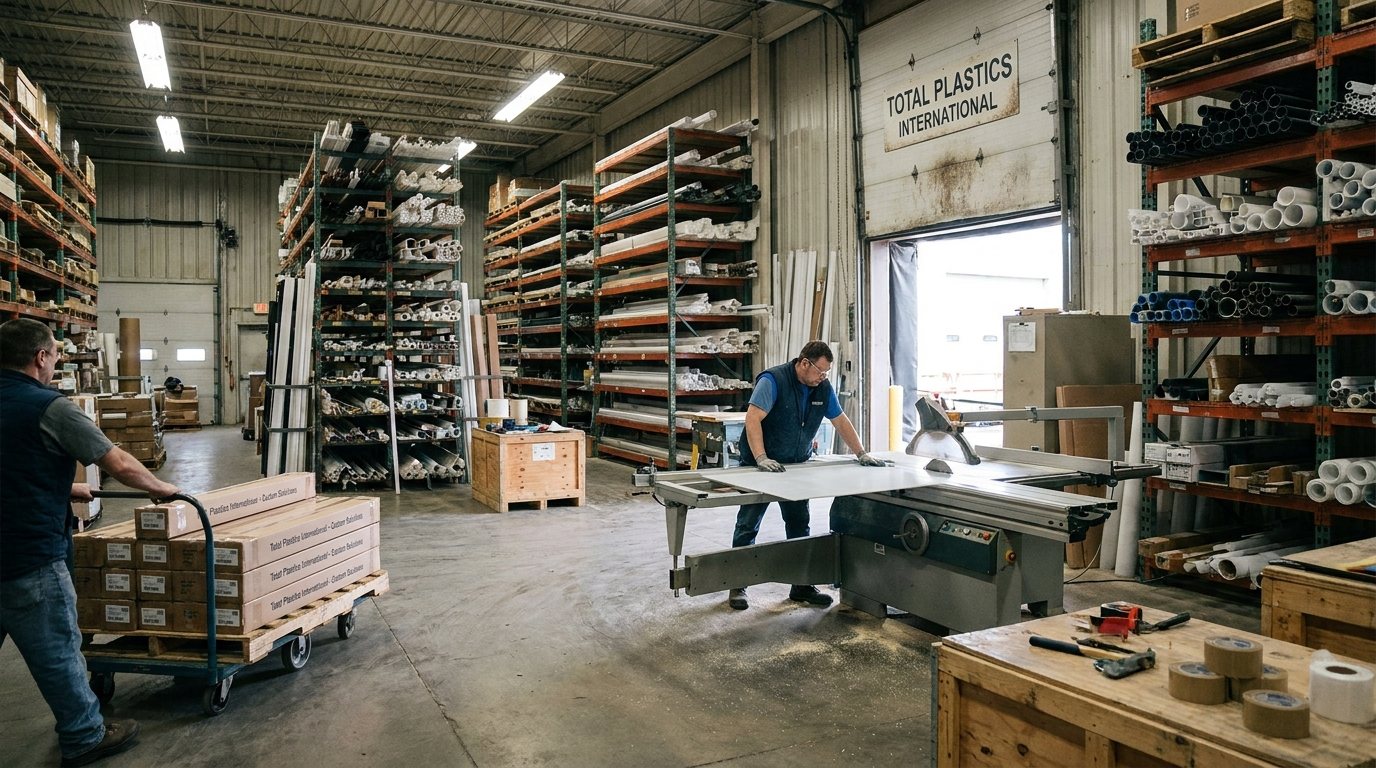
Total Plastics doesn't just move sheet, rod, tube, and film. Its site lists CNC machining, laser cutting and engraving, plastic welding and bonding, and rapid prototyping as in-house capabilities sitting alongside standard products like acrylic and Lexan polycarbonate sheet and engineering polymers such as PEEK, PTFE, and UHMW, per the company's homepage. That combination, warehouse plus fabrication shop, is what lets a plastics distributor sell into aerospace, medical device, and marine accounts that need a finished part, not just a cut-to-length blank. It is a harder business to run than pure stock-and-cut distribution, because it requires machinists and quality processes a commodity distributor doesn't carry. It is also a harder business for a private-equity roll-up to bolt together quickly, since fabrication capability is built branch by branch, not acquired in bulk.
Two specialty divisions carved out of one distributor
Rather than diversify by buying adjacent companies, Total Plastics built two named divisions inside its own structure: a Life Sciences division based in Fort Wayne and a Marine Plastics division based in Kalamazoo, both called out separately on its locations page. That is a deliberate choice. Life sciences customers need traceability, cleanroom-compatible materials, and regulatory fluency that a generalist plastics counter doesn't have to think about. Marine customers need UV-stable, salt-tolerant material and fabrication that holds up on a boat deck, not a factory floor. Standing up dedicated teams for each, instead of running everything through the same generalist branch model, is how a mid-size distributor competes for specialized accounts without needing the balance sheet to acquire a specialist rival outright.
Growth without the roll-up playbook
Here is the unique insight this profile is built around: Total Plastics has spent close to fifty years growing almost entirely without a visible acquisition trail. There's no platform-and-bolt-on press release, no financial-sponsor bio on its team page, no rebrand history suggesting a private equity platform absorbed it into a portfolio. That puts it at odds with the broader pattern in specialty plastics distribution, where scale increasingly comes from buying competitors rather than opening new locations. Total Plastics' answer instead has been to open a branch, staff it, add fabrication equipment, wait for it to mature, then open the next one. It is a slower way to build a fifteen-branch network. It is also a way to build one that answers to itself rather than to a sponsor's exit timeline, which may be exactly why the company still carries its founders' original bet, made in a Kalamazoo warehouse in 1978, as its operating model rather than as a line in a history section.
That combination, decades of unglamorous branch-opening plus in-house fabrication plus two purpose-built specialty divisions, is a case study in how a distributor earns a spot on a national ranking without a headline deal to point to.
This profile is part of Anglera's Distributor Playbooks series, a running look at the companies that keep North American distribution running on catalogs, branches, fabrication floors, and the unglamorous data behind all three.