
Total Wine & More: How Two Brothers Beat the Three-Tier System
Total Wine & More is #68 on NRF's 2026 Top 100 with $6.39B in sales. The real story is two brothers who grew by fighting state liquor regulators.
Part of Retailer Playbooks — history-first profiles of every company on the NRF Top 100 Retailers list.
Total Wine & More lands at #68 on the National Retail Federation's 2026 Top 100 Retailers list, with $6.39 billion in 2025 U.S. retail sales, compiled with Kantar. It got there without a single share of public stock, a private-equity backer, or a national ad campaign that most Americans could name. It got there by two brothers from Pittsburgh figuring out, store by store and state by state, which liquor laws had room to move.
A Beer Store in Grad School
David Trone was a Wharton MBA student in 1984 when he opened Beer World, a single beer-only shop outside Pittsburgh. Pennsylvania's liquor licensing rules capped how many retail licenses one person could hold, so as Trone opened more locations, he registered some under the names of family and friends just to keep expanding. It was a workaround, not a business plan, but it taught him the lesson that would define the next four decades: in alcohol retail, the license law is the business model.
In 1991, David brought his brother Robert into the venture and the two opened two stores in Claymont, Delaware, under the name Liquor World. Delaware was a deliberate choice. It has no sales tax and a licensing regime friendlier to multi-unit ownership than Pennsylvania's. The stores carried wine and spirits alongside beer for the first time, and the format was immediately profitable on thin margins, according to the Wikipedia history of Total Wine & More and David Trone's own biography. The brothers had found something bigger than a beer shop: a template for going wherever the law allowed the largest store.
The Total Beverage Merger and the Category-Killer Bet
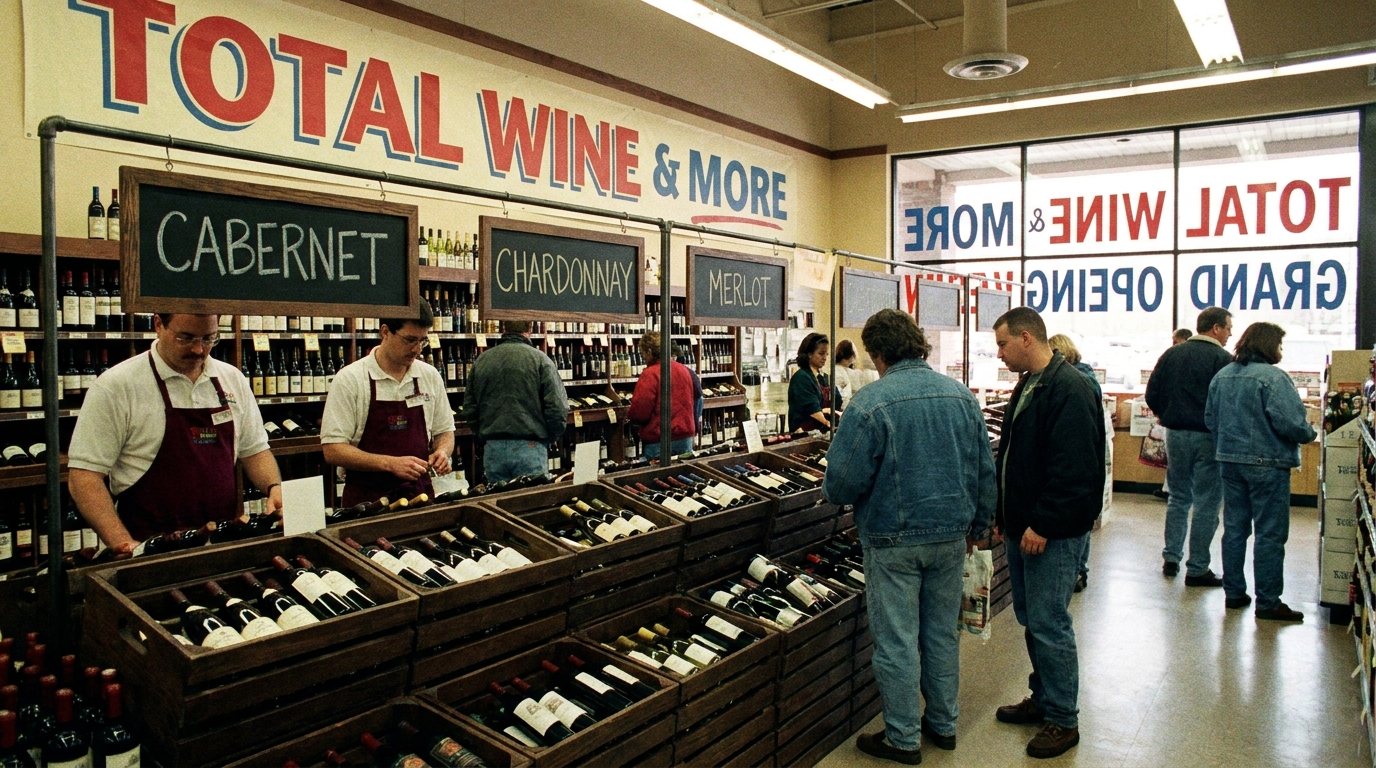
The company spent the 1990s testing that template outward from Delaware. The turning point came in 1998, when the Trones acquired Total Beverage, a Washington, D.C.-area chain, and adopted its name. Total Wine was born from that merger, and with it came the format that still defines every store: 20,000-plus square feet, roughly 8,000 wine labels, 3,000 spirits, and 2,500 beers under one roof, staffed by employees trained to walk a customer through an unfamiliar region or grape rather than just ring up a sale.
This was the "category killer" logic that Home Depot and Best Buy were proving out in their own aisles at the same time: beat the corner liquor store on selection so badly that comparison shopping becomes pointless. Total Wine expanded into Florida in 2005 and into California and Arizona in 2007, each entry timed to states where big-format alcohol retail was legally and economically viable.
Picking Fights the Corner Store Couldn't Afford
Here is the part of the Total Wine story that rarely makes it into a company profile, and it is the single most instructive thing about how the business actually grew: Total Wine treated state alcohol regulators as a recurring counterparty to negotiate with, not a fixed cost of doing business.
Many states still enforce "fair trade" or minimum-pricing laws left over from the post-Prohibition three-tier system, rules originally meant to keep large retailers from using volume to undercut smaller competitors into bankruptcy. Total Wine's scale made it the natural test case for those laws, and it did not quietly comply. In Connecticut, the company paid a $37,500 settlement in 2016 over underselling minimum retail prices. In Massachusetts, regulators suspended Total Wine's licenses in 2016 and 2017 over loss-leader pricing violations, and the company turned around and sued the state's Alcoholic Beverages Control Commission, winning a ruling against the enforcement action, per the Wikipedia account of the company's regulatory history. New York regulators rejected the company's megastore license applications outright between 2017 and 2019, judging the format incompatible with the state's retail character.
Most retailers treat a regulatory loss as a cost center to bury in a footnote. Total Wine treated each fight as market research: a signal for which states were worth pushing into next and which pricing floors were actually enforceable versus symbolic. That is the unique insight buried under the wine selection and the loyalty app: Total Wine's expansion map was drawn as much by litigation outcomes as by demographic studies.
Growing Up Without Going Public
The company never took the exit that would have been obvious for a chain doing billions in sales: an IPO, a private-equity recapitalization, a sale to a distributor looking to integrate downstream. It stayed a family business. Robert Trone continued running day-to-day operations while David Trone stepped back from the presidency in 2016 and, in 2018, was elected to represent Maryland's sixth congressional district in the U.S. House, a shift that put daylight between the company's public face and its political one. By 2023 the chain had grown to roughly 250 stores across 28 states, and Forbes now puts its revenue north of $6 billion, tracking almost exactly with the NRF's own figure.
The lesson for anyone studying Total Wine's climb is not "sell a lot of wine." It is that a regulated, fragmented industry rewards the operator willing to spend legal and lobbying effort understanding exactly where the rules bend, store by store, state by state, decade by decade. Most retailers avoid that fight. Total Wine built a $6 billion company by picking it on purpose.
This is what the unglamorous plumbing of American retail actually looks like up close: not a slogan, but a state-by-state map of licenses, price floors, and court filings that decided where a company could even open a store in the first place.