
Tractor Supply Co.: How a Farm Chain Bet on Hobbyists
Tractor Supply Co. is #32 on the NRF Top 100 with $15.52B in 2025 sales. Its history is a lesson in surviving four owners and one bankrupt rival.
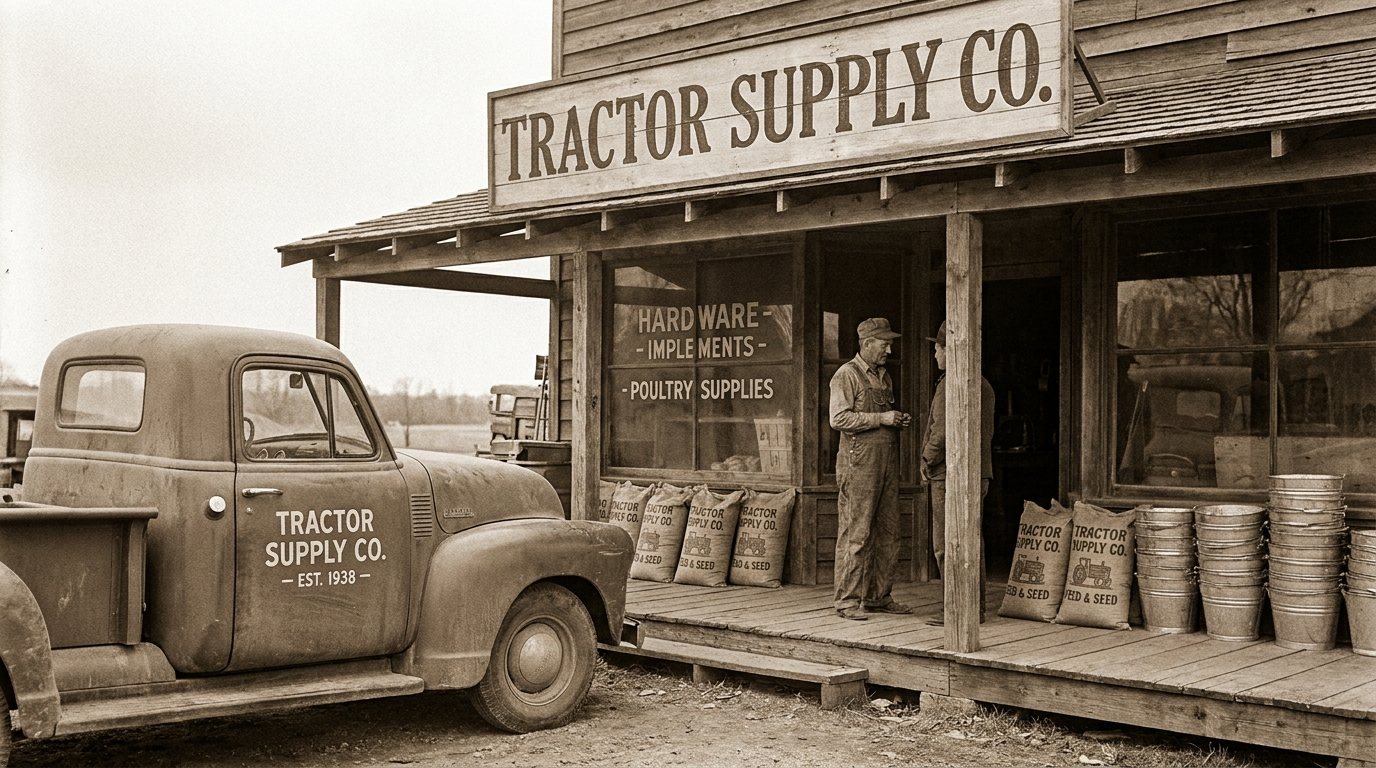
Part of Retailer Playbooks — history-first profiles of every company on the NRF Top 100 Retailers list.
Tractor Supply Co. is #32 on the NRF Top 100 Retailers 2026, the National Retail Federation's annual ranking compiled with Kantar, with $15.52 billion in 2025 U.S. retail sales. It runs more than 2,400 stores in 49 states and calls itself the largest rural lifestyle retailer in the country. The company got there by surviving three corporate parents who didn't understand what it sold, then finding a customer nobody else was chasing.
A Breakfast-Table Catalog
Charles E. Schmidt founded Tractor Supply Company in Chicago in 1938. He had an economics doctorate from the University of Chicago, earned by age 20, and had spent part of the Depression sweeping floors at a brokerage firm. That year he started a mail-order tractor parts business from his own breakfast room table, printing a catalog called the "Tractor Supply Co. Blue Book." First-year sales hit $50,000, according to FundingUniverse's company history, enough for Schmidt to open his first physical store in Minot, North Dakota, in 1939 (Tractor Supply's own corporate history page dates it to 1940). Either way, a solo catalog operator became a bricks-and-mortar chain within two years.
The business grew through the 1940s into Nebraska, Minnesota, and Iowa, selling replacement parts to farmers who could not afford to idle a broken tractor waiting on a dealer. Schmidt took the company public over the counter in January 1959, by which point it had reached $10 million in sales, per Wikipedia's account. He sold his controlling stake to National Industries in 1969 and later moved to Florida, where he became a banker in his sixties. The founder was gone from day-to-day operations less than 30 years after starting the company at his kitchen table.
Three Owners Who Didn't Get It
What followed is the part of the story a company website leaves out and a retail historian lingers on. National Industries owned Tractor Supply until 1978, when it was sold again to Fuqua Industries, a conglomerate. Neither owner treated the farm-store chain as anything more than an asset on a balance sheet, and the business drifted through diversification experiments that pulled it away from its core farm-supply customer and into inventory categories it had no real edge in. By the early 1980s the company was posting losses.
The rescue came from inside. In 1982, five Tractor Supply executives, including Joseph H. Scarlett Jr., engineered a management-led leveraged buyout, taking the company private again at $125 million in annual revenue across 135 stores. Thomas J. Hennesy III ran the post-buyout turnaround: paying down the buyout debt, moving headquarters to Nashville, and refocusing the merchandise mix back on the farm-store niche that had built the chain in the first place. The company reincorporated in Delaware that same year and, per Wikipedia, hit break-even for 1982 after the refocus. Scarlett took over as CEO in 1992 and led the company back onto public markets in February 1994, this time on Nasdaq under the ticker TSCO. A company that had been sold three times in 15 years finally found owners who wanted to run it as a farm-supply retailer rather than trade it as a line item.
Betting on the Hobby Farmer
The unique insight in Tractor Supply's story is not the leveraged buyout. It is who the company decided to sell to next, a decision most farm retailers of the era got backwards.
By the early 2000s, full-time farmers made up only about 8 percent of Tractor Supply's customer base. Rather than treat that as a problem, the company built its growth strategy around the other 92 percent: people with a few acres outside a growing suburb, raising chickens or horses, mowing pastures on weekends, doing their own fencing because no contractor wanted the job. That was not the commercial farmer grain co-ops were built to serve. It was a lifestyle customer, and Tractor Supply built stores for that person specifically: compact 12,000 to 20,000 square-foot formats staffed with former farmers and welders, expanded pet and equine departments, and a deliberate push to court women shoppers at a time most farm-supply chains treated the category as male by default.
That format let Tractor Supply expand into real estate other retailers were leaving behind. Between 1994 and 2000 it pushed south, filling old Wal-Mart boxes at a discount as Wal-Mart itself moved to supercenters. The entry into Florida in 2000, eleven stores opened at once, drew skepticism from investors who thought the pace reckless. It worked.
The Rival That Didn't Survive
The clearest test of the strategy came in 2001, when Quality Stores, a competing farm-and-fleet chain, filed for bankruptcy. Tractor Supply bought 85 of its locations for $35 million and spent another $70 million redesigning them and restocking inventory to its own format. The timing mattered as much as the price: Tractor Supply wasn't just adding square footage, it was proving that a niche retailer with a disciplined format could absorb a bankrupt competitor's real estate faster than the competitor's own creditors could liquidate it. By 2002 the company had crossed $1 billion in annual sales for the first time.
The table below traces the arc from founding to national scale:
| Year | Event |
|---|---|
| 1938 | Charles Schmidt starts a mail-order tractor parts catalog in Chicago |
| 1939/40 | First retail store opens in Minot, North Dakota |
| 1969 | Schmidt sells control to National Industries |
| 1982 | Executive-led leveraged buyout; refocus on core farm niche |
| 1994 | Public again, this time on Nasdaq (TSCO) |
| 2001 | Acquires 85 stores from bankrupt Quality Stores |
| 2002 | Crosses $1 billion in annual sales |
| 2014 | Reaches Fortune 500 status |
Growth since has come from adjacent formats rather than another rescue deal: Petsense by Tractor Supply now runs more than 200 stores, and the company has added an online pet pharmacy and mobile veterinary services to the same rural-lifestyle customer base it identified two decades ago.
The Takeaway
Tractor Supply's history reads like a lesson in patience rewarded twice over: patient enough to survive being owned by people who didn't understand the business, and patient enough to build for a customer, the hobby farmer, that competitors were still trying to out-discount the commercial grower for. The company that eventually thrived was the one willing to shrink its addressable customer on paper and grow it in practice.
Every retailer on this list runs on some version of the same unglamorous machinery: a catalog, a store format, a supply chain, and the record of what's actually on the shelf. Tractor Supply's began on a breakfast table in 1938 and it hasn't stopped since.