
Victoria's Secret: The Gift Shop That Became a Retail Empire
How a Stanford grad's embarrassment, a Columbus retailer's flip of the customer, and a decades-long identity crisis built Victoria's Secret into a retail giant.
Part of Retailer Playbooks — history-first profiles of every company on the NRF Top 100 Retailers list.
Victoria's Secret ranks #82 on the NRF Top 100 Retailers 2026 list, with $5.43 billion in 2025 U.S. retail sales. The brand that number describes barely resembles the one its founder built, and that gap is the whole story.
A store built to solve one man's embarrassment
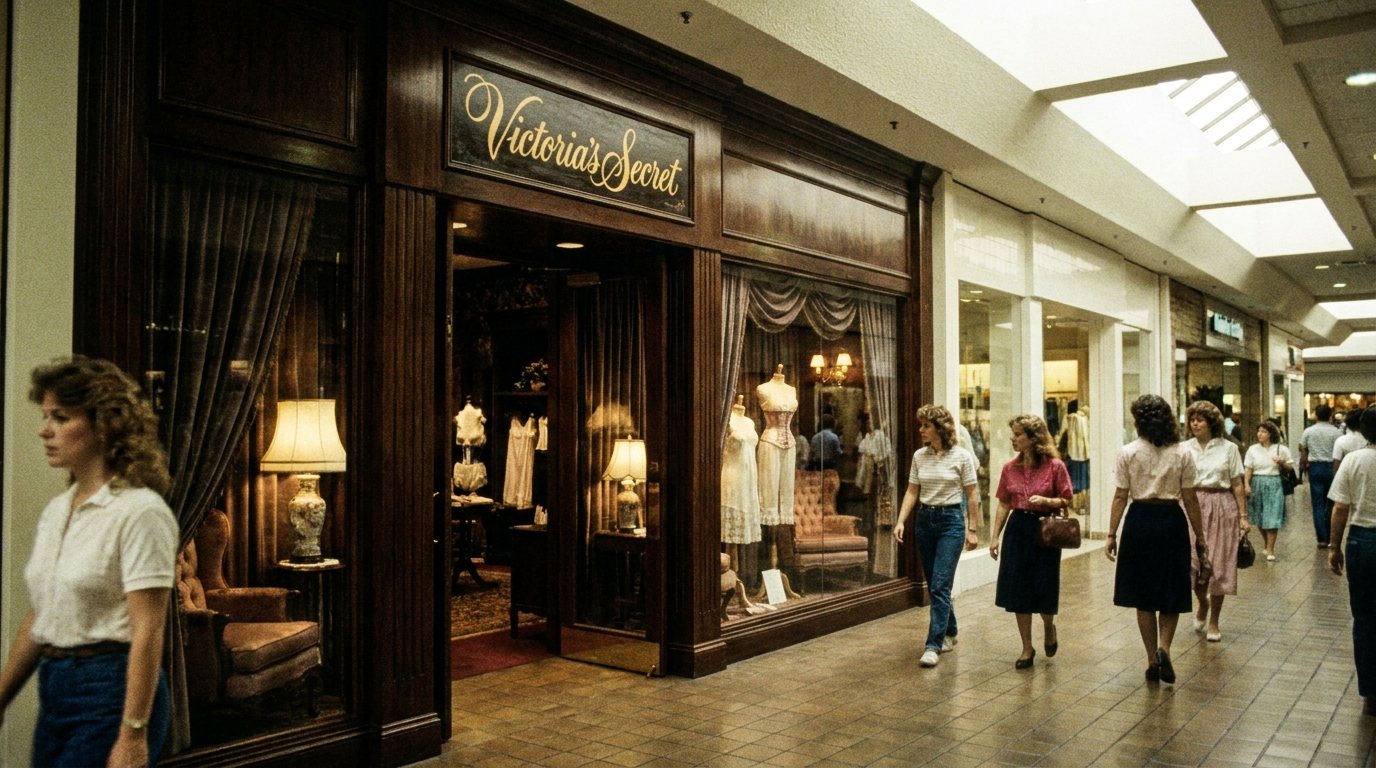
Roy Raymond opened his first store at the Stanford Shopping Center in Palo Alto on June 12, 1977. He'd gone shopping for lingerie as a gift for his wife and left a department store feeling, by his own account, like a suspect under fluorescent lights. So he built the store he wished had existed: Victorian-themed, wood-paneled, staffed to make a man feel like a gentleman rather than a trespasser, per Wikipedia's account of Raymond's life. The name was a deliberate double meaning, evoking old-world refinement while winking at "the secret underneath the clothes."
It worked immediately. The store and an accompanying mail-order catalog grossed $500,000 in year one. By 1982 Raymond had five stores and a 42-page catalog generating roughly $6 million a year. But the business had a structural flaw: it was a men's gift shop. Male customers bought once or twice a year, around anniversaries and Valentine's Day, and there was no answer for the other fifty weeks. The company ran short on cash, and in 1982 Raymond sold it for $1 million in cash and stock to Leslie Wexner, the Columbus, Ohio retailer who had built The Limited from a single storefront into a fast-growing mall chain, according to Wikipedia's history of Wexner.
The flip that actually built the empire
Wexner didn't change what Victoria's Secret sold. He changed who it was talking to. He rebuilt the brand around women shopping for themselves rather than men shopping for women, deepened the Victorian romance into full aspirational fantasy, and put stores in malls nationwide. That reversal of customer, more than any garment, is the real founding invention behind the brand most people credit entirely to Raymond. By 1986 Victoria's Secret was the only national lingerie chain in the country, and by the early 1990s it was doing roughly $1 billion in sales as America's largest intimate-apparel retailer, per Wikipedia. The 1993 Miracle Bra sold two million units in its first year alone. Raymond, meanwhile, lost money on a children's boutique that failed within two years of opening, filed for bankruptcy, and died in 1993, a bitter footnote to a brand about to become a cultural institution.
Turning underwear into a television event
Starting in 1995, the annual Victoria's Secret Fashion Show became the engine of the brand's identity. Supermodels rebranded as "Angels", Tyra Banks, Heidi Klum, Gisele Bündchen, Adriana Lima, walked a runway that turned into appointment television and, by 1999, an early internet-streaming phenomenon watched by 1.5 million people. The show's budget grew from $120,000 in 1995 to $12 million by 2011. Around it, the company built out fragrance (1991), cosmetics (1998), and a beauty division that alone was generating close to $1 billion a year by 2006, the same year the store count passed 1,000 and Victoria's Secret accounted for roughly a third of all intimate-apparel purchases in the U.S.
When the aesthetic became the anchor
The same machine that built the brand eventually pinned it in place. Starting around 2016, same-store sales stalled as shoppers moved toward athleisure and bralette-style comfort, and challengers like Aerie and Savage X Fenty built loyal followings by casting a far wider range of bodies than the Angels lineup ever had. Victoria's Secret had spent two decades telling one aesthetic story exceptionally well; it had no second story ready when the first one stopped selling. The company closed 53 stores and canceled its fashion show in November 2019, the same year a widely covered investigation into its internal culture added pressure on leadership to change course. Wexner, who had run the parent company for nearly six decades, stepped down as CEO in February 2020 and took the title of chairman emeritus.
Going public again, alone
On August 3, 2021, L Brands spun Victoria's Secret off as an independent, publicly traded company, freeing it to rebuild without the parent's baggage. The new leadership moved fast: the Angels were retired in favor of the VS Collective, a group of athletes, actors, and activists including Megan Rapinoe, Priyanka Chopra, and Valentina Sampaio, the brand's first openly transgender model. In November 2022 the company acquired the direct-to-consumer lingerie brand Adore Me for $400 million, a bet on a size-inclusive digital-first model built by a different generation of founders. Martin Waters led the turnaround as CEO from the spinoff before Amy Hauk took over in 2022, overseeing both Victoria's Secret and its PINK sub-brand. Today the company runs roughly 1,400 stores and trades on the NYSE under the ticker VSXY, with a market capitalization around $6.5 billion as of mid-2026, per stockanalysis.com.
The under-told part of this story
Most retellings of Victoria's Secret treat Roy Raymond as a footnote and Les Wexner as the visionary who built an empire. The more useful lesson for anyone running a retail brand today is narrower: Wexner's genius wasn't merchandising or real estate, it was recognizing that the customer standing in the store was the wrong customer, and that fixing who a brand talks to matters more than fixing what it sells. Victoria's Secret's decline in the 2010s was the same lesson learned the hard way a second time. The company had built a singular, extremely profitable answer to "who is this brand for" and stopped asking the question, right as a new generation of shoppers wanted a different answer. Its current rebuild is, in effect, a third attempt at the same question Raymond first asked in 1977.
Victoria's Secret's history is really the history of a catalog and a fashion show functioning as the same kind of infrastructure: systems for getting a product in front of exactly the customer built to want it, at the moment it needs updating.