
ShopRite: The Co-op That Outlived the Chain That Quit It
Wakefern, the cooperative behind ShopRite, ranks #28 on NRF's Top 100 Retailers 2026 with $19.57B in sales. Here is how seven grocers built it.
Part of Retailer Playbooks — history-first profiles of every company on the NRF Top 100 Retailers list.
Wakefern Food Corporation lands at #28 on NRF's Top 100 Retailers 2026, the National Retail Federation's annual ranking compiled with Kantar, with $19.57 billion in 2025 U.S. retail sales. Almost nobody outside the grocery trade has heard the name Wakefern. Nearly everyone in New Jersey, New York, Connecticut, Pennsylvania, Delaware, and Maryland has shopped at ShopRite, the banner it owns. That gap between the corporate name and the storefront is the whole story.
Seven grocers and a thousand dollars each
The company was born out of desperation. After World War II ended price controls and rationing, independent grocers in and around Newark, New Jersey found themselves outgunned by chains like A&P, which could buy in volume and undercut them on price. A Del Monte Foods sales representative, watching the same small grocers struggle store by store, suggested they stop competing with each other and start buying together. On December 5, 1946, a group of independent grocers formalized that idea into Wakefern Food Corp., each putting up $1,000. The name is an acronym built from founders' surnames, among them Kesselman, Aidekman, and Fern, according to Wikipedia's entry on Wakefern and the founding account preserved by FundingUniverse.
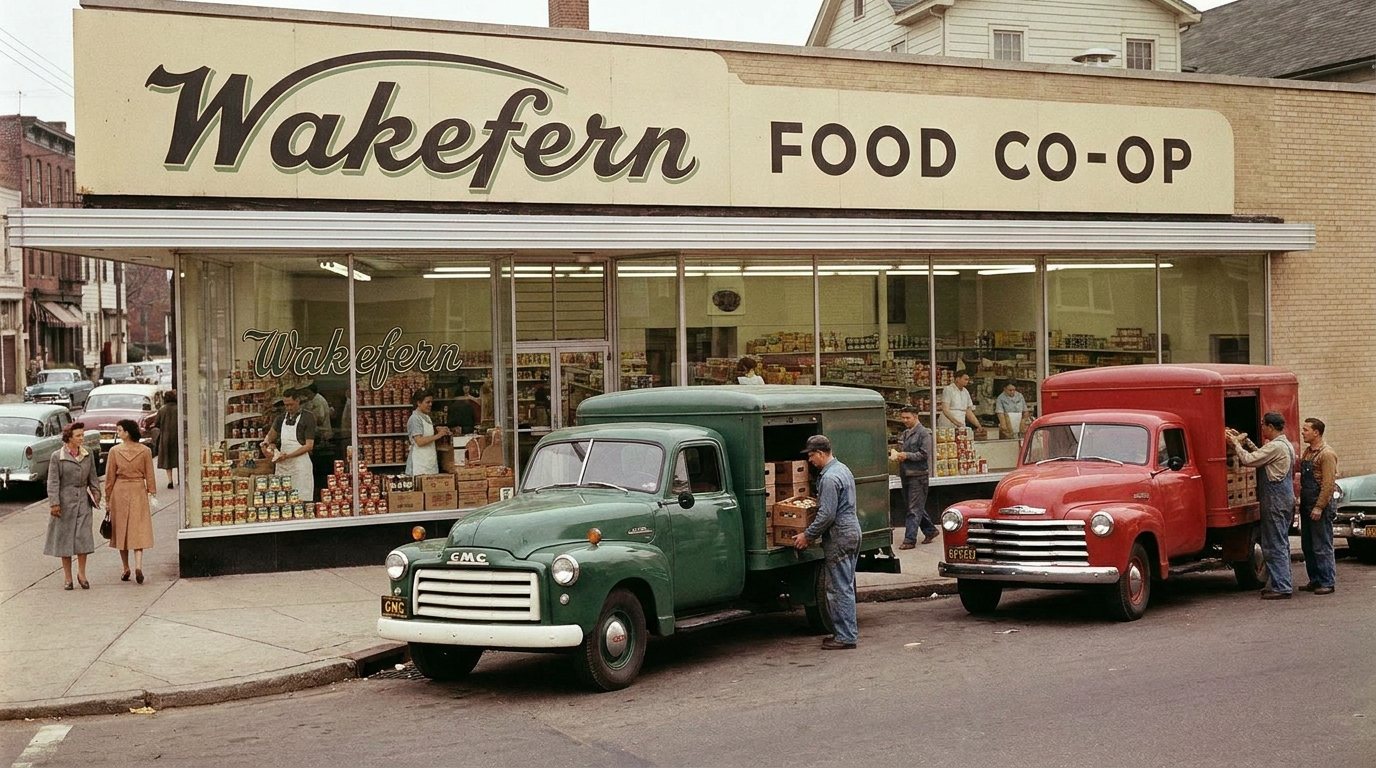
It nearly didn't survive its own first few years. Manufacturers considered the new cooperative too small and too undercapitalized to extend credit, until a personal connection got Campbell's Soup to take the risk. The founders ran the operation out of a 1,000-square-foot Newark storefront, splitting deliveries and bookkeeping among themselves and using their own cars to move product. Some members had to sell items at a loss just to stay price-competitive with the chains they were trying to outrun. It was a cooperative held together by necessity, not capital.
The bet that made the name
For its first five years the group operated as an unbranded buying pool. In 1951 the founders took a real gamble: they pooled money for a single newspaper advertisement, priced at $1,500, to launch a unified brand across their stores. Only nine members signed on for that first ad. It worked. Within a year, membership had passed 50 stores. The brand was ShopRite, and it gave a scattered group of family grocers something a single-owner chain already had for free: one name shoppers could trust across every location. That October, the co-op also put out its first private-label product, a batch of Halloween doughnuts, seeding what would grow into a full store-brand program.
By 1956, the cooperative had grown to more than 70 stores and $100 million in annual sales. Two years later, when the rest of the grocery industry was chasing customers with trading stamps, Wakefern's members went the other direction and cut retail prices ten percent, betting on being the low-price leader instead. It cost them in the short run and paid off over the long one, cementing a price-first identity ShopRite still trades on.
The break that should have killed it
The cooperative's sharpest test came in 1968. Supermarkets General Corporation, formed by a merger of two of Wakefern's largest members controlling 65 stores, pulled out entirely and relaunched those locations under its own name: Pathmark. Overnight, Wakefern lost roughly half its volume and its foothold in the entire Long Island market. For a cooperative built on shared buying power, losing its two biggest members at once should have been fatal.
It wasn't. The members who stayed leaned into expansion rather than retrenchment, and the co-op rebuilt its volume within about three years, per Wikipedia's account of ShopRite's history.
The unique insight: the one that left didn't make it
Here's the detail that doesn't show up on either company's About page. Pathmark, the chain that walked away from the cooperative to go it alone as a conventional corporate operator, spent the next four decades on a very different track than the one it left. It grew fast in the 1970s, pioneered 24-hour stores in 1972, and became a top-ten U.S. chain by the early 1980s. Then it filed for Chapter 11 in 2000, was bought by A&P in 2007, and when A&P itself collapsed into bankruptcy in 2015, every remaining Pathmark store was closed or sold off within months, according to Wikipedia's history of Pathmark.
Wakefern, the slower, messier, member-governed cooperative that Pathmark's founders judged not worth staying in, is still standing eighty years after seven grocers each wrote a $1,000 check. That is not a coincidence of timing. It is what the cooperative structure is actually built to do: spread risk across independent owners with skin in their own stores, rather than concentrate it in a single balance sheet that one bad decade can break. Wakefern formalized this with a "one member, one vote" governance rule adopted in the 1970s, giving a member with two stores the same say as one with twenty, which kept the group's incentives aligned even as individual members grew unevenly.
What ShopRite looks like today
The cooperative now counts roughly four dozen member companies operating a few hundred ShopRite stores across the Mid-Atlantic and Northeast, alongside banners like Fresh Grocer and PriceRite that joined through member acquisitions over the years. Wakefern itself runs central distribution, warehousing, and one of the region's larger private trucking fleets, functions no single family-owned grocer could justify alone but that make sense split eighty ways. ShopRite introduced its Price Plus loyalty card in 1989, launched online grocery ordering in 1999, and has kept building private-label lines since that first batch of doughnuts in 1951.
None of it looks like a Silicon Valley growth story. It looks like what it is: seven grocers who couldn't beat A&P separately, so they didn't try to.
Retail's biggest advantage rarely photographs well. It lives in warehouses, delivery schedules, and who owns which register, not in a mission statement, and Wakefern's eighty years are a reminder of how much of retail's staying power comes from getting that unglamorous machinery right.