
Walgreens: From a Chicago Corner Store to a Private Split-Up
Walgreens ranks #7 on NRF's Top 100 Retailers 2026 list. Here's how a single Chicago drugstore built an empire, then got taken apart by its own ambitions.
Part of Retailer Playbooks — history-first profiles of every company on the NRF Top 100 Retailers list.
Charles Rudolph Walgreen bought one drugstore on Chicago's South Side in 1901. A century later, the company he built ranks #7 on the National Retail Federation's Top 100 Retailers 2026 list, with $112.05 billion in 2025 U.S. retail sales. The stranger part of the story is what happened after it got that big: the same year it made this list, Walgreens was quietly taken apart.
A Pharmacist Buys the Counter He Worked Behind
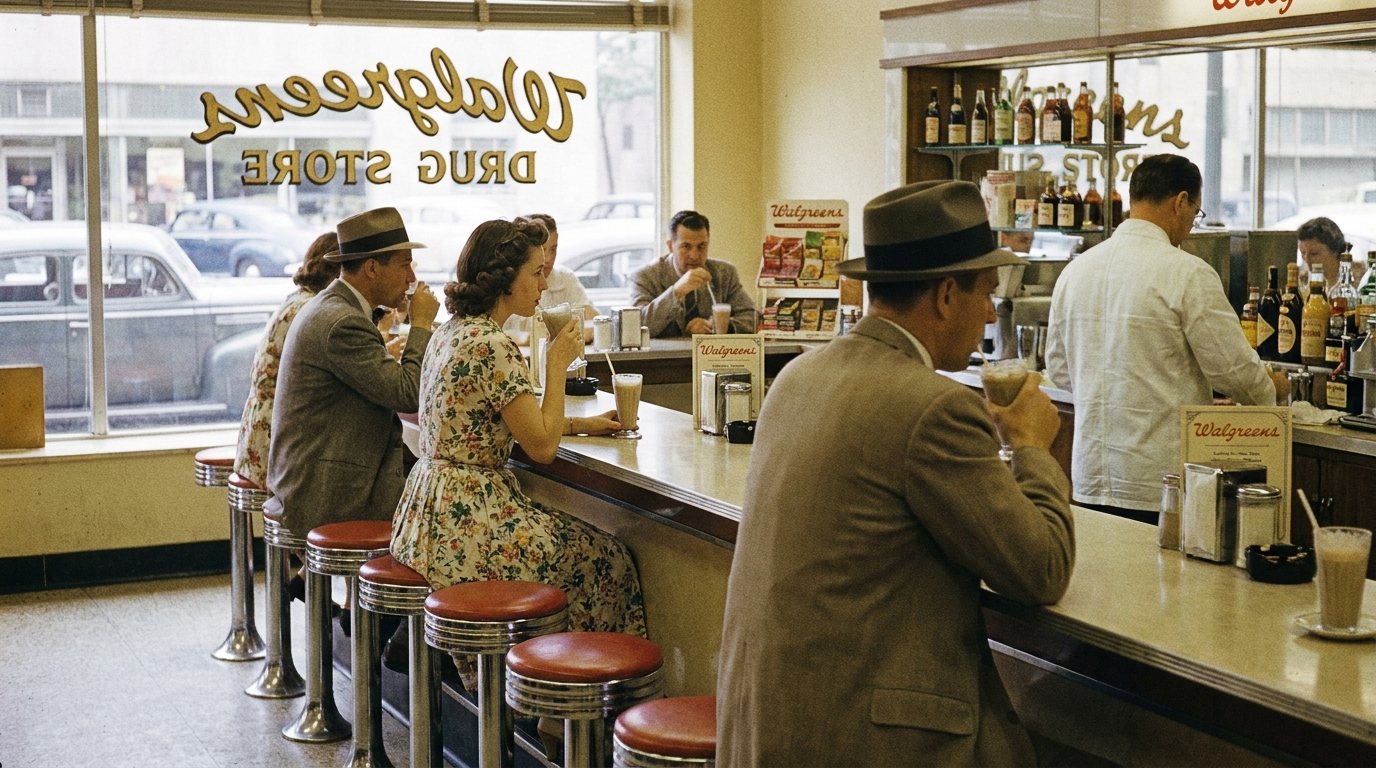
Walgreen had trained as a pharmacist and worked the counter at the very drugstore he eventually purchased on Chicago's South Side. That detail matters more than it sounds. He wasn't a financier spotting an opportunity in retail; he was the guy who filled the prescriptions, and he bought the store because he thought he could run it better than his boss did. Early on he manufactured his own line of drug products to control quality and keep prices competitive, and he added soda fountains with lunch service, turning the pharmacy into a place people wanted to linger, not just a place they had to stop.
The Milkshake and the Whiskey
The 1920s made Walgreens a household name for reasons that had almost nothing to do with medicine. In 1922, an employee named Ivar Coulson added scoops of vanilla ice cream to the standard malted milk recipe at the soda fountain, and the malted milkshake was born, selling for 20 cents a glass and turning Walgreens counters into social destinations across Chicago. At the same time, Prohibition-era law allowed pharmacies to sell whiskey by prescription, and Walgreens sold plenty of it at a markup, funding a growth spurt that took the chain from nine stores in 1916, the year Walgreen incorporated the business, to 65 stores by mid-1925. The company went public in 1927 and had grown to 397 stores with $4 million in annual sales by 1930, right as the Depression hit.
Surviving 1930 by Selling More, Not Less
Most retailers contracted hard in the early 1930s. Walgreens, oddly, kept growing: sales actually rose to $52 million in 1930 before the broader collapse forced wage cuts and new employee benefit funds to hold the workforce together. The company leaned into marketing rather than retreating from it, becoming one of the first drugstore chains to advertise on radio in 1931, and when Prohibition ended in 1933, it moved fast to acquire liquor licenses and add another retail category to the mix. The instinct to expand into a downturn, rather than away from it, shows up again and again in how the company handled later crises.
The Self-Service Bet That Doubled Revenue
The most consequential operational decision in Walgreens history probably isn't the milkshake. It's 1952, when the company opened its first self-service store under Charles Walgreen's grandson, Charles R. Walgreen III, who also pushed barcode scanning and larger-format "Superstores" into the chain. Self-service was counterintuitive at the time: bigger stores with open shelving actually required more staff, not less, and pharmacy executives worried it would cannibalize the personal-counter relationship that built the brand. Instead it did the opposite. Sales climbed from $163 million in 1950 to $312 million by 1960, even as the total store count shrank, because volume per location went up faster than headcount did. It's the clearest early proof that Walgreens' real skill was never the drugstore format itself; it was rebuilding the format every couple of decades before a competitor forced the issue.
Building a Global Pharmacy Giant
The 2000s and 2010s were an acquisition binge. Walgreens bought the Happy Harry's chain across the Mid-Atlantic in 2006, then Duane Reade for $1.075 billion in 2010, keeping the New York City banner intact rather than repainting it. The bigger swing came next: a 45 percent stake in the European pharmacy group Alliance Boots in 2012 for $6.7 billion, followed by full acquisition of the remaining 55 percent in a 2014 deal involving cash and $10.7 billion in stock, creating Walgreens Boots Alliance as a new holding company with Walgreens itself becoming a subsidiary of what it had built. By 2017 the company added roughly 1,932 Rite Aid stores for $4.38 billion, a deal that needed a fourth attempt to clear antitrust review. By 2024, WBA operated nearly 12,700 locations across the U.S. and UK with over 300,000 employees, a scale that would have been unimaginable to the man who bought one Chicago storefront in 1901.
The Bet That Didn't Pay Off, and the One That Followed It
Scale brought new kinds of trouble. Walgreens poured billions into VillageMD, a primary-care clinic operator, betting that pharmacy foot traffic could anchor a broader health-services business. It also spent the 2010s and 2020s fighting opioid litigation, including a $683 million Florida settlement in 2022 and, more recently, an April 2025 Department of Justice settlement worth at least $300 million over dispensing practices. By fiscal 2024, WBA reported a negative operating income of $14.1 billion and an $8.64 billion net loss, and disclosed that only 75 percent of its 8,600 U.S. stores were actually profitable. That June, the company announced plans to close roughly 2,150 stores, a quarter of its U.S. footprint, over three years.
Full Circle: Private, and in Pieces
Here's the detail that doesn't show up in a corporate history page: when Sycamore Partners completed its $10 billion take-private deal in August 2025, ending 98 years of public trading that began with the 1927 IPO, it didn't just delist Walgreens. It split the company into five separate entities: Walgreens, The Boots Group, VillageMD, CareCentrix, and Shields Health Solutions. The consolidation Walgreens spent two decades building, folding Boots, Duane Reade, and Rite Aid stores into one sprawling structure, was largely unwound within a year of the buyout closing. A company that grew by merging pieces together ended up, at least on paper, back in pieces.
Walgreens' story is really the story of the American drugstore counter itself: a place built to sell medicine that kept surviving by selling everything else, and that eventually got so big it had to be broken apart to be understood again.