
Walmart: How a Failed Ben Franklin Franchise Built Retail's Giant
Walmart ranks #1 on the NRF Top 100 with $575.99B in 2025 U.S. sales. Here's how a lost lease in Newport, Arkansas built the world's largest retailer.
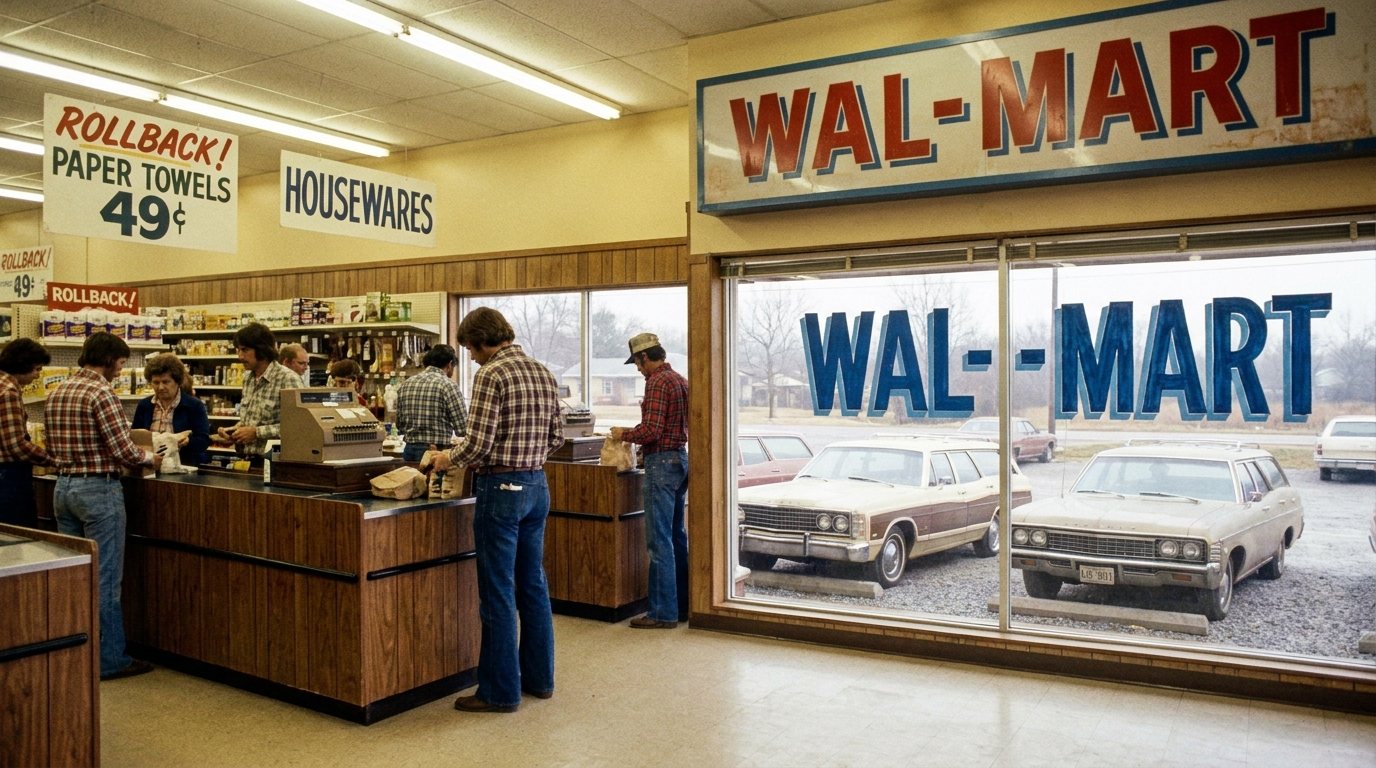
Part of Retailer Playbooks — history-first profiles of every company on the NRF Top 100 Retailers list.
Walmart is #1 on NRF's Top 100 Retailers 2026 list, with $575.99 billion in 2025 U.S. retail sales, more than the next several companies on the list combined. That scale traces back to a single lost lease in a small Arkansas town in 1950, and the stubborn bet a young store owner made in response.
The franchise that said no
Sam Walton graduated from the University of Missouri in 1940, trained at J.C. Penney, served in the Army, and in 1945 used savings and borrowed money to open a Ben Franklin variety store in Newport, Arkansas. He built it into one of the chain's best-performing franchises. Then his landlord declined to renew the lease and sold the building out from under him. Walton lost the store he had built and had to start over in Bentonville, according to FundingUniverse's company history.
In Bentonville he and his brother Bud grew a nine-unit Ben Franklin network through the 1950s while Sam toured the country studying discount merchandising. He came back with a thesis: cut prices hard, sell in volume, and put large-format stores in small towns everyone assumed were too thin to support them. He took the idea to Ben Franklin's franchise leadership and asked them to back it. They turned him down. So the Walton brothers went around them and opened their own store instead.
Rogers, Arkansas, and the radius bet
That store, Wal-Mart Discount City, opened July 2, 1962, in Rogers, Arkansas, at 719 W. Walnut Street. Within five years the brothers had 18 stores across Arkansas and $9 million in sales, per Wikipedia's account of the company's founding.
The insight underneath it wasn't just low prices. It was geography. Walton put stores in towns of 5,000 to 25,000 people, small enough that competitors ignored them, but positioned so each store could pull shoppers from a much wider radius who would drive in for the selection and the price. He built distribution centers first and then filled a roughly 200-square-mile ring around each one with stores, so trucks could restock daily and advertising could be bought regionally instead of store by store. That logistics-first sequencing, warehouse before storefronts, is the part of the Walmart playbook that's easiest to miss and hardest to copy: rivals could match the pricing, but matching the delivery cadence meant matching years of infrastructure they hadn't built yet.
It worked at a pace almost nobody in retail has repeated. By 1979, Walmart hit $1.25 billion in sales, the fastest any company had reached that mark, running 276 stores in 11 states.
The build-out, in order
| Year | Milestone |
|---|---|
| 1962 | First Wal-Mart Discount City opens, Rogers, Arkansas |
| 1970 | Company incorporates; first distribution center opens in Bentonville |
| 1972 | Lists on the NYSE |
| 1983 | First Sam's Club opens, Midwest City, Oklahoma |
| 1987 | Completes a $24 million private satellite network linking every store |
| 1988 | First Supercenter opens, Washington, Missouri |
| 1990 | Becomes the largest retailer in the United States by revenue |
| 1999 | Acquires Asda in the UK for $10 billion |
| 2016 | Acquires Jet.com for $3.3 billion |
| 2024 | Acquires Vizio for $2.3 billion |
The satellite network deserves its own mention. In 1987, before most companies had heard of enterprise data networking, Walmart wired its entire store base together for voice, video, and inventory data, per corporate.walmart.com's history page. That let headquarters see what was selling in real time and move product accordingly, a capability that took competitors years to approximate. Combined with the distribution-center-first store layout, it meant Walmart wasn't competing on price alone. It was competing on knowing its own shelves faster than anyone else in the industry.
Sam's Club, Supercenters, and going overseas
Walton kept adding formats rather than resting on the discount box. Sam's Club opened in 1983 as a membership warehouse concept aimed at small businesses and bulk shoppers. The Supercenter, merging general merchandise with a full grocery store, arrived in 1988 in Washington, Missouri. Sam Walton died in 1992, having built a company that by then was closing in on Sears and Kmart, the two chains that had dominated American retail for decades.
International growth followed a similarly patient, format-by-format logic: Mexico in 1991 through a Sam's Club joint venture, Canada in 1994 via the Woolco acquisition, China in 1996, the UK in 1998 through Asda, Japan in 2002 via an investment in Seiyu, and South Africa in 2011 through Massmart, according to Walmart's own history page.
The retailer that became a media company
The least-told part of the Walmart story is what it's building now, not what it built in 1962. In 2016 it paid $3.3 billion for Jet.com, a smaller, money-losing e-commerce upstart, mainly to get its leadership team and its urgency around online retail. In 2024 it paid $2.3 billion for Vizio, a television manufacturer, per Wikipedia. On the surface that looks like an odd purchase for a grocery-and-general-merchandise company. Underneath it, a television maker owns something increasingly valuable to a retailer with 270 million weekly customers: a direct pipeline into what people watch, and therefore where advertising dollars should go.
That's the unique thread worth naming plainly: the company that spent sixty years winning by moving physical goods cheaper and faster than anyone else is now building a second profit engine out of the data and attention those same shoppers generate, an advertising and media business layered on top of the stores. It's the same instinct Sam Walton had in 1962, watch where the money actually is, and go get infrastructure ahead of the competition, aimed at a completely different kind of shelf.
Walmart's history is, underneath everything else, a story about logistics: trucks, warehouses, satellites, and now data pipelines, built years before anyone realized they'd decide who won.