
Wegmans: How a Rochester Produce Cart Built a Grocery Icon
Wegmans lands #38 on NRF's Top 100 Retailers list with $13.36B in sales. Here is how two brothers' 1916 produce cart became one of America's most admired grocers.
Part of Retailer Playbooks — history-first profiles of every company on the NRF Top 100 Retailers list.
Two brothers pushing a produce cart around Rochester, New York in 1916 could not have known they were starting a company that would still be family-run more than a century later. Wegmans now ranks #38 on the National Retail Federation's Top 100 Retailers 2026 list, compiled with Kantar, with $13.36 billion in 2025 U.S. retail sales, and it did it while remaining privately held and staying out of most of the acquisitions that reshaped its peers.
A Produce Cart, Then a Cafeteria
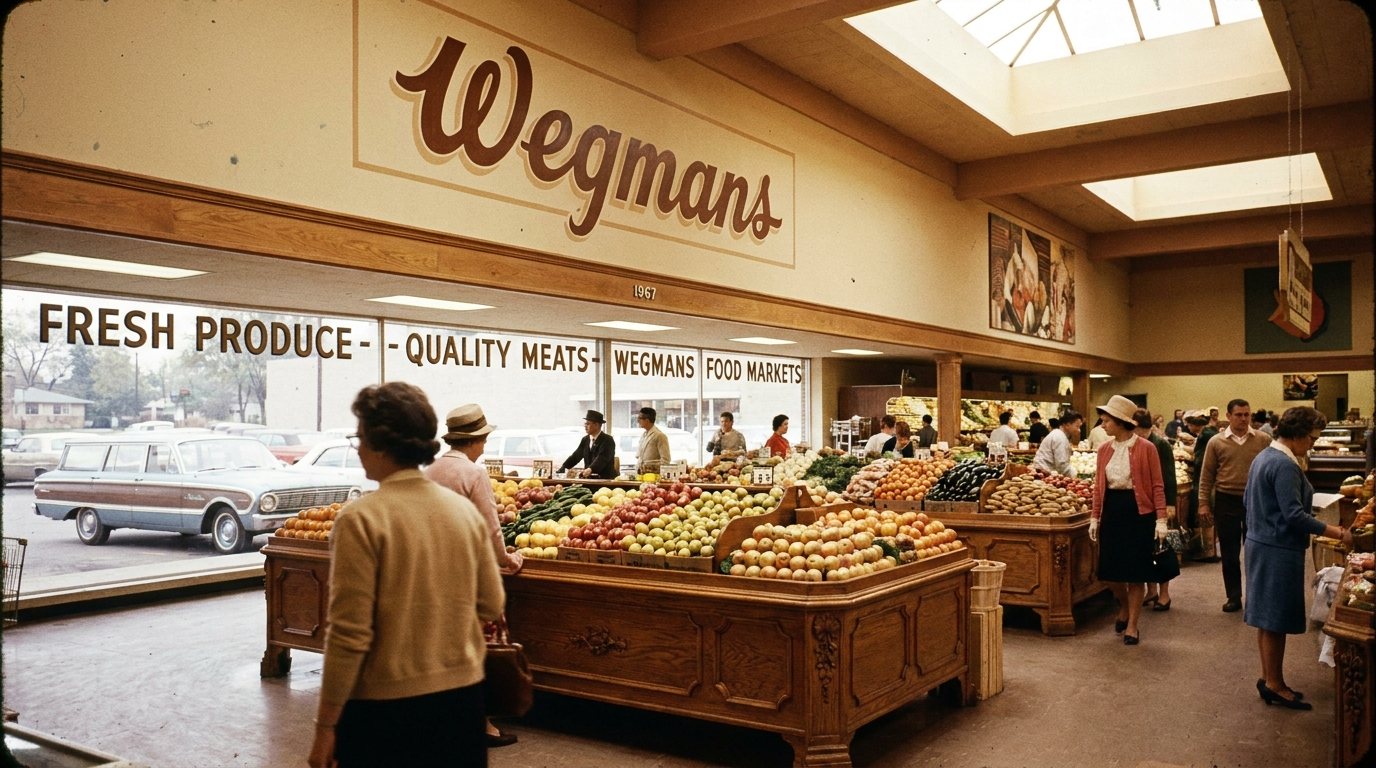
John and Walter Wegman started the Rochester Fruit and Vegetable Company in 1916, selling produce out of their family home before opening a proper storefront at 72 West Main Street in January 1917, according to Wikipedia's history of the company. Six years in, the brothers expanded that single store into a full grocery with a bakery counter and an in-house cafeteria, a combination that was unusual for the era and became a template the company never really abandoned, according to FundingUniverse's company history. The instinct to sell prepared food alongside groceries, decades before "grocerant" was a word anyone used, traces straight back to that early cafeteria.
The bigger bet came in the early 1930s. While most American grocers still worked behind service counters, the Wegman brothers converted their store to self-service, letting customers pick their own goods off open shelves, a format that would not become standard across the industry for another decade or more. Their 1931 store also added vaporized water sprays to keep produce fresh and refrigerated display cases, small mechanical details that mattered enormously in an era when spoiled produce was the fastest way to lose a customer for good, per FundingUniverse.
Robert Wegman's Vertical Bet
Robert Wegman, son of founder Walter, took over as president in 1950 and spent the next quarter-century building the company outward from its stores into the supply chain that fed them. He acquired an egg farm, opened a central meat-processing plant and bakery, and formed Wegmans Enterprises to manage the company's real estate, according to FundingUniverse. That vertical integration reduced the company's dependence on outside suppliers for the categories customers cared about most, and it set a pattern of owning more of the chain than a typical grocer bothered to.
Robert also pushed the company into new technology early. In 1972, Wegmans became only the third supermarket chain in the country to install electronic cash registers with optical scanners, a full decade before scanning was routine at U.S. checkout lanes. Not every bet paid off. In 1974 he acquired the Bilt-Rite Chase-Pitkin home improvement chain, a diversification outside grocery that the company carried for more than three decades before quietly closing every Chase-Pitkin location by March 2006, per Wikipedia. It is the one clear strategic retreat in the company's history, a reminder that even a family known for patient, decades-long bets got one wrong and had the discipline to unwind it rather than keep feeding it.
Danny Wegman and the Turnover Number
Danny Wegman became president in 1976 and spent the following decades turning employee retention into a deliberate business strategy rather than a nice-to-have. The company launched a Work-Scholarship Program, opened an on-site child development center in 1990, and built a reputation strong enough that Fortune first named it one of the 100 Best Companies to Work For in 1993, five years before the magazine's flagship annual list even began in 1998. Wegmans has appeared on that list every year since, according to Wikipedia.
The number that explains why sits in a Consumer Reports comparison from 2000: Wegmans ran roughly a 9 percent annual employee turnover rate against an industry average of 16.7 percent, per FundingUniverse. In a grocery business where margins are thin and service quality depends entirely on whether the person behind the deli counter has done the job long enough to be good at it, halving turnover is not a perk line item. It is a supply chain decision, applied to labor instead of produce. That same period saw persistent speculation that Kroger or Safeway would try to buy Wegmans; the family never sold, a choice that let it keep making multi-decade bets no public-market grocer answering to quarterly earnings could easily justify.
Colleen Wegman's Patient Expansion
Colleen Wegman, Danny's daughter, became president and CEO in 2017, the fourth generation of the family to run the company. Under her, Wegmans has kept expanding at the same unhurried pace that has defined it since the 1993 move into Erie, Pennsylvania, its first store outside New York. The chain opened its 100th store in Raleigh in 2019, its first Manhattan flagship at 770 Broadway in 2023, and a Long Island location in 2025. It now operates 114 stores across nine states and Washington, D.C., still overwhelmingly funded by the company's own capital rather than acquisitions of rival chains, per Wikipedia.
That is the detail easy to miss underneath the cheese caves and made-to-order sushi bars everyone writes about: Wegmans has grown almost entirely by building new stores one at a time, not by buying other grocers' footprints. Competitors that expanded through acquisition inherited someone else's supply chains, someone else's store formats, someone else's culture, and spent years reconciling the differences. Wegmans never had to. Every store speaks the same operational language because the company built every store itself.
Wegmans is a reminder that the unglamorous parts of retail, the supplier relationships, the store-by-store buildout, the people who stay long enough to know the aisles cold, are usually what the glamorous parts are quietly resting on.