
WinCo Foods: The Employee-Owned Grocer Built on Bulk Bins
WinCo Foods hit #47 on NRF's 2026 Top 100 by staying 100% employee-owned since 1985, skipping credit cards, and land-banking store sites years ahead of demand.
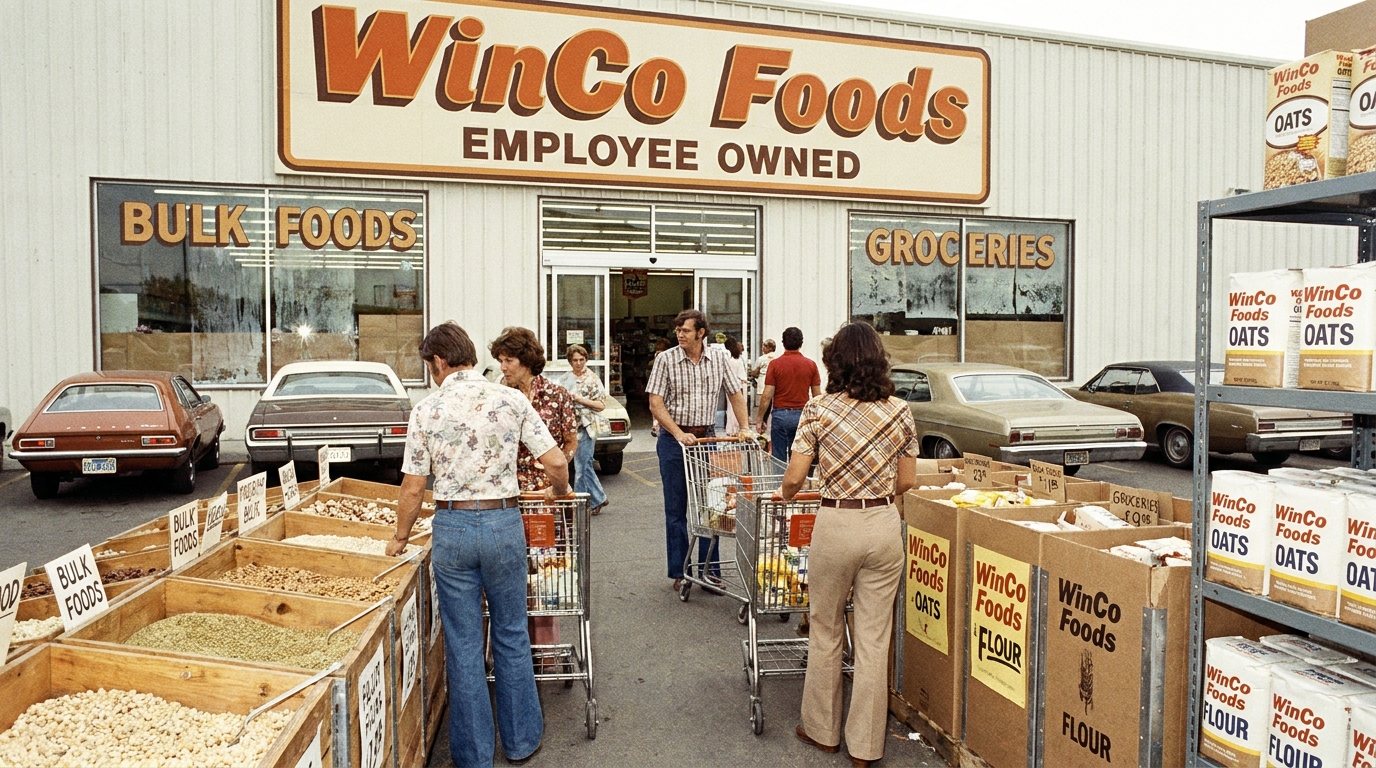
Part of Retailer Playbooks — history-first profiles of every company on the NRF Top 100 Retailers list.
WinCo Foods checks in at #47 on the NRF Top 100 Retailers 2026, the National Retail Federation's annual ranking compiled with Kantar, with $10.65 billion in 2025 U.S. retail sales. It is a strange kind of famous: a grocery chain most Americans outside the West have never shopped in, run by a company its own customers rarely think to Google, sitting on a list dominated by names like Walmart and Kroger. The story behind that number is less about marketing and more about a 1985 decision to hand the company to the people stocking its shelves.
A Discount Warehouse Called Waremart
The chain began in 1967, when Ralph Ward and Bud Williams opened a no-frills, warehouse-style grocery store in Boise, Idaho, under the name Waremart. The pitch was simple: strip out everything that didn't lower the price, and pass the savings straight to the register. By 1968 there were two stores. In 1972, a Waremart location in Vancouver, Washington was destroyed by a tornado, and rather than retreat, the company rebuilt and kept expanding, a small early signal of the stubbornness that would define it, according to FundingUniverse's company history.
Bill Long, who had joined the company in 1968, became president in 1978 and CEO in 1985. That same year produced the pivot that everything else in this story hangs on: Waremart's employees, through a newly formed Employee Stock Ownership Trust, bought majority control of the company from the Ward family.
Betting the Company on Its Own Workforce
Handing a discount grocer to an ESOP in the mid-1980s was not an obvious move. Grocery is a low-margin business that competes on price every single day, and an employee-ownership structure only works if the workforce actually behaves like owners. WinCo bet it would, and the numbers back it up. By 2003, more than 80 percent of the company was employee-owned, and the ESOP had compounded at roughly 19.3 percent annually since its founding, per FundingUniverse. Today WinCo sits at #2 on the National Center for Employee Ownership's Employee Ownership 100 list, marked as 100 percent ESOP-owned with about 20,000 employees.
That ownership structure shaped how WinCo grew. Public grocery chains answer to shareholders who want quarterly results; WinCo answered to the checkout clerks and warehouse pickers who held the stock. The company grew from $198 million in sales and 850 employees in 1987 to nearly $300 million and 1,750 employees by 1991, then to $419 million across 21 stores by 1994. It never chased a national footprint. It methodically saturated the Northwest first, then California, then the Mountain states, before finally reaching Texas in 2014.
The Confusion That Renamed a Company
For its first three decades, this chain traded under a name that no longer exists on any storefront. By the late 1990s, "Waremart" was getting lost in a sea of "mart" retailers, most notably Kmart and Walmart, and customers kept mixing them up. In 1998 and 1999, the company rebranded to WinCo, a portmanteau of "winning company." A folk theory has circulated for years claiming WINCO stands for the five states the chain first operated in (Washington, Idaho, Nevada, California, Oregon), a story tidy enough to be believable and false enough that company leadership has called it "part of the folklore" rather than confirm it.
The Insight Hiding in Plain Sight: Land Banking
Here is the piece that doesn't show up on WinCo's About page. According to FundingUniverse's account of the company's expansion strategy, WinCo routinely bought store sites two to five years before it broke ground on them, timing construction to when the surrounding population had actually caught up to demand rather than building ahead of the rooftops and hoping. That is a patient-capital move, and patient capital is exactly what an ESOP structure without outside shareholders or a private-equity clock can afford. Most retail real estate strategy is a race to grab corners before a competitor does. WinCo could afford to lose that race on purpose and buy the corner anyway, then wait.
Everything else WinCo is known for, the missing credit-card readers, the self-bag checkout lanes, the sacks of bulk rice and cereal by the pallet, is downstream of the same logic: strip friction and fees from the transaction, and let the ownership structure absorb the patience that a leveraged competitor can't. Truckload buying direct from manufacturers reportedly saved the chain up to 7.5 percent versus distributor pricing, according to FundingUniverse, savings that showed up as prices 50 cents to over a dollar below competitors on comparable items.
Where the Chain Stands Now
WinCo now operates roughly 145 stores across ten Western and Southwestern states, backed by six distribution centers spanning Oregon, Idaho, Arizona, Texas, and California, per Wikipedia. It entered Utah and eastern Washington in 2009, Nevada and Arizona in 2012, Texas in 2014, and announced plans for Colorado in 2025. Forbes has ranked it among the 60 largest privately held companies in the United States. It got there without a national ad campaign, without a loyalty app chasing points, and without ever taking the company public. It got there by making the people ringing up groceries the same people who owned the balance sheet.
The unglamorous truth about American retail is that fortunes are rarely made at the register. They are made in the warehouse, the distribution route, and the decision about which corner to buy five years before anyone needs a store there.